Sugarcane Woes, Joblessness And Anger, But Yogi Still Has The Edge In Western UP | Ground Report
“Hum to ganna kisaan hain ji. Humare ganne ka daam badha do…bas,” says Sumit Malik, a Jat farmer from Peerna in Purqazi, western Uttar Pradesh, almost as soon as he is asked about the upcoming assembly elections.
Ni Arunima··112K nabasa
Sugarcane Woes, Joblessness And Anger, But Yogi Still Has The Edge In Western UP | Ground Report
“Hum to ganna kisaan hain ji. Humare ganne ka daam badha do…bas,” says Sumit Malik, a Jat farmer from Peerna in Purqazi, western Uttar Pradesh, almost as soon as he is asked about the upcoming assembly elections.
The demand is simple: better prices for sugarcane. Across western UP’s sugarcane belt, farm distress remains a recurring concern. Yet, when asked whether this will determine their vote, farmers are divided.
The region matters politically. In the 2022 assembly elections, the farmers’ agitation was widely seen as one of the factors behind the BJP losing ground in western UP compared with its 2017 tally. In agrarian pockets across Shamli, Moradabad, Meerut and Muzaffarnagar, the Samajwadi Party (SP)-Rashtriya Lok Dal (RLD) alliance gained at the BJP’s expense, riding on anger over the now-repealed farm laws and demands for a guaranteed Minimum Support Price (MSP).
Three years later, sugarcane prices remain a sore point.
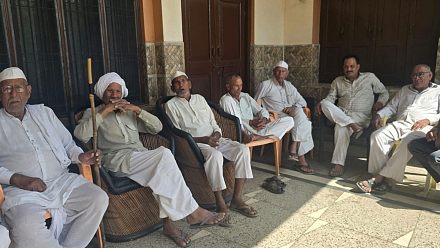
A chaupal at Sardana in western UP. (News18)
“Cheeni mehangi ho gayi hai, ethanol ki demand badh gayi hai per ganna kisan wahin ke wahin. Ab koi kheti karna nahi chahta,” a farmer in Modinagar says.
But will this translate into votes against the BJP?
“Ganne ka daam badha do…toh hum khoob duayein denge lekin agar nahi badha to hum to Yogi se hi ummid rakhenge,” says an octogenarian in Peerna.
Malik, who spoke passionately about agricultural distress, makes his political preference clear in the same breath: “Ye chunav Yogi Aditynath ka hai. Unke alawa kisi aur ka naam CM ke liye chal gaya toh 1 baje hi haar ki ginti shuru ho jayegi.”
The sentiment in favour of incumbent chief minister Yogi Adityanath is echoed across constituencies and demographic groups.
The western UP belt, covering Meerut, Muzaffarnagar, Baghpat, Shamli, Kairana and Saharanpur, delivered significant gains to the SP-led alliance in 2022. In Muzaffarnagar, for instance, five of the six seats went to the SP-RLD alliance amid the farmers’ agitation.
Jayant Chaudhary subsequently joined the NDA, bolstering the BJP-led alliance’s numbers. In the 2024 Lok Sabha elections, the SP won Kairana, while Saharanpur elected Congress leader Imran Masood.
The Opposition had reason to be optimistic about its prospects in 2027. But across chaupals in Purqazi, Sardhana, Modinagar and Saharanpur, the challenge appears formidable.
Kolhus making gur have been fired up. (News18)
Economic anxieties are evident, but they coexist with a continued belief that Yogi Adityanath has delivered on law and order.
Law And Order: The BJP’s Enduring Pitch
Dheeraj Ahlawat is an unabashed critic of the BJP. “Khet bech bech kar balkon ko padha rahe hain aur fir naukri mango to lathi chala dete hain,” says the Jat farmer in Sardhana.
Yet, even he concedes that law and order in western UP has improved over the past decade.
At the same chaupal, unemployment and governance dominate the conversation, with supporters and critics weighing in.
“We sold our land to ensure our children go to good schools and colleges. Today they have a degree but no job. If they protest against the situation, police chases them with lathis. They are tear gassed, beaten up,” says Amardeep Ahlawat, a father of two youngsters.
Others are quick to counter him, pointing to what they see as the government’s achievements over the past 10 years.
“Yogi Adityanath has done quite a bit for law and order. Riots frequently happened in this area but that has improved. Anti-social elements would misbehave with women earlier, now girls feel safer. No one can deny the work that has been done to improve law and order,” says Virender Singh.
A young voter, Aditya, agrees that the government has made a difference on the issue of law and order, but argues that farmers’ concerns need urgent attention.
“Yes it is correct. Farmers have their back to the wall. They don’t get fertilisers on time. The canal water doesnt reach us. The irrigation system must be improved. We dont want a change of government. Yogi-ji himself should find a solution to these genuine issues,” he says.
The contrast is telling: dissatisfaction with the government’s handling of jobs and agriculture does not necessarily translate into a demand for a change of government. For some voters, the expectation is that Yogi Adityanath will address these grievances himself.
Young Voters Restless, But Waiting For Answers
The Jantar Mantar protest has brought renewed attention to youth concerns, with Rahul Gandhi’s ‘Chhatron Ki Goonj’ and Prime Minister Narendra Modi’s outreach through platforms such as Instagram adding to the political conversation. Young people in western UP are glad that their problems are receiving attention, but remain restless about the solutions on offer.
“How many people can start their own work? Most youngsters come from agrarian families. You either do farming or look for a government job. But the latter is just not available. The government has finished farmers and jobs,” says Ayush Chowdhary, a third-year BA student at DAV College, Muzaffarnagar.
His friend, a student at a nearby polytechnic, adds: “The upcoming elections will be fought on issues that matter to the youth.”
Nishant, a first-time voter, strikes a more measured note.
“Good must be called good and bad must be called bad. The BJP government has done some good work. It is correct that goons have been controlled in BJP government but now policemen have become goons. Look at the way they are thrashing young people.”
The message from young voters is not uniformly anti-BJP. Some acknowledge the government’s achievements, but frustration over unemployment, police action against protesters and the lack of opportunities remains palpable.
Whether that discontent can be converted into a decisive electoral issue is another question.
Caste And Religion: Old Equations, New Calculations
Jats, Muslims and Dalits remain important voting blocs in western UP. Jats account for an estimated 17% of the population, Muslims 26% and Dalits around 22%, making their electoral preferences crucial to the region’s political calculations.
In 2017, the BJP benefited from the sharp communal divide between Jats and Muslims following the 2013 Muzaffarnagar riots. Today, some Muslims in Saharanpur and Muzaffarnagar, as well as Jats in Baghpat, play down the prospect of religion determining the vote. But pockets of Muzaffarnagar suggest that the polarisation has not entirely disappeared.
“A pre-Independence era masjid has been broken down in Sahranpur. Hindus are as saddened by the decision as Muslims. This communal politics will no longer work,” says Younis, who runs a computer centre in Saharanpur.
At Khalapar in Muzaffarnagar, Dilshad Pahalwan also believes voters have moved beyond communal divisions.
“No one will vote on riots or Hindu- Muslim. Everyone wants peace, development,” he says.
For some voters, then, development and peace are more important than the communal faultlines that have shaped western UP politics in the past. Whether that sentiment holds across communities and constituencies remains to be seen.
Dalit voters, traditionally associated with Mayawati’s Bahujan Samaj Party (BSP), are also in a state of flux as the party’s electoral decline continues. At a hostel for Scheduled Caste students, young people refuse to disclose their political preferences. But the conversation soon turns, once again, to education and employment.
“The politics that is dominating India for the last decade is politics of religion. No one is willing to talk about employment. I saw a clip on social media where deputy CM of western UP Brajesh Pathak said ‘what will you achieve by studying? You should drive an e- rickshaw and earn a living’. This is the importance being given to issues of education and employment,” says Divya Prakash, a civil services aspirant.
“This government has degraded the level of education so much. It has fallen significantly. Paper leak is just one part,” says Rajkumar.
Across western UP, the anger over jobs, farm incomes and education is difficult to miss. Yet, there is little visible anti-incumbency against Yogi Adityanath and the BJP.
The question is whether Akhilesh Yadav and Rahul Gandhi can bring their parties together and turn young voters’ restlessness into an electoral advantage. Or will Yogi Adityanath secure a record third term?
For now, voters are watching as the contest between governance, economic distress and opposition unity takes shape.