'Strikes At Heart Of Constitution': Justice Ujjal Bhuyan Calls SIR 'Disenfranchisement Of Indian Citizens'
Supreme Court judge Justice Ujjal Bhuyan has said that any process that results in the disenfranchisement of millions of Indian citizens and turns them into “second-class citizens” without voting rights “strikes at the v
Ni Vani Mehrotra··187K nabasa
'Strikes At Heart Of Constitution': Justice Ujjal Bhuyan Calls SIR 'Disenfranchisement Of Indian Citizens'
Supreme Court judge Justice Ujjal Bhuyan has said that any process that results in the disenfranchisement of millions of Indian citizens and turns them into “second-class citizens” without voting rights “strikes at the very heart of the Constitution”, remarks that come amid the ongoing controversy over the Election Commission of India’s Special Intensive Revision (SIR) of electoral rolls.
Speaking at the valedictory ceremony of the 19th Justice Bodh Raj Sawhney Memorial Moot Court Competition at NALSAR University of Law in Hyderabad on Sunday, Justice Bhuyan said, “If any process results in disenfranchising millions and millions of Indian citizens, making them second-class citizens in their own country in the sense of being citizens without a voting right, such a process is intrinsically arbitrary.”
“No amount of whataboutery can justify it,” he added.
“It strikes at the very heart of the Constitution, and I would go to the extent of saying that it is a negation of the Constitutional order which we have adopted under the Constitution of India,” he said.
Justice Bhuyan said the Constitution does not envisage two categories of Indian citizens, those who have voting rights and those who do not.
He said any process leading to the wholesale disenfranchisement of citizens would be violative of Articles 326 and 14 of the Constitution.
He further said the right to vote is closely linked to India’s long struggle against foreign rule and represents the freedom secured after years of struggle and sacrifice.
“Article 326 cannot be tinkered with at all,” Justice Bhuyan said, adding, “No authority can do it. No court can endorse it or condone it. No one is above the Constitution.”
Right To Vote Is Part Of Constitutional Democracy
Justice Bhuyan said the right to vote, or the right to be a voter, cannot be treated merely as a statutory right arising from parliamentary legislation such as the Representation of the People Act, 1951.
According to him, it is a constitutional right that forms a distinct part of democracy and is positioned within the framework of the basic structure of the Constitution.
Citing a Supreme Court order, he said the court had observed that a citizen’s right to vote cannot be separated from the mandate of Article 326.
The right of a citizen to be a voter and to vote, he said, is of the “greatest importance” and forms the foundation of free and fair elections.
Justice Bhuyan also referred to Section 22 of the Representation of the People Act, which permits deletion of an entry from the electoral roll but only after the voter has been given a reasonable opportunity of being heard.
He cited another Supreme Court judgment to say that the court has laid down guidelines governing the deletion of voters’ names.
Except in the case of a dead person, he said, the name of a voter once included in the electoral roll cannot be deleted without notice and an opportunity of being heard.
“From the persona of an Indian citizen, the right to vote or right to be included in the voters list cannot be detached. It will be like taking out the soul from the body,” he said.
Remarks Come Amid SIR Controversy
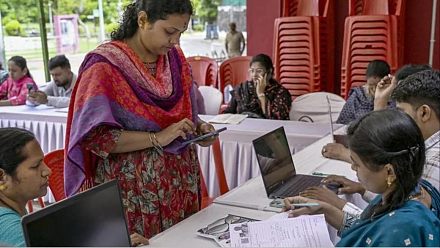
Justice Bhuyan’s comments come against the backdrop of the controversy surrounding the ECI’s SIR exercise, with the Opposition targeting Chief Election Commissioner Gyanesh Kumar and demanding his resignation, according to ANI.
The Supreme Court had earlier in May upheld the ECI’s SIR exercise, which was first undertaken in Bihar, holding that the exercise was constitutional and legally tenable and could not be struck down merely because it differed from the ordinary process of electoral-roll revision.
A bench comprising Justices Surya Kant and Joymalya Bagchi held that the SIR exercise could not be declared ultra vires solely because it adopted a process different from the routine revision of electoral rolls contemplated under the statutory framework.
The Supreme Court also clarified that the ECI’s powers in the exercise are limited to determining eligibility for inclusion in electoral rolls and do not extend to determining citizenship status.
It held that deletion of a person’s name from the voter list does not take away that individual’s citizenship, as citizenship can only be determined by the competent authority under law.
‘Highest Office Is That Of The Citizen’
Justice Bhuyan also invoked the views of US judge Justice Felix Frankfurter, saying he had expressed the view that in a democracy, the highest office is not that of the President but that of the citizen.
Quoting Frankfurter, Justice Bhuyan said, “Democracy is always a beckoning goal, not a safe harbour; for freedom is an unremitting endeavour, never a final achievement.”
“I ask myself, what is the worth of a citizen without his/her voting rights,” he said.
Justice Bhuyan, who served as Chancellor of NALSAR, also praised the university’s students at the event.
“You have shown to the country and the world what a university student, that too, a student of law, should be like. You are brilliant. You are bold, and you are brave,” he said.
He also commended the NALSAR faculty, saying they had performed their duties admirably and done what was expected of university teachers.
Justice Bhuyan complimented Vice Chancellor Srikrishna Deva Rao as well, saying he had led the university admirably.