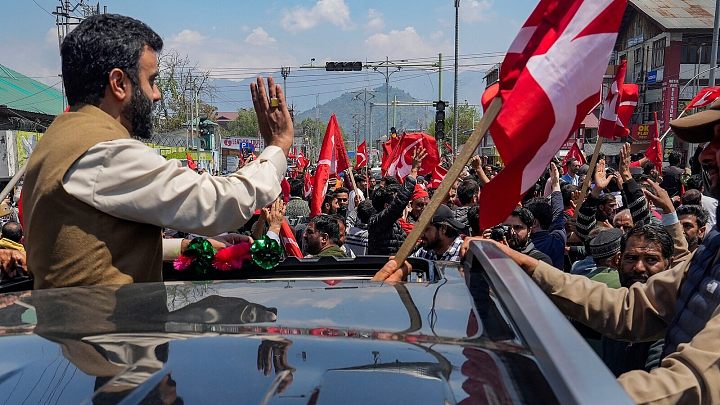
Ruhullah’s Revolt: What His Exit Could Mean For The National Conference, Omar Abdullah And J&K Politics
Aga Ruhullah’s open confrontation with the National Conference is more than the departure of one MP. It strikes at the party’s central claim: that it remains the principal political vehicle for restoring the special stat
Ni Ieshan Wani··37K nabasa
Ruhullah’s Revolt: What His Exit Could Mean For The National Conference, Omar Abdullah And J&K Politics
Aga Ruhullah’s open confrontation with the National Conference is more than the departure of one MP. It strikes at the party’s central claim: that it remains the principal political vehicle for restoring the special status that was dismantled in August 2019.
Ruhullah is not a routine dissenter. His 2024 victory from Srinagar gave him independent political weight. He speaks for a section of the electorate that still judges the NC primarily by its position on Article 370, Article 35A and the larger political rights of Jammu and Kashmir. His exit therefore forces Omar Abdullah into an awkward balancing act — defending the government’s practical priorities while trying to hold on to a constituency that expects the party to stay uncompromising on its electoral promises.
The core disagreement: Article 370 or statehood?
The dispute is rooted in how the two sides read the 2024 mandate. The NC’s manifesto promised to work for the restoration of Article 370 and Article 35A, along with statehood and the implementation of the 2000 Autonomy Resolution. Ruhullah treats these as non-negotiable commitments that brought the party back to power. He argues that the leadership has quietly narrowed its ambition to the restoration of statehood — something he says is little different from the BJP’s own position.
Omar’s calculation is shaped by the constraints of governing a Union Territory. The elected government has limited authority; the Lieutenant Governor and the Centre retain substantial powers. From this vantage, statehood is a necessary first step that would give the administration greater institutional space. Ruhullah worries that making statehood the primary demand risks normalising the constitutional changes of 2019.
Neither view is trivial. The disagreement has simply exposed that the party lacks a shared strategy on its most important electoral promise.
Who owns the mandate?
Farooq Abdullah’s public challenge — that Ruhullah should resign his seat and test his popularity without the party — turned an internal argument into a contest over political legitimacy. The NC leadership maintains that Ruhullah’s win was made possible by the party’s organisation, cadre and support. Ruhullah counters that his position is rooted in public aspiration and that he cannot stay in a party he believes has abandoned its commitments.
By resigning from both the party and the Lok Sabha, he is effectively accepting the challenge. It is a high-stakes move. He is giving up a national platform and the institutional advantages that come with being an MP. If he retains a substantial part of his support base, he could emerge as an independent force. If he cannot convert personal popularity into votes without the NC’s machinery, the party’s claim that its organisation was central to his victory will look stronger.
The stakes run both ways. The question is not only whether Ruhullah can survive outside the NC, but also whether the NC can retain voters who identify with his stance on special status.
An older fault line
The current confrontation did not begin with Article 370. In December 2024, barely two months after the NC took office, Ruhullah led a protest outside Omar Abdullah’s residence demanding rationalisation of the reservation policy. Opposition leaders, including those from the PDP, joined the demonstration. An NC parliamentarian was on the streets against a government led by his own party.
That episode revealed an early gap between the party’s electoral rhetoric and the expectations of parts of its base. The differences later widened from reservations to the government’s broader political direction, particularly its approach to special status and statehood. Ruhullah’s criticism grew more public, and his participation in protests made it harder for the leadership to treat the matter as a private disagreement. His exit is the culmination of a rift that has been building for nearly two years.
For Omar, the episode is especially sensitive because the criticism targets both the party organisation and the political choices of the government. He must run an administration while protecting the narrative on which the NC sought votes. The government has prioritised the restoration of statehood in its engagement with the Centre and has passed resolutions on special status. Ruhullah’s point is that these steps have not been enough to convince at least one prominent voice inside the party that the commitments are being pursued with conviction.
The leadership also faces a tactical dilemma. Ignoring the criticism risks looking unable to defend its position. A confrontational response could alienate a leader who still commands an independent following. How the party responds will matter as much as Ruhullah’s decision to leave. Omar’s immediate task is to show that the NC’s political agenda remains intact even after losing one of its most vocal advocates for the restoration of special status.
Could this create space for a new political formation in Kashmir?
What Ruhullah does next is the larger uncertainty. He has spoken of returning to the people and seeking like-minded individuals who want the restoration of constitutional rights and dignity for Jammu and Kashmir. He has not said whether he will form a new party or join an existing one.
The space between the NC, the PDP and other regional formations has remained contested since 2019. Ruhullah could try to occupy ground built around the demand for constitutional guarantees, political rights and greater accountability. His appeal may reach beyond traditional party lines, especially among younger voters who feel the political leadership has not adequately addressed the consequences of the 2019 decisions.
Turning public dissatisfaction into a functioning political organisation is a different matter. He would need cadre, allies, a clear programme and a structure capable of competing with established parties. It is also unclear whether other disgruntled NC leaders would join him or whether this remains an individual project.
The most serious challenge for the National Conference may not be the immediate loss of Ruhullah but the questions his departure leaves behind. The party returned to power in 2024 after campaigning on the restoration of statehood, special status and constitutional guarantees. Its victory reflected the discontent that followed the August 2019 decisions. Governing, however, has brought a different set of realities. The NC must work within the existing constitutional framework, deal with the Centre and manage an administration that does not enjoy the powers of a full state government.
Ruhullah’s rebellion has brought that contradiction into the open. The party now faces a larger question: can it retain the support of voters who expect it to challenge the post-2019 constitutional arrangement while governing inside that same arrangement?