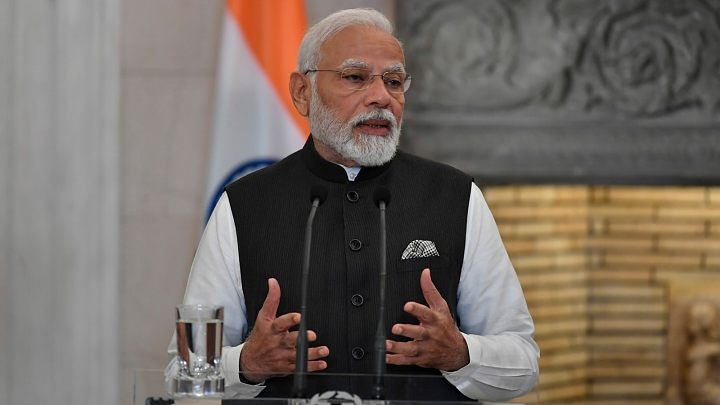
PM Modi Reviews Crucial Rail Project For Andhra's New Capital Amaravati | Exclusive
Prime Minister Narendra Modi has reviewed the progress of the 57-km Errupalem–Amaravati–Namburu railway line at a PRAGATI meeting two weeks ago, putting fresh focus on a project that is important not just for Andhra Prad
Ni Aman Sharma··74K nabasa
PM Modi Reviews Crucial Rail Project For Andhra's New Capital Amaravati | Exclusive
Prime Minister Narendra Modi has reviewed the progress of the 57-km Errupalem–Amaravati–Namburu railway line at a PRAGATI meeting two weeks ago, putting fresh focus on a project that is important not just for Andhra Pradesh’s infrastructure plans for its new capital, but also for the politics of the NDA bloc in the state.
The Rs 2,047-crore railway line is meant to connect the capital region to the national railway network. For a new administrative centre that is being built up from scratch, strong connectivity is not a luxury—it is basic infrastructure.
At the PRAGATI meeting, the Prime Minister reviewed the progress of the project, where the issue of land acquisition came up for discussion, since it is one of the key hurdles holding up faster execution. The focus now is on speeding up the process and handing over the required land to the Railways so that construction can move ahead without further delays.
The timing of Modi’s review is significant. The project is now moving through an important phase, with work progressing on land acquisition as well as the different construction packages.
Officials have been asked to resolve pending issues involving surveys, compensation and documentation so that the required land can be handed over quickly, sources told CNN-News18.
Construction has also moved into the tendering stage. One of the biggest remaining packages is the Vaddamanu–Namburu section, covering more than 28 km and estimated to cost around Rs 599 crore. The package includes civil works as well as electrification, signalling and Kavach-related infrastructure.
The importance of the line goes beyond passenger connectivity.
The project is expected to improve access for people living across the capital region and surrounding areas. It is expected to benefit around 168 villages and a population of nearly 12 lakh people, with new stations planned along the route.
Better rail connectivity can also help attract businesses, investment and economic activity. As government offices, institutions and commercial activity expand, connectivity will be one of the factors that determine how quickly the region develops.
The project has a wider railway significance as well. The Vijayawada region is among the busiest rail corridors in the country, and the new route can provide an additional connectivity option while strengthening the wider railway network in Andhra Pradesh.
But there is also an unmistakable political dimension.
For Chief Minister N Chandrababu Naidu and the TDP, the development of the capital region is central to their political and governance narrative. Big infrastructure projects are therefore more than development initiatives—they are also a test of the government’s ability to translate its vision into visible results.
The railway line is particularly significant because it requires close coordination between the state and the Centre.
This is where the BJP and the NDA come into the picture.
The TDP is a key ally of the BJP, and the success of large infrastructure projects depends heavily on cooperation between Delhi and the Andhra Pradesh government.
For the Naidu government, the Centre’s support helps accelerate projects that require major funding and coordination. For the BJP, backing such projects provides an opportunity to demonstrate that the alliance is delivering tangible results.
That is why PM Modi personally reviewing the project at PRAGATI carries political weight.
PRAGATI is designed to monitor important projects and remove bottlenecks. When the Prime Minister takes up a project directly, it puts pressure on different agencies and authorities to speed up execution.
For the Andhra Pradesh government, the immediate challenge is clear: land acquisition and other pending issues cannot be allowed to hold up the project indefinitely.
The coming months will therefore be crucial. The required land has to be acquired and handed over, while the remaining construction packages have to move from the tendering stage to actual work on the ground.
Only then will the project begin to take visible shape.
The significance of the 57-km Errupalem–Amaravati–Namburu railway line, therefore, lies on two levels.
As an infrastructure project, it could provide an important missing link in the region’s transport network and support its long-term economic development.
Politically, it has become a visible test of cooperation between the TDP-led state government and its ally BJP at the Centre.
For Chandrababu Naidu, progress on the project strengthens the argument that the government’s development plans are moving from promise to execution.
For the BJP and Prime Minister Modi, it provides an opportunity to show that the Centre is backing a key NDA partner with concrete support.
And for the alliance, the eventual success of the project could become one of the clearest examples of what coordinated governments in Delhi and Andhra Pradesh can deliver on the ground.