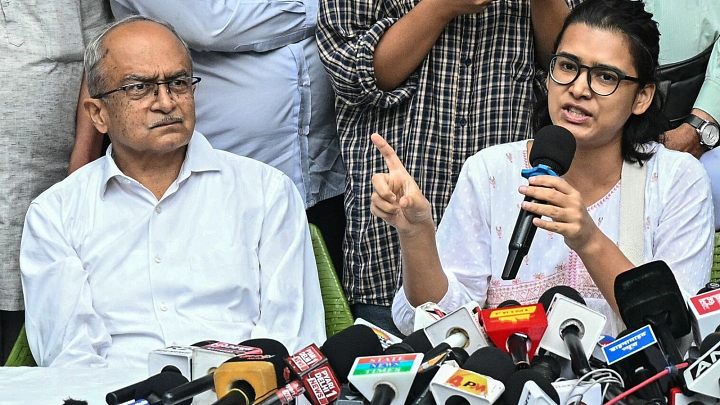
Neha Bora, Prashant Bhushan And The Dangerous Romance Of ‘Regime Change’
What if the movement promising to free us from one set of problems ends up creating another, far worse? In 1953, Polish poet Czesław Miłosz explored this danger in The Captive Mind, showing how intellectuals in communist
Ni Anindya Banerjee··196K nabasa
Neha Bora, Prashant Bhushan And The Dangerous Romance Of ‘Regime Change’
What if the movement promising to free us from one set of problems ends up creating another, far worse? In 1953, Polish poet Czesław Miłosz explored this danger in The Captive Mind, showing how intellectuals in communist Poland surrendered independent thought to the promise of a better society.
In India today, as student protests, street demonstrations and battles over civil liberties, institutional accountability and the right to dissent shape the political landscape, Miłosz’s warning deserves a closer look. When we take to the streets demanding change, do we question not just the system we oppose, but also the ideology and the people claiming to offer an alternative?
Neha Bora, the 29-year-old president of the All India Students’ Association (AISA), described by The New York Times as the “reluctant face of the moment”, said in a video message marking the sixth national conference of the Socialist Student Front that she and her team draw inspiration from the student-led movements in Bangladesh. “We extend our solidarity to you. We take inspiration from you, lessons from the movements that you lead,” she said.
Bora did not stop there. She went on to hail the Gen-Z movement, saying: “And we know that the Gen-Z movement that we are seeing everywhere in this country first started in Bangladesh. And congratulations to you for showing us the way.”
The student-led protest in Bangladesh that Bora so openly praises is widely known as the ‘July Revolution’ among those who spearheaded it in July 2024. Former Prime Minister Sheikh Hasina, meanwhile, describes it as a ‘regime-change operation’. The student stir began over reservations in government jobs, but eventually turned into a nationwide uprising against the government. On August 5, 2024, an elected government was ousted, and Hasina had to be flown out by helicopter as her government collapsed.
When Bora says she and India’s Gen Z thank their Bangladeshi counterparts for “showing us the way”, even the harshest critic of Narendra Modi should pause to consider what exactly is being celebrated.
Bora has been trending on Bangladeshi X ever since her comments. Bangladeshi media outlets have also prominently covered her praise for the student movement.
“Bora said young people in India are also participating in and leading movements for democratic and voting rights, drawing parallels between the struggles of students in the two countries,” reported New Age.
Interestingly, another person drew a similar parallel: Nahid Islam, convenor of the National Citizen’s Party (NCP), a party born out of the July student movement. “In July 2024, our student-led movement against recruitment quotas transformed into a nationwide uprising against 15 years of authoritarian rule. The state responded with live ammunition. The United Nations later estimated that as many as 1,400 people were killed during the uprising and its suppression,” he said in a statement.
The statement added: “To the democratic people of India: from Dhaka, and from the unfinished democratic aspirations of our July generation, we stand with you.”
Nahid Islam invokes the deaths of as many as 1,400 people in Bangladesh to describe the cost of the uprising. In India, the protests at Jantar Mantar and those over Chief Election Commissioner Gyanesh Kumar have unfolded in a very different context. There has not been a single casualty in New Delhi. Yet, Islam has drawn a parallel between the protests in Dhaka and New Delhi, a parallel that Bora seems to endorse.
The question is not whether the two countries’ young people have the right to protest. They do. Nor is it whether Indians have legitimate grievances about electoral processes or the functioning of institutions. They may well have them. The question is whether the experience of Bangladesh is being examined in its entirety or selectively celebrated as a template for political change.
The NCP, which emerged from the July student movement and has been associated with Jamaat-e-Islami in Bangladesh’s political landscape, won just six seats in this year’s parliamentary election. The political journey from a mass uprising to electoral politics is a reminder that bringing down a government and building a stable, democratic alternative are two very different challenges.
These are precisely the dangers that Miłosz warned about in 1953. Poland has its own history of confronting the consequences of ideological conformity under Stalinism. India, with its democratic institutions and political traditions, must be careful not to confuse the appeal of revolutionary change with proof that the promised alternative will be better.
To say that the Election Commission of India is beyond criticism would be living in a fool’s paradise. Large sections of the Opposition perceive CEC Gyanesh Kumar as ‘biased’. Those concerns deserve scrutiny, and allegations of institutional failure should be addressed through democratic and legal processes. But India also has constitutional remedies, courts and elections through which governments and institutions can be challenged.
To insist that the rule of the streets must prevail over the rule of law, however, risks taking a legitimate demand for accountability into dangerous territory. Protest is an essential part of democracy. It cannot, by itself, become a substitute for the constitutional processes that sustain it.
Yuri Bezmenov, a former Soviet journalist who defected to the West, warned that ideological subversion could weaken a society from within by eroding trust in its institutions, widening divisions and changing how people saw the world. He argued that activists and intellectuals could, sometimes unknowingly, advance an agenda whose eventual consequences differed from the society they hoped to create. This is the basic idea behind the term “useful idiot”: serving a cause without fully understanding who ultimately benefits from it.
In Mumbai’s Azad Maidan, Delhi’s Jantar Mantar and Bengaluru’s Freedom Park, there are undoubtedly idealistic people who believe they are fighting for a better future. Their convictions should not be dismissed, and their right to dissent must be protected. But idealism does not exempt anyone from asking difficult questions about the political forces they support, the methods they endorse and the consequences they are willing to accept.
Supreme Court lawyer Prashant Bhushan did not hide behind any pretence when he spoke about regime change. “The government alleges the opposition wants a regime change… We’re currently fighting to ensure that elections are conducted properly. But if this kind of brutality continues, there’ll certainly be regime change,” he said. “Yes, we all want regime change,” he added.
There is nothing inherently undemocratic about wanting a government to change. In a democracy, that is precisely what elections allow citizens to do. The crucial distinction is between changing a government through the ballot and treating its removal, by whatever means, as an end in itself.
That is where the Bangladesh parallel becomes uncomfortable. A movement that began with a specific grievance over recruitment quotas became an uprising that swept away a government.
India does not need to choose between unquestioning loyalty to those in power and romanticising every movement that seeks to dislodge them. It needs citizens capable of challenging governments without abandoning constitutional democracy.
The freedom to demand change is indispensable to democracy. So is the wisdom to question those promising it.