Neha Bora At The 'Big Table': Congress's Left Turn Is Fuelling Dissent Within
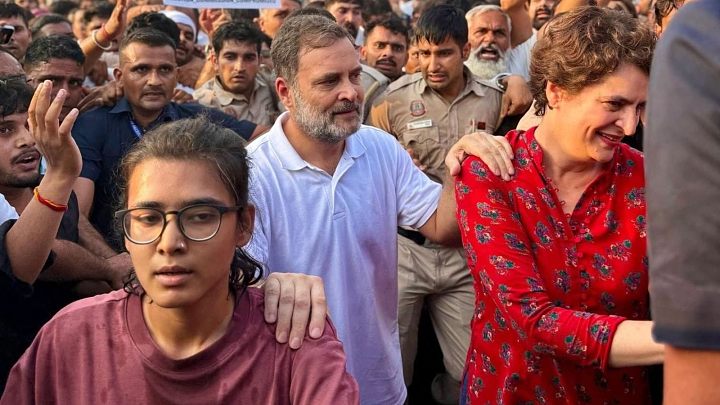
The presence of Neha Bora alongside Rahul Gandhi and Priyanka Gandhi Vadra during the Opposition’s march to the Supreme Court may have been intended to project a united front against the BJP. Within the Congress, however
Ni Apoorva Misra··56K nabasa
Neha Bora At The 'Big Table': Congress's Left Turn Is Fuelling Dissent Within
The presence of Neha Bora alongside Rahul Gandhi and Priyanka Gandhi Vadra during the Opposition’s march to the Supreme Court may have been intended to project a united front against the BJP. Within the Congress, however, it has triggered a different conversation—why are leaders from Left-affiliated student organisations increasingly finding space alongside the party’s top leadership, sometimes at the expense of its own youth cadre?
Bora, national president of the All India Students’ Association (AISA), a student organisation affiliated with the Communist Party of India (Marxist-Leninist) Liberation, has emerged as one of the prominent faces of the protests against Chief Election Commissioner Gyanesh Kumar. Her appearance beside the Gandhi siblings during the Congress-led march has sharpened questions within sections of the party, particularly its student wing, the National Students’ Union of India (NSUI), over the leadership’s preference for activists from outside its organisational structure.
The unease touches upon a larger debate over the Congress’s ideological direction, its relationship with the Left, and whether bringing Left-linked activists into prominent positions is helping the party expand its base or alienating its own workers.
Why Neha Bora’s Place At The ‘Big Table’ Matters
The optics of the march to the Supreme Court on Monday were striking. While senior Congress leaders sought to remain close to Rahul Gandhi and Priyanka Gandhi Vadra, Bora, who had earlier been associated with the Cockroach Janta Party (CJP)-led protests, was also seen walking alongside the party’s top leadership.
ALSO READ | Abhijeet Dipke Was Taken To Judge After 24 Hours, But Neha Bora Was Let Off In Evening: The 2 ‘Detentions’ Explained
The prominence given to Bora reportedly surprised sections of the NSUI, with some believing that their organisation had been made to appear insignificant at a protest led by the Congress and the broader INDIA bloc.
For the Congress leadership, however, there is a political calculation at play. Bora’s visibility among young protesters gives the party access to a constituency that it has been trying to mobilise, while her presence also complicates the CJP’s attempt to establish itself as the principal face of the ongoing agitation.
A Congress leader quoted by The Indian Express argued that Bora’s inclusion prevented the CJP from projecting itself as the central force behind the protests. The argument was that the visuals instead placed the Congress and the INDIA bloc at the forefront of the movement.
Rahul Gandhi has also sought to frame the agitation as a wider democratic mobilisation rather than a contest between rival protest platforms. In a social media post, he said: “Students. Youth. Journalists. The INDIA bloc. Different banners, one cause. All protests are one: citizens demanding their constitutional rights.”
Yet, the effort to broaden the movement has raised an uncomfortable question within the Congress: if the party already has a substantial student organisation, why does it need to give so much prominence to activists from ideologically distinct groups?
The Congress’s Long-Standing Comfort With The Left
Bora’s rise has brought renewed attention to what some Congress leaders describe as the Gandhi family’s longstanding comfort with Left-leaning political activists.
ALSO READ | Neha Bora Got A Lookalike To Evade Delhi Police? The Sunday Matinee Drama, Chase & Its Ending Explained
Several people who came through Left-affiliated student organisations have moved into important roles within the Congress in recent years. These include former AISA leaders Sandeep Singh, Mohit Pandey and Akbar Chaudhary, all of whom previously headed the Jawaharlal Nehru University Students’ Union (JNUSU). Singh later became part of Priyanka Gandhi Vadra’s team.
Prasenjit Bose, who was associated with the Students’ Federation of India (SFI), the student wing of the Communist Party of India (Marxist), has also joined the Congress.
Another prominent example is Kanhaiya Kumar, a former JNUSU president who came from the All India Students’ Federation (AISF), affiliated with the Communist Party of India. Kumar is in charge of the NSUI, placing a leader with a Left student-politics background at the helm of the Congress’s own student organisation.
These appointments have helped bring activists with experience in campus mobilisation, ideological debates and street politics into the Congress fold. But they have also raised questions about the party’s recruitment and promotion priorities, particularly among those who believe its own organisational structures deserve greater investment.
A Congress worker quoted by The Indian Express questioned the need to bring in leaders from AISA when the party already has the NSUI. The worker also raised doubts about whether the entry of Left activists had strengthened the Congress’s student presence, particularly in JNU, where the NSUI has struggled to establish itself.
The criticism reflects a wider organisational concern: whether the leadership is rewarding those who have built their careers within the party or giving preference to individuals who arrive with a ready-made public profile, ideological fluency and the ability to command attention.
An Ideological Contradiction Within The Opposition
The discomfort is not merely about who gets to stand next to Rahul Gandhi at a protest. It also concerns the ideological distance between the Congress and the organisations whose leaders are being welcomed into its political space.
The Congress has historically attempted to function as a broad-based party, accommodating different social groups, ideological strands and political interests. The Left, by contrast, has its own distinct ideological traditions, organisational loyalties and political positions.
AISA’s own description of the NSUI illustrates the contradiction. Its website groups the Congress student outfit alongside the RSS-affiliated Akhil Bharatiya Vidyarthi Parishad (ABVP), describing both as right-wing and anti-people organisations.
This makes the growing proximity between the Congress leadership and AISA figures politically significant. An organisation that has publicly criticised the NSUI is now represented by its national president at a prominent Congress-led demonstration.
For critics within the Congress, the arrangement raises questions about ideological consistency. They argue that the party risks appearing more receptive to activists from Left organisations than to its own grassroots workers, even when the latter have spent years building the Congress’s student and youth networks.
There is also concern that the Left’s ideological positions, particularly on religion and cultural issues, could complicate the Congress’s attempt to rebuild its appeal among voters who may oppose the BJP politically but remain uncomfortable with the Left’s worldview.
This is particularly relevant as the Congress tries to reclaim its traditional umbrella character and reach voters beyond its existing support base. Leaders sceptical of the Leftward tilt question whether an association with organisations that have a limited electoral footprint can help the party attract undecided voters.
The opposing view within the Congress is that such concerns overlook the value of political inclusion. From this perspective, bringing together student activists, civil society voices and groups that may not formally belong to the party is a way to broaden the opposition’s social base.
The question, therefore, is not simply whether the Congress is moving leftwards, but whether the leadership can accommodate Left-linked activists without weakening its own organisational identity.
Why The Left’s Student Leaders Have Found Space In The Congress
The movement of Left-affiliated student leaders into mainstream politics is not entirely new. Student organisations have long served as training grounds for political careers, providing activists with experience in public speaking, campaign organisation, ideological argument and mobilisation.
AISA, SFI and AISF operate within different strands of the Indian Left, but their leaders often gain experience in high-intensity campus politics and public campaigns. Some eventually seek larger political platforms beyond student organisations.
A professor with an AISA background, quoted by The Indian Express, suggested that the movement of Left activists into mainstream politics was a natural progression. Liberalisation and social media, the professor argued, have changed the opportunities available to political activists, while mainstream platforms offer a wider audience.
For the Congress leadership, such figures can bring established networks, a command over political messaging and the ability to connect with young people who may not identify with conventional party structures.
Bora’s emergence during the protests has also demonstrated the importance of visibility in contemporary political mobilisation. Her speeches and presence at demonstrations have helped her become a recognisable face of the agitation, making her a potentially useful figure for a party seeking to connect with younger protesters.
But the advantages of importing political talent can come with organisational costs. Leaders who have risen through the Congress’s own youth and student wings may question why outsiders receive prominent platforms while their own performance and contribution appear to attract less recognition.
Is The Congress Risking Its Own Youth Cadre?
The unease around Bora comes at a time when the NSUI’s organisational performance is also under scrutiny. The Congress student wing has faced questions over its performance in recent Delhi University student elections, which followed the July Gen Z agitation.
Kanhaiya Kumar’s position, especially, has attracted attention, with questions being raised about whether he has been sidelined in the protest mobilisation. The contrast between the leadership’s visible engagement with Bora and the concerns around the NSUI has added another layer to the internal debate.
For an organisation that depends on its student and youth wings to build its next generation of leaders, the issue is not insignificant. These wings are expected to mobilise students, develop local leadership and serve as a pipeline into the party’s broader structure.
If activists outside the Congress are seen to receive greater recognition than those working within it, the leadership risks creating resentment among its own cadre. Conversely, refusing to accommodate outsiders simply because they come from rival organisations could limit the party’s ability to build coalitions and attract new political talent.
The tension is therefore between organisational loyalty and political utility. The Congress needs its own student and youth wings to remain effective, but it also wants to draw in activists who can bring wider public attention and new constituencies into its orbit. How it balances those objectives will determine whether the elevation of Left-linked figures becomes a source of renewal or another point of friction within the party.