'Negative Demographic Changes Led To Partition': RSS's Sunil Ambekar Makes Case For NRC | Exclusive
The Rashtriya Swayamsevak Sangh’s (RSS) demand for a nationwide National Register of Citizens (NRC) is rooted in the need to clearly establish who is a citizen of India, while “negative demographic change” remains a conc
Ni Madhuparna Das··43K nabasa
'Negative Demographic Changes Led To Partition': RSS's Sunil Ambekar Makes Case For NRC | Exclusive
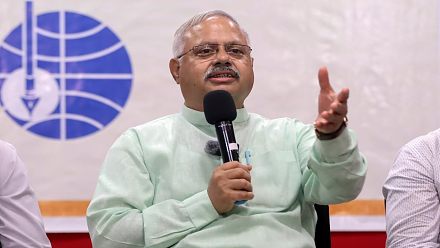
The Rashtriya Swayamsevak Sangh’s (RSS) demand for a nationwide National Register of Citizens (NRC) is rooted in the need to clearly establish who is a citizen of India, while “negative demographic change” remains a concern for the organisation because of its implications for national unity, integrity and security, RSS Akhil Bharatiya Prachar Pramukh Sunil Ambekar said in an exclusive interview with CNN-News18.
Ambekar also reiterated the Sangh’s position on the Uniform Civil Code (UCC), saying that citizenship and demographic questions needed to be viewed in the context of the country’s cultural identity.
“In a democracy, we need to be very clear who are the citizens of this country. I think any country will do that,” Ambekar said, adding that only citizens should have the right to participate in the democratic process and access facilities meant for citizens.
“Population imbalance is a very important issue because negative demographic changes were one of the factors that led to the Partition in 1947,” he said.
NRC, Demography And Citizenship
Explaining the idea further, Ambekar said there could be different mechanisms and tools available to the government to establish citizenship. However, he stressed that the objective should be to safeguard national unity, integrity and security.
“Only citizens will have the right to participate in the democratic process. As citizens, if they are subscribed to any facilities that are meant for citizens, they should have access to them. For the rest of the people, they can come legally through the immigration process and be part of our development process. No problem. But it should be legal.”
He added, “After 75 years of independence, I think any aware citizen or any very well aware country should spare a thought about this situation, that how will the government identify non-citizens, what the legal process should be for them.”
Ambekar, however, reiterated that the RSS’ concerns were not directed against any particular community or religion.
“So, in that way, it is not against anybody. Anyone can follow any religion or worship any God, but as a country, our commitment to our identity, culture, unity, and integrity is, I think, the ultimate priority.”
The argument, Ambekar said, was ultimately about the country’s cultural identity.
“Any country has its own cultural identity. And that cultural identity builds the foundation for our national unity, national identity,” he said.
Bhagwat’s Global Outreach
Elaborating on RSS chief Mohan Bhagwat’s visits to the US, the UK and Canada, Ambekar said it was this broader understanding of Bharat that Bhagwat sought to communicate during his recent overseas engagements.
Ambekar said the visit was different from Bhagwat’s earlier overseas engagements, which were largely focused on the Indian diaspora.
“But this time, the purpose was to meet local people, particularly those from public life. They are important opinion-makers. The idea was to communicate and convey the message to them,” he said.
According to Ambekar, the message was about Bharat and the country’s growing potential. “Bharat is changing at every level, and it has emerged as a great source of potential, not only for Bharat but for the world as well,” he said.
Ambekar also emphasised the need to present Bharat as a cultural nation rather than viewing it solely through the political framework of a nation-state. “Bharat is a cultural nation that has evolved over centuries through its cultural practices, traditions and way of life,” he said.
Hindu Rashtra: Cultural, Not Political
Ambekar acknowledged that the RSS needed to do more to explain its understanding of Hindu, Hindutva and Hindu Rashtra to the world. “Yes, definitely. We need to do it,” he said, pointing to the global relevance of what he described as India’s civilisational values.
“Take yoga, for example. It is helping people even in the modern world. The same is true of meditation. These are age-old practices. I do not know when they originated, but they remain very relevant and helpful in the modern world,” he said.
He added, “We have strong cultural values and a strong foundation, such as the family system. We also have a particular way of thinking about the environment and our relationship with it.”
The most politically significant clarification, however, came on the idea of Hindu Rashtra.
Ambekar rejected the interpretation that Hindu Rashtra was simply a political entity waiting to be created. “He has not said that he is interested in creating a Hindu Rashtra. Hindu Rashtra is already there,” he said, referring to Bhagwat’s remarks.
“As long as the last person continues to follow these cultural traditions and identities, it is the Rashtra,” he added.
Ambekar said the idea was not about creating a new political structure but about reviving awareness of an existing civilisational identity. “So, it is not a political concept. It is a cultural concept of recognising this cultural identity and these traditions,” he said.
He described the process as one of “recovering the memory” of Bharat’s cultural identity. “When people realise, ‘Oh, this is our identity, this is our culture,’ they will embrace it and take pride in it,” Ambekar said.
For the RSS, then, the second century is not simply about expanding its organisational footprint. Its unfinished task, Ambekar said, remains reaching every household and every locality while building a society capable of taking responsibility for its own social and national life.