NCP's Silent Power Struggle: Patel's Warning And The Pawar Family's Challenge | The Maha Picture
The recent elections to the Maharashtra Legislative Council from the Graduates’ and Teachers’ constituencies have turned out to be an eye-opener for the ruling Mahayuti government. The poor performance of the alliance ex
Ni Mayuresh Ganapatye··189K nabasa
NCP's Silent Power Struggle: Patel's Warning And The Pawar Family's Challenge | The Maha Picture
The recent elections to the Maharashtra Legislative Council from the Graduates’ and Teachers’ constituencies have turned out to be an eye-opener for the ruling Mahayuti government. The poor performance of the alliance exposed the friction between the BJP and Shiv Sena, with leaders from both parties openly criticising each other and blaming their allies for the electoral setback.
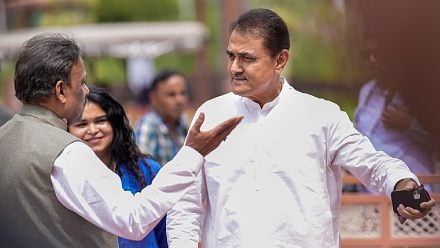
However, beyond the public exchange of accusations between the BJP and Shiv Sena, it was a social media post by senior NCP leader and Rajya Sabha MP Praful Patel that offered a glimpse into a different kind of political unease. This time, the discomfort was not within the alliance but inside the NCP itself.
On October 28, Patel took to X and wrote: “Today’s Vidhan Parishad election results serve as a definitive wake-up call. The time has come for urgent introspection to rebuild trust, realign our priorities, and fix our organisational structure.”
For a leader of Patel’s stature, this was not an ordinary post reacting to an election result. The choice of words was significant. When a senior leader speaks about rebuilding trust, realigning priorities and fixing the organisational structure, it raises a larger question: Is everything really well within the NCP?
The electoral setbacks have only added to the existing discontent. The Pune Graduates’ constituency, which the NCP had traditionally considered its stronghold, was given to the BJP as part of the Mahayuti seat-sharing arrangement. The NCP leadership could not retain the seat within its own share. The BJP fielded Dr Smita Jadhav, who lost to NCP (SP) candidate Harshada Jadhav. The decision to concede the seat to the BJP did not go down well with sections of the NCP organisation in Pune. Many party workers were expecting their own party to contest the constituency. The setback in Chhatrapati Sambhajinagar was equally embarrassing. NCP candidate Satish Chavan failed to retain the Graduates’ constituency seat, exposing the party’s organisational weaknesses in a region where it had expected a better performance.
Patel’s post, therefore, appeared to reflect a sentiment shared by a section of the party’s leadership and cadre. Many may not be willing to question the leadership publicly, but in private conversations, concerns about the party’s functioning, organisational decisions and direction are increasingly being expressed.
To understand the present situation, one needs to look at how Ajit Pawar had structured the party after his dramatic split from Sharad Pawar in 2023. Ajit Pawar was not merely the face of the breakaway faction; he was the central political authority. After securing the party name and symbol, he divided responsibilities among his trusted colleagues. As National President, he handled the political affairs of the party, its expansion in Maharashtra and its electoral strategy. Praful Patel, meanwhile, was entrusted with managing the party’s presence in Delhi and coordinating with the BJP’s central leadership.
It was a division of responsibilities that worked because the two leaders shared a political understanding and complementary roles.
Ajit Pawar’s sudden demise in January 2026 changed that equation completely. His wife, Sunetra Pawar, subsequently took charge as the National President, while their son Parth Pawar was elevated to the Rajya Sabha. The family now occupies a central position in the party’s decision-making structure.
But the transition has not been without questions.
According to a senior party source, the leadership style has changed considerably since Ajit Pawar’s death. Regular meetings with MLAs, which Ajit Pawar used to convene to discuss constituency-level issues and hear grievances, are no longer taking place with the same frequency. Such meetings were important not merely as organisational exercises but also as a mechanism through which legislators could directly communicate with the leadership.
The source further pointed out that Devgiri bungalow, the official residence of Deputy Chief Minister Sunetra Pawar in Mumbai, has increasingly become the centre of NCP’s political activity. Earlier, party leaders, legislators and workers would routinely visit the party office to meet ministers and senior leadership. Today, many important discussions and decisions are believed to be taking place at Devgiri. There is also a question about the functioning of the party’s core committee. After Sunetra Pawar assumed charge, it was decided that the committee would meet every 15 days to discuss organisational matters and advise the party president. However, according to a senior NCP leader, these meetings have not taken place regularly. On several occasions, the views of committee members have allegedly not received the consideration they expected on important decisions.
The proposed party convention in Nashik is another example cited by disgruntled leaders. The NCP had announced the convention as an important organisational event, particularly because it would have been Sunetra Pawar’s first major convention after taking over as party president. Workers, office-bearers, MLAs and MPs were expected to participate and demonstrate the party’s organisational strength.
The convention was postponed, with drought conditions in Maharashtra cited as the reason. However, it has not been rescheduled so far.
A senior party leader questioned the logic behind the prolonged postponement. Maharashtra has been facing drought-related challenges this year, and there are concerns about an even more difficult situation next year. Does that mean the party will continue to put off its organisational activities? The question reflects the larger frustration among leaders who believe the party needs to get back on the ground rather than remain confined to internal meetings.
There is also growing criticism over the influence of a handful of relatively inexperienced young leaders who are perceived to be close to the Pawar family. According to a senior party functionary, these leaders are increasingly influencing decisions at the top, while experienced organisational hands are finding their voices diminished. The criticism is not necessarily about bringing younger faces into leadership. It is about whether political experience, organisational understanding and the views of senior leaders are being adequately considered.
Interestingly, the unease surrounding Praful Patel’s position is not new. Questions about his organisational authority emerged soon after Ajit Pawar’s death. On February 16, according to allegations made by NCP (SP) MLA Rohit Pawar, Praful Patel, Sunil Tatkare and Brijmohan Shrivastava communicated with the Election Commission, claiming that amendments had been made to the NCP constitution. The alleged amendments provided for the National Working President to exercise decision-making powers in the absence of a national president. Since Patel held that position, the communication had significant implications for the party’s interim leadership arrangements. Sunetra Pawar subsequently wrote to the Election Commission on February 28, requesting that communications made between Ajit Pawar’s death and her assumption of the party presidency not be treated as official party communications.
The issue resurfaced in March and April when the party submitted lists of office-bearers to the Election Commission. In the March 10 communication, the organisational designations of several senior leaders, including Patel, Tatkare and Chhagan Bhujbal, were not specified. A subsequent list submitted on April 29 also raised questions about the designations assigned to senior leaders. Patel was identified as the Rajya Sabha leader, rather than being specifically designated as National Working President.
The omissions triggered speculation about whether the party was quietly changing its organisational hierarchy. The leadership subsequently described the omissions as technical or clerical errors and indicated that corrections would be made.
The episode was politically significant. Patel was among the most important leaders who had stood firmly behind Ajit Pawar during the 2023 split. He had played a crucial role in the faction’s political consolidation. Yet, after Ajit Pawar’s death, his position within the organisational structure appeared to be changing.
In May, even Sharad Pawar made an observation that was difficult to ignore. While defending Patel and Tatkare amid the controversy, he recalled that in the undivided NCP, Patel’s name would come immediately after his own. It was a reminder of the political stature Patel once commanded within the party.
None of this necessarily means that Patel is preparing for a confrontation with the Pawar family or that he intends to challenge Sunetra Pawar’s leadership. But his October 28 post has brought into the open questions that were earlier being discussed largely behind closed doors.
The larger issue before the NCP is whether it can preserve the organisational balance that Ajit Pawar had painstakingly built. A political party cannot run only on the strength of a family name, nor can it afford to ignore the leaders who helped build its political machinery. The Pawar family may have inherited the party leadership, but political authority also needs to be sustained through consultation, confidence and organisational engagement.
For now, Praful Patel has chosen to convey his message through a carefully worded social media post rather than an open confrontation. But when a leader of his standing speaks about rebuilding trust and fixing the organisation, the party leadership would do well to pay attention.
The NCP has a bigger challenge than explaining its recent electoral defeats. It has to answer a more fundamental question: Is it still functioning as a political organisation built around collective leadership, or is it gradually turning into a party where decisions are concentrated within the Pawar family and a small circle around it? The answer could determine not just Praful Patel’s future in the NCP, but the political direction of the party itself.