Navsari To Patna: 19 Years On, Congress Has Learnt No Lessons
“Modi kahin nahin jayega (PM Narendra Modi won’t go anywhere).” These were the four words of Congress supporter Santosh Kumar at the party’s Patna event who wanted to say, by his own admission, that “unless the public re
Ni Anindya Banerjee··39K nabasa
Navsari To Patna: 19 Years On, Congress Has Learnt No Lessons
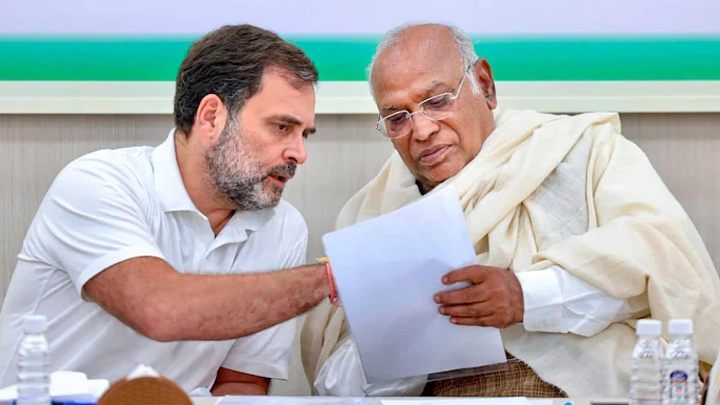
“Modi kahin nahin jayega (PM Narendra Modi won’t go anywhere).” These were the four words of Congress supporter Santosh Kumar at the party’s Patna event who wanted to say, by his own admission, that “unless the public revolts, PM Modi will not go”. But Congress president Mallikarjunun Kharge mistook him as a heckler and angrily shot back, “Modi ka baap bhi jayega (Even his father will have to go)”.
Thus, from the Patna event, the Congress president brought in the prime minister’s late father Damodardas Mulchand Modi, who died around 36-37 years ago.
On expected lines, BJP’s top leadership, including Union Home Minister Amit Shah, party president Nitin Nabin, JP Nadda, Shivraj Singh Chouhan and a volley of chief ministers attacked the Grand Old Party. The BJP also launched street protests against what it called a ‘deplorable’ act by Kharge.
If it is a mistake, the next best thing in politics is to accept it, issue an apology and move on. After all, to err is human. But the Congress decided to go full throttle and its state wings latched on to the “Modi ka baap bhi jayega” bandwagon. Congress in Tripura posted an AI-generated video of Kharge, where he is sitting cross-legged in a chair. Behind him is a house in flames. Kharge is seen angrily throwing pamphlets towards the camera that read: “Uska baap bhi jayega” and sipping tea.
The Maharashtra Pradesh Congress Committee posted an AI-generated photo of Kharge’s walking silhouette, with text prominently saying, “Uska baap bhi jayega”.
A bandwagon of Congress-aligned influencers and social media accounts soon pushed the same message, often with a more crass language.
In the last 19 years, PM Modi has seen many changes. He has become prime minister of India from chief minister of Gujarat. He has seen the Patidar movement peak in 2015 soon after leaving Gujarat, but also seen it lose its mass movement character. For the first time, during the Jantar Mantar student stir in Delhi in 2026, the government was forced to let go of its education minister. But one thing has been constant—every time the Opposition attacked him personally, he made it his political capital. Repeatedly. And after Kharge’s faux pas, Congress’ decision to double down shows it has learnt very little in the last two decades.
HATE AS POLITICAL CAPITAL
“Kahan Le jat ho? (where are you taking this?)”
“Ghar- e (to my house)”
“Ka karbo?” (What will you do?)”
“Chhat pe lagaibo light lagaike (will put it in the roof and adorn it with lights)”
This was a random conversation between a social media user and a person he came across in Varanasi who was carrying home a life-size cut-out of PM Modi after his recent visit. The video has since gone viral.
Several voters today, including BJP supporters, have legitimate complaints against the ruling party over job creation, affordability, mounting debt, and pollution in metros, to name a few.
But the Congress-led Opposition fails to realise that the BJP supporters of today’s India may not think twice before shelving those concerns to vote against the Opposition to ‘extract a cost’ for the ‘personal insult’ of PM Modi.
Political scientist KC Suri, in Aseema Sinha’s academic paper ‘Why Has “Development” Become a Political Issue in Indian Politics?’ argued, “People of this country vote more on the basis of emotional issues or primordial loyalties, such as caste, religion, language or region and less on the basis of policies.”
Let’s go back to December 1, 2007. The occasion was the Gujarat assembly election and the venue was Navsari. Sonia Gandhi used the phrase “maut ka saudagar” (merchant of death) for then Gujarat CM Modi in the context of allegations surrounding encounter killings. That year, Modi turned it into an electoral topic. “Encounter, encounter, encounter. If she has the guts, she can hang me to death,” he retorted at a rally in south Gujarat. In another rally in Karchelia village of Surat, Modi asked the crowd, “You tell me what should have been done to someone like Sohrabuddin who was wanted by police in four states and kept arms and ammunition.’’ The crowd responded with, “Kill him, kill him”.
The BJP won a landslide victory with 117 seats in a 182-seat house in that year.
But the Congress did not learn its lesson. That is why, just before the 2014 Lok Sabha election, Mani Shankar Aiyar made a comment at an AICC event, saying Modi could never become prime minister, but could be given a place to sell tea at the Congress event, taking a dig his humble background. The same year, Sonia Gandhi, at a rally in Karnataka’s Gulbarga, accused Modi and the BJP of sowing “Zeher ki kheti” (seeds of poison).
WATCH: You are doing ‘Dalali’ of their(Jawans) blood: Rahul Gandhi to PM Modi https://t.co/9FyidaF6uj
— ANI (@ANI) October 6, 2016
In 2016, Rahul Gandhi accused Modi of using the sacrifices of soldiers for political gain after the September 2016 surgical strikes, suggesting “khoon ki dalaali”. “Humare jawan hain jinhone khoon diya hai, jinho ne surgical strike kiya, unke khoon ke peeche aap (PM) chhupe huye ho. (You (PM) are hiding behind our soldiers, who gave their blood and who carried out surgical strikes)”, Rahul Gandhi said. In 2017, Mani Shankar Aiyar was back just before another Gujarat assembly election when he called the prime minister “Neech kisam ka aadmi”. ‘Chowkidaar Chor hai’ by Rahul Gandhi in 2018 and ‘Ravana’ by Mallikarjun Kharge in 2022 are some of the many personal attacks the Congress’s top leadership has made at PM Modi over the years.
For almost every personal attack PM Modi endured, the political cost was borne by the Congress. People-centric issues that the Congress could champion got sidelined and it ended up being a clash of personalities.
Prithvi Iyer concludes in ‘Emotions and Vote Choice: Perspectives from the US and India’ which is an analysis on how emotion plays a role in US and India elections, “Voters do not always abide by the rational choice models and can be swayed by emotional messaging.”
Imagine this: Five states, including Punjab, Uttar Pradesh and Uttarakhand, are headed for elections. What if an emotional Narendra Modi appears across all his social media handles, urging voters to “answer Congress with your votes” over the ‘baap’ insult? That is precisely the point Iyer is making—and one Congress still seems to have missed, 19 years on.