‘Muslims Must Leave’: What Is Happening At Gujarat’s Garba Events?
AHMEDABAD: Navratri celebrations in Gujarat have increasingly become the centre of controversy, with Hindu right-wing groups seeking to keep Muslims and other non-Hindus out of garba events. From announcements asking Mus
Ni Parishmita Saikia··90K nabasa
‘Muslims Must Leave’: What Is Happening At Gujarat’s Garba Events?
AHMEDABAD: Navratri celebrations in Gujarat have increasingly become the centre of controversy, with Hindu right-wing groups seeking to keep Muslims and other non-Hindus out of garba events. From announcements asking Muslim attendees to leave to confrontations over workers’ identity cards and the employment of Muslim musicians, several incidents have been reported across Ahmedabad, Vadodara, Surat and Bhavnagar this Navratri season.
Groups including the Vishwa Hindu Parishad (VHP), Bajrang Dal and Antarashtriya Hindu Parishad (AHP) have challenged the presence of Muslim workers and performers at different venues. In some cases, police have received complaints or intervened during confrontations, while organisers and representatives have offered differing accounts of what happened.
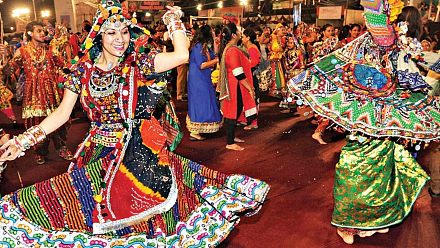
The incidents have also raised questions about the contrast between attempts to restrict participation on religious grounds and garba’s recognition as a cultural tradition that brings together people from different communities.
Aditya Gadhvi’s Garba Event Sparks Row Over Call To Remove Muslims
On October 14, an anchor at Rang Morlo, an upscale Navratri event featuring folk singer Aditya Gadhvi, announced from the stage that people described as ‘vidharmi‘, meaning those belonging to another faith, and Muslims should voluntarily leave the venue, as reported by The Indian Express. The anchor also said that the VHP had come to protect Hindus and announced a helpline number from the stage. Tickets for the event were priced between Rs 1,000 and Rs 7,500.
The announcement triggered widespread criticism, following which Gadhvi, known for his Coke Studio Bharat rendition of Khalasi, distanced himself from the incident through a statement on Instagram.
Responding to what he described as claims being made in his name, Gadhvi said a group of people had taken over the backstage area and done something he would never do. He added that neither he nor the anchor had been consulted and that they were not involved in the incident in any capacity.
Akash Trivedi, the anchor who made the announcement, also issued a statement. He said he had spoken on behalf of the organisers and that the remarks did not represent his personal opinion.
Ahmedabad Rural Superintendent of Police Om Prakash Jat told The Indian Express that the police had received an application from the event organisers and were making inquiries into the incident.
VHP Questions Muslim Worker’s Identity At Vadodara Garba Venue
On October 16, another confrontation was reported at the popular United Way of Baroda garba venue in Vadodara. Razzak Pathan was working at the entrance, scanning entry passes, when the VHP alleged that his event identity card identified him as Aayush Patel. The organisation submitted an application at the Atladara police station, claiming that the name on his Aadhaar card did not match the name on the identity card he carried at the venue.
Senior police officials said Pathan was part of the team scanning entry passes and that the event identity card may have been issued to him by the agency responsible for providing staff. The matter was under investigation.
VHP workers confronted Pathan at the garba ground and handed him over to the police. Videos of the confrontation subsequently circulated on social media.
Atladara Police Inspector PU Pastagiya said the police had received an application from the VHP and initiated an inquiry. He said further action would depend on the findings.
United Way of Baroda representatives, meanwhile, said the organisation did not directly employ workers for the event and that a sub-vendor may have engaged Pathan. The organisation also stated that the incident occurred after midnight, when people had already left the venue, and that the police began their inquiry afterwards.
‘No Tilak, No Entry’ Signs At Vadodara Venue
Religious identity was also brought into focus at Vadodara’s garba festival at Navlakhi grounds, where organisers put up signs reading ‘No tilak, No entry’ several days before the celebrations began. The signage introduced a visible religious marker as an entry condition at the venue.
On the same day as the reported confrontation involving Pathan, videos also circulated online showing a purported heated exchange between VHP members and staff at a garba event organised by Kiran Medical College and Hospital in the Olpad area of Surat district.
However, Olpad Police Inspector CR Jadav offered a different account of the situation. He said the college had organised garba for its staff members across different departments, including people from different faiths.
According to Jadav, police personnel were present at the venue and told VHP members that only the institution’s staff were attending. Police also told the group to inform them if they found anyone harassing people or engaging in illegal activity. The VHP members then left the premises.
Senior college officials denied having any knowledge of the reported incident.
Surat Organisers Had Announced Muslim Exclusion In September
The controversy in Gujarat had surfaced before the October incidents. In September, Harshal Mistry and his brother Mimesh, organisers of Surat’s Raslok Navratri event, announced that Muslims would not be allowed at their celebration. Harshal Mistry said that the organisers had ensured there were no Muslim individuals among the musical bands, security staff or other teams involved in running the event.
He also said their teams would remain present at the venue and remove anyone identified as Muslim or non-Hindu.
The announcement indicated that the proposed exclusion extended beyond attendees to workers and performers involved in organising and managing the festivities.
More Than 40 Detained During Confrontation Over Muslim Musicians In Bhavnagar
One of the major confrontations took place on October 13 at Rangoli Party Plot in the Vartej area of Bhavnagar. Police had to physically restrain and detain more than 40 members of the Antarashtriya Hindu Parishad and other groups during a confrontation over the employment of Muslim musicians for a dandiya event.
The groups were allegedly protesting the organisers’ decision to hire the musicians. Those detained were released at around 3 am on October 14.
On October 17, Bhavnagar Superintendent of Police Nitesh Pandey told IE that the organisers had filed an application against the men who protested in Vartej. He said the police had identified all of them and were taking appropriate preventive action.
The incident brought the dispute over religious identity at garba events into direct conflict with the question of whether Muslim performers could be employed to provide music for the celebrations.
Bajrang Dal Claims Muslim Men Were Handed Over To Police In Ahmedabad
The Bajrang Dal has also made claims about incidents at multiple garba venues in Ahmedabad. In a post on its X account, the organisation said it had handed over two Muslim men who allegedly used ‘Hindu-sounding names’ to enter a garba pandal at Dwarkesh Farm in the Vatva area. It also claimed that five men had been handed over at another venue in Ahmedabad whose name was not disclosed, along with two men at a garba event organised at the Maninagar football ground.
These were claims made by the organisation; the supplied account does not establish that the allegations against the men were independently verified.
Maninagar Inspector JP Jadeja said police personnel were generally present at event venues and tried to prevent such incidents. He added that when people were handed over to the police, officers sometimes checked their phones and released them if they found nothing illegal.
Additional Commissioner of Police (Ahmedabad City) Jaipal Singh Rathore said local police stations had been allowed to handle such matters at their level. He said the police’s primary concern was to maintain law and order throughout the festivities.
VHP And Bajrang Dal Seek Restrictions On Non-Hindus
The incidents form part of a wider pattern in which Hindu right-wing groups, particularly the VHP and Bajrang Dal, have submitted memorandums to police seeking to keep non-Hindus out of Navratri celebrations. Their interventions have taken different forms, including calls for Muslims to leave events, objections to workers’ identity documents, confrontations over the hiring of Muslim musicians and demands for restrictions on who can enter venues.
The reported incidents have not all resulted in the same police response. In some cases, police have received applications and initiated inquiries; in others, officers have intervened during confrontations or asked groups to report suspected illegal activity rather than take matters into their own hands.
The distinction between an allegation and an established finding remains important. Complaints made by organisations or videos circulating on social media do not, on their own, establish wrongdoing by the people targeted.
UNESCO Recognition Of Garba Highlights Its Inclusive Tradition
The developments have drawn attention to garba’s recognition as an important cultural tradition associated with community participation. In 2023, UNESCO’s Intergovernmental Committee inscribed Gujarat’s garba on its Representative List of the Intangible Cultural Heritage of Humanity.
In its inscription, UNESCO described garba as a form of collective celebration that promotes unity in diversity and social equality by bringing together people of different genders, religions and socio-economic backgrounds. It also noted that each generation adapts the dance through new performing styles, lyrics and dress while preserving its central cultural significance.
UNESCO further stated that garba fosters social equality by diluting socio-economic, gender and religious divisions. It described the tradition as continuing to include diverse and marginalised communities, thereby strengthening social bonds.
The reported attempts to exclude Muslims from some celebrations have brought this stated tradition of inclusion into focus, particularly as the controversy has spread beyond attendees to workers, security personnel and musicians.
Police Focus On Maintaining Law And Order
Police responses across Gujarat have varied according to the incidents reported to them. In the Rang Morlo case, Ahmedabad Rural police said they were making inquiries after receiving an application from the organisers. In Vadodara, police initiated a probe into the identity-card complaint involving Pathan. In Bhavnagar, the police said they had identified the men involved in the confrontation over Muslim musicians and were taking preventive action.
In Surat’s Olpad area, police said they intervened by explaining that the garba event was for college staff and instructing VHP members to report any suspected harassment or illegal activity.
Ahmedabad City Additional Commissioner of Police Jaipal Singh Rathore said the main priority was maintaining law and order during the festivities, with police stations permitted to deal with issues locally.
As Navratri celebrations continue to draw large crowds, the incidents have placed the treatment of Muslim workers and performers, the role of organisers and the responsibility of law enforcement under scrutiny. The cases also underline the need to distinguish between allegations made during confrontations and facts established through police inquiries, while examining how restrictions based on religious identity are being applied at individual garba events.