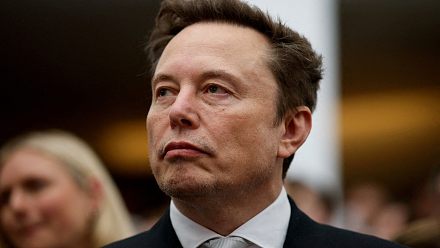
'Much Appreciated': Elon Musk Softens Tone As Reliance Sets Record Straight On Starlink Row
Tesla and SpaceX chief Elon Musk appears to have softened his stance towards Mukesh Ambani’s Reliance Industries after days of publicly attacking the conglomerate over delays in Starlink’s entry into India.
Ni Karishma Jain··154K nabasa
'Much Appreciated': Elon Musk Softens Tone As Reliance Sets Record Straight On Starlink Row
Tesla and SpaceX chief Elon Musk appears to have softened his stance towards Mukesh Ambani’s Reliance Industries after days of publicly attacking the conglomerate over delays in Starlink’s entry into India.
In a marked departure from last week’s sharp accusations and sarcastic remarks, Musk responded with just two words — “much appreciated” — after Reliance issued a statement welcoming competition in India’s satellite communications market, including from Starlink.
The exchange also drew a response from Starlink, which sought to reassure India about its readiness to operate in the country.
Reliance Sets The Record Straight, Musk Softens His Stand
Breaking its silence over Musk’s accusations, Reliance Industries issued a statement on X, making it clear that competition was welcome in India, but compliance with the country’s laws was non-negotiable.
“In light of recent remarks about Reliance and the Indian market, we wish to place the facts on record,” the company said.
Reliance asserted that India’s openness to domestic and foreign investment was firmly rooted in the rule of law, with no special treatment for any applicant.
“That openness rests on the rule of law. As the Government of India has stated, it applies the same process to every applicant, Indian or foreign. Jio’s own satellite services await clearances,” it said.
Countering the suggestion that Reliance was seeking to shield its telecom business from foreign competition, the conglomerate pointed to Jio’s own entry into India’s fiercely competitive telecom market in 2016.
“At Reliance, we have never feared competition. We see it as the truest test of who serves the customer best,” it said.
The company highlighted that Jio had started with no subscribers and grown to serve more than 530 million customers in a decade, offering some of the world’s most affordable mobile data services.
Reliance then directly addressed the controversy surrounding Starlink.
“We welcome competition in satellite communications, including Starlink. Every player, Jio included, must serve the people of India and abide by the laws and policies of the land,” it said.
Musk, who had spent the previous week publicly questioning Reliance’s influence over India’s telecom sector, offered no further criticism.
“Much appreciated,” he replied.
@RIL_Updates Much appreciated
— Elon Musk (@elonmusk) October 16, 2026
The response marked a striking shift from the confrontation that had unfolded just days earlier.
Starlink also responded to Reliance’s post, highlighting that it had worked with Indian regulators and industry stakeholders for over five years and built infrastructure in the country with the necessary approvals. It asserted that it was ready to connect India with high-speed internet.
We have worked closely with regulators, industry and operators in India for 5+ years, and built a network of dedicated systems, gateways, and other infrastructure all in-country to exclusively serve Indian traffic safely and securely – and all with the requisite government approvals.
Starlink is ready to connect India with high-speed internet.
— Starlink (@Starlink) October 16, 2026
Musk’s ‘Oligarchs’ And ‘Monopoly’ Allegations
The cordial exchange was a far cry from Musk’s attacks on October 7, when he accused Indian “oligarchs” of seeking to protect their dominance over the country’s telecommunications market.
Musk alleged that powerful business interests were maintaining a “monopolistic chokehold” over the sector by obstructing Starlink’s launch, describing the alleged situation as a “crime against the people of India”.
He went a step further by mockingly referring to Mukesh Ambani as “Prime Minister Ambani”, questioning whether the Reliance chairman would allow Starlink to compete in India.
Dear Prime Minister Ambani,
Please accept my humble apologies for not realizing that you are the real boss of India.
Naturally, you would prefer to maintain your monopolistic exploitation of the great people of India, but would you nonetheless consider allowing Starlink to compete?
There are many areas of India, as there are in all countries, with no Internet access, which denies children the opportunity for education and for small businesses the opportunity to sell their goods to a global market. Starlink would change their lives for the better.
Thank you �
— Elon Musk (@elonmusk) October 9, 2026
Musk argued that Indian consumers stood to benefit from greater competition and that Starlink would have to price its services affordably to succeed in the market.
“Obviously, if Starlink is too expensive in India, no one will buy it, so SpaceX will need to make pricing affordable,” he said.
India Draws A Firm Line: No Compromise On Security
The Indian government has firmly rejected Musk’s allegations of discriminatory treatment, making it clear that neither the size of an investor nor its international influence can override the country’s regulatory requirements.
The Ministry of Communications has maintained that the approval process is fair and non-discriminatory. Starlink, Jio’s satellite venture and Eutelsat OneWeb are all subject to the prescribed procedures, including security clearances.
India’s insistence on these safeguards is rooted in concerns extending far beyond telecom competition.
Satellite internet services operate through infrastructure that can cross national boundaries, raising questions about data sovereignty, lawful interception, network control and the government’s ability to regulate communications during security emergencies.
In May 2025, the Department of Telecommunications introduced additional security conditions for satellite communication operators holding Global Mobile Personal Communication by Satellite (GMPCS) licences.
These requirements mandate that traffic to and from Indian users be routed through gateways located in India, provide for real-time monitoring by security agencies and prohibit Indian telecom data from being copied or decrypted outside the country.
Operators must also comply with directions to restrict or deny services in specified areas during hostilities or national security emergencies.
The rules impose special monitoring requirements in sensitive border and coastal regions.
These are not conditions directed exclusively at Musk’s company. They form part of India’s broader attempt to ensure that satellite communication networks operating within its territory remain subject to Indian law and security oversight.
Why India Has Reason To Be Cautious About Starlink
India’s concerns are not hypothetical. Musk’s own statements and Starlink’s conduct in conflict zones have raised questions about the degree of control governments can exercise over privately operated satellite networks.
In 2025, Musk described Starlink as “the backbone of the Ukrainian army”, underlining the extent to which the system had become embedded in Ukraine’s military communications during its war with Russia.
Yet Musk had reportedly restricted access to the service on multiple occasions and declined a Ukrainian request to activate Starlink near Crimea.
The episodes highlighted the risks of critical communications infrastructure remaining dependent on decisions made by a private company.
India has also encountered concerns closer to home.
Starlink equipment was recovered in Manipur amid ethnic tensions, while its terminals were also linked to smuggling activities in the Andaman and Nicobar Islands.
Responding to reports of the Manipur seizure in December 2024, Musk said, “This is false. Starlink satellite beams are turned off over India.”
However, a research paper by the Takshashila Institution raised questions about the effectiveness of Starlink’s geographical restrictions. “Because of the imperfections in geofencing, the devices may have worked in parts of the state bordering Myanmar,” it said.
When Indian authorities sought information about the devices, Starlink cited data privacy laws and directed requests through US law enforcement or established international channels rather than directly providing the requested user and usage details.
The company’s response added to concerns about whether Indian security agencies would have timely access to critical information during investigations.
The Takshashila paper also examined how Starlink’s low-Earth-orbit satellite network could complicate efforts to restrict communications in sensitive areas.
Unlike conventional satellite systems, Starlink uses a moving constellation of satellites capable of maintaining connections through rapidly changing links. This makes conventional jamming and geographical restrictions more difficult to enforce.
The paper cited Iran, where Starlink terminals reportedly continued operating despite government attempts to disrupt the service, as an example of the challenges faced by national authorities.
“Starlink services may remain illegally active when the Government wants them to be halted in an area. Conversely, Starlink services may be halted when the Government needs them to be operational,” it warned.
The concern is particularly relevant to India, where communications restrictions may be imposed in sensitive regions for security reasons.
Musk’s “much appreciated” comment may have lowered the temperature of the public confrontation. It does not, however, change the fundamental requirement that any satellite operator seeking access to India’s market must satisfy the country’s regulatory and national security conditions.