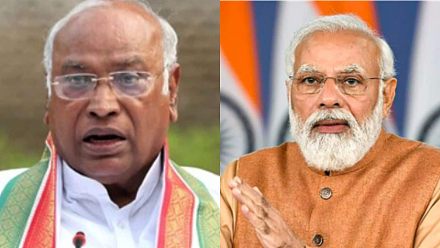
'Maut Ka Saudagar', 'Neech': 7 Times Congress Shot Itself In The Foot Calling Modi Names - A Timeline
The row over Congress president Mallikarjun Kharge’s latest ‘Modi ka baap bhi jayega’ remark has yet again put the party’s choice of words under scrutiny. From Mani Shankar Aiyar’s ‘neech’ jibe to Rahul Gandhi’s ‘Modi su
Ni Pragati Ratti··74K nabasa
'Maut Ka Saudagar', 'Neech': 7 Times Congress Shot Itself In The Foot Calling Modi Names - A Timeline
The row over Congress president Mallikarjun Kharge’s latest ‘Modi ka baap bhi jayega’ remark has yet again put the party’s choice of words under scrutiny. From Mani Shankar Aiyar’s ‘neech’ jibe to Rahul Gandhi’s ‘Modi surname’ barb, there have been several personal attacks on PM Narendra Modi by Congress leaders over the years.
The Congress and the Bharatiya Janata Party (BJP) are locked in another war of words after Congress president Mallikarjun Kharge’s controversial remark, “Modi ka baap bhi jayega”, triggered demands for an apology from the ruling party.
The remark, made in Patna on October 25, came as Kharge was addressing an event marking the 139th birth anniversary of Bihar’s first Chief Minister, Shri Krishna Singh. Kharge had been criticising the BJP-led government over alleged irregularities in electoral rolls and what the Congress calls “vote chori” when an audience member interjected that Prime Minister Narendra Modi would not leave office.
Kharge responded with the controversial line, translated as “Even Modi’s father will have to go”. The BJP condemned the remark, describing it as an example of the Congress’s disrespectful political language and demanding an apology. The exchange has since reignited a familiar debate: when does a political attack stop being criticism of a government and become a personal insult?
For the BJP, such controversies have often offered an opportunity to turn the spotlight on the Congress’s language rather than the allegations it raises against the government. Over the years, several Congress leaders have made remarks about PM Modi that have become defining moments in the political contest between the two parties.
Here is a timeline of some of the most prominent episodes.
2007: Sonia Gandhi’s ‘Maut Ka Saudagar’
The roots of this political pattern go back to Gujarat. During the 2007 Assembly election campaign, then Congress president Sonia Gandhi described Modi, who was Chief Minister at the time, as “maut ka saudagar” – a merchant of death – in a reference to the 2002 Gujarat riots.
The phrase was intended as a condemnation of Modi’s record. The BJP, however, turned it into a campaign issue, portraying the remark as an insult to Gujarat and its people.
Modi repeatedly invoked the phrase during the campaign, presenting himself as the target of an attack by the Congress leadership. The BJP returned to power in Gujarat, although no single remark can explain an election outcome.
2014: The ‘chaiwala’ jibe
As Modi emerged as the BJP’s prime ministerial candidate in 2014, his humble origins became a central part of his political narrative. At a Congress event, Mani Shankar Aiyar mocked the prospect of Modi becoming Prime Minister, suggesting that he could sell tea at a Congress gathering. The remark was widely interpreted as a jibe at Modi’s background as a tea seller.
The BJP seized on the comment to portray the Congress as an establishment that looked down on someone who had risen from modest circumstances. Modi used his background to connect with voters and frame the contest as one between a political elite and an outsider.
2017: Aiyar’s ‘neech’ remark
During the Gujarat Assembly election campaign, Aiyar said, “Mujhko lagta hai ki ye aadmi bahut neech kisam ka aadmi hai. Isme koi sabhyata nahi hai. (Modi is a low-level person who lacks civility.)”
The word “neech” acquired particular political significance because it could be interpreted as a personal insult, including an attack on social standing or birth.
Modi responded by invoking his humble background and accusing the Congress of looking down on him. Rahul Gandhi publicly disapproved of Aiyar’s language and asked him to apologise. The Congress suspended Aiyar from its primary membership.
Aiyar subsequently apologised, saying he had intended to criticise Modi’s conduct rather than his caste or birth. The controversy, however, had already become a major talking point during the campaign.
2019: Rahul Gandhi’s ‘Why do all thieves have Modi surname?’
During the 2019 Lok Sabha election campaign, Rahul Gandhi repeatedly used the slogan “Chowkidar chor hai” to attack PM Modi over allegations surrounding the Rafale fighter-jet deal. The Congress alleged wrongdoing and demanded answers from the government, while the BJP denied the allegations.
At a rally in Kolar, Karnataka, Rahul asked, “Why do all thieves, be it Nirav Modi, Lalit Modi or Narendra Modi, have Modi in their names?”
The remark prompted BJP MLA Purnesh Modi to file a criminal defamation case. In March 2023, a Surat court convicted Rahul Gandhi and sentenced him to two years in prison, triggering his disqualification from the Lok Sabha. The Supreme Court stayed the conviction in August 2023, paving the way for the restoration of his parliamentary membership.
2022: Kharge’s ‘Ravan with 100 heads’
During the Gujarat Assembly election campaign in November 2022, Kharge criticised the BJP for seeking votes in Modi’s name even when local candidates were contesting elections.
At a rally in Ahmedabad, he asked: “How many times shall we see your face? Are you Ravan with 100 heads?”
Kharge’s argument was that the BJP relied excessively on Modi’s personal popularity rather than the performance of its candidates. But the reference to Ravana, the antagonist of the Ramayana, gave the BJP an opening to portray the remark as an insult to the Prime Minister.
Once again, the debate over the Congress’s campaign strategy was overtaken by a controversy over its president’s choice of words.
2023: The ‘poisonous snake’ comparison
In April 2023, while campaigning in Karnataka ahead of the Assembly election, Kharge said, “Don’t make a mistake. Modi is like a poisonous snake.” The BJP condemned the comparison. Kharge subsequently clarified that his remarks were directed at the BJP’s ideology rather than Modi personally.
The clarification did not prevent the remark from becoming a political flashpoint. The BJP cited it as another example of the Congress crossing the line between criticism of a political opponent and personal attacks.
Can Congress Keep The Focus On Its Issues?
The latest controversy over Kharge’s ‘Modi ka baap’ remark has brought this recurring problem back into focus. The Congress has raised substantive questions about employment, economic performance, social harmony, electoral processes and institutional accountability. Yet, on several occasions, controversial remarks by its leaders have competed with those issues for public attention.
The BJP has used these episodes to portray the Congress as disrespectful towards Modi, while Congress leaders have argued that their statements are intended to challenge the BJP’s politics and governance.
In a political contest where every statement can become a campaign weapon, the distinction between a forceful attack and a damaging personal barb can prove consequential.