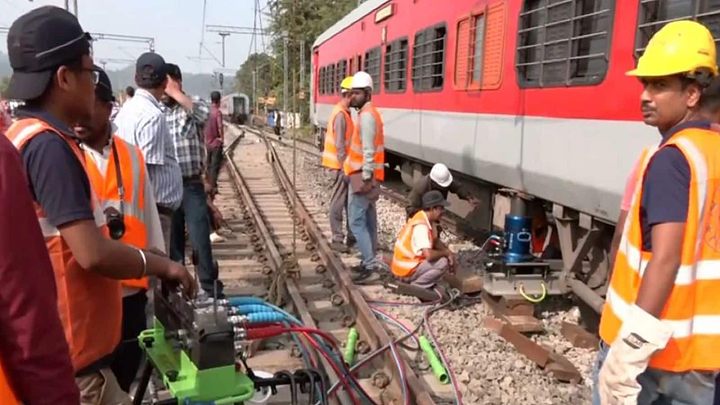
The Kolkata-Sairang Express reported a brake-binding problem before its locomotive and five coaches derailed at Digaru railway station in Assam on November 11. The train had been stopped at an intermediate station for ar
The Kolkata-Sairang Express reported a brake-binding problem before its locomotive and five coaches derailed at Digaru railway station in Assam on November 11. The train had been stopped at an intermediate station for around 20 minutes to examine the problem before being allowed to continue its journey.
A joint inspection report prepared after the accident has now raised questions about the locomotive’s braking system. It points to a possible failure of the brakes and records that an angle cock at the rear of the locomotive was found in an isolated condition. It reads, “LP have applied brakes but the brakes may not have applied as the angle cock was in closed condition previously.”
“Departmental investigation process regarding the entire incident is in progress. All aspects are being looked into in detail. It would not be proper to make any premature conclusions at the moment,” said KK Sharma, CPRO, Northeast Frontier Railway.
The findings are important because it will give clarity on what went wrong. The accident occurred while the train was entering Digaru station at around 6:54 am. It was being received on a loop line to give precedence to another train when it overshot the dead-end stop board and derailed.
The Northeast Frontier Railway had initially attributed the accident to the loco pilot’s inability to control the train’s speed. However, the joint inspection report has brought the train’s braking performance into focus.
Train Reported Brake Problem Before Reaching Digaru
According to the joint inspection report, the Kolkata-Sairang Express, numbered 13125, encountered a brake-binding problem involving power car during its journey. The train was stopped at Panbari station at around 6:16 am. It remained there for approximately 20 minutes while railway staff examined the reported problem.
The train resumed its journey at around 6:46 am and proceeded towards Digaru.
It reached Digaru station at approximately 6:54 am. The train was routed through Loop Line No. 1. It then overshot the dead-end stop board and the locomotive and five coaches derailed.
What Happened At Digaru Station?
The accident took place in Assam’s Kamrup Metropolitan district, around 44 km from Guwahati.
The Kolkata-Sairang Express was travelling from Kolkata to Sairang in Mizoram. According to the Northeast Frontier Railway, the train was being received at Digaru to give precedence to another train.
The locomotive and five passenger coaches derailed as the train entered the station.
Initial statements from the railway said all passengers were safe and no injuries had been reported. However, subsequent reports mentioned passengers sustaining injuries.
The derailment disrupted train movement on both main lines. Railway teams subsequently restored normal operations after carrying out restoration work.
Joint Inspection Points To Possible Brake Failure
The joint inspection team examined the locomotive, derailed coaches, track, signalling equipment and available technical records.
The locomotive involved in the accident was WAP-7 number 34631.
One of the key observations concerns the FP/OP angle cock at the rear of the locomotive. The inspection team found it in an isolated or closed condition.
The report says the brakes may not have applied because this angle cock was in an isolated condition. It also considers the possibility that the locomotive brakes were applied but did not function effectively because the angle cock had already been isolated. Interestingly, a video purportedly showing the train staff trying to stop the train before the dead-end indicated the same. However, the authenticity of the video was not confirmed by the officials.
The inspection does not establish when or how the angle cock came to be isolated.
The report also records that the front and rear angle cocks of several affected coaches were found in an open condition.
Loco Pilot Describes Attempts To Apply Brakes
The statement of loco pilot Manish Kumar, included in the inspection provides an account of the events inside the locomotive before the accident.
He describes a brake-binding problem during the journey and says the assistant loco pilot examined the affected power car.
His statement also refers to attempts to control the train’s speed while approaching Digaru.
According to his account, the crew tried to apply the train brakes and reduce speed. He describes attempts to use different braking controls, including the emergency brake. However, the required braking response was not achieved.
Several questions remain unanswered
The findings have raised questions about the handling of the brake-binding complaint before the train reached Digaru. Experts tell that the role of the locomotive crew and the procedures followed during the train’s detention will be examined. They explain that the joint inspection report provides preliminary technical observations. It does not establish the final cause of the accident or fix responsibility.
Northeast Frontier Railway was approached for a comment on possibilities of brake failure in the incident. But till the time this report was filed, we could not get an answer.