Kolkata’s Chorbagan Durga Puja Pandal Stampede: 'Tech'tics To Handle Crowds
In the wake of the tragic stampede at Kolkata’s Chorbagan Sarbojanin Durga Puja pandal, which claimed 19 lives and injured 25 others, mitigating festival risks requires a strict blend of physical architectural redesign a
Ni Manjiri Joshi··53K nabasa
Kolkata’s Chorbagan Durga Puja Pandal Stampede: 'Tech'tics To Handle Crowds
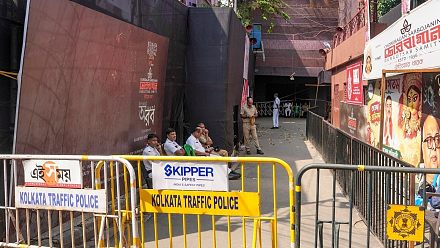
In the wake of the tragic stampede at Kolkata’s Chorbagan Sarbojanin Durga Puja pandal, which claimed 19 lives and injured 25 others, mitigating festival risks requires a strict blend of physical architectural redesign and real-time tech intervention.
Technology alone cannot stop a pandal stampede, especially when extreme weather, narrow urban lanes, and sudden rushes converge, but can help handle the crowd better, say experts.
LESSONS FROM THE CHORBAGAN PANDAL TRAGEDY
The October 2026 stampede exposed how urban festival infrastructure buckles under pressure:
Sudden, heavy rainfall triggered a frantic rush of hundreds of visitors diving under the covered pandal structure for shelter. Investigators noted a reliance on restrictive zig-zag single-chute entryways and a lack of clear, illuminated emergency exits.
Overcrowding swelled past safe density limits (often exceeding 7–8 persons per square meter against the international safety norm of max 4) while security personnel were heavily concentrated near VIP zones.
THE TECH AND SAFETY STACK DURGA PUJA PANDALS NEED
To prevent similar cascading failures, local committees and municipal bodies must deploy a synchronized framework of digital tools and physical rules:
Real-Time Density Tracking: AI Video Analytics, & Computer Vision (CV) & People Counters
Feeds live CCTV feeds into computer vision models to count heads per square meter and trigger automated red-alerts in the control room before density crosses 4–5 persons/sqm. Used during the 2025 Maha Kumbh Mela with 500 AI-enabled cameras to map density.
Linked weather sensors or manual command overrides that automatically halt new entries and trigger public address announcements the moment a heavy downpour starts, routing people to open-air safe zones.
Wide, multi-gate architecture (separate dedicated entry, exit, and emergency corridors at least 3–3.5m wide) using heavy-duty Q-managers like Moglix Safety Barriers to eliminate 90-degree trapping corners.
Emergency Communication: Decentralized PA & SMS Alerts
Synchronized speakers every 300 meters and integration with state disaster warning systems like the National Disaster Management Authority SACHET App to broadcast calm, multilingual instructions during a surge.
Anomaly & Flow Tracking: Algorithms evaluate movement vectors
They look for flow reversals, sudden clustering, bottleneck formations, or fallen individuals rather than just headcount. Implemented by Indian Railways to manage platform chokepoints and passenger flow.
It maps the “heat” and size of large outdoor crowds that ground cameras miss due to blind spots. Deployed across major mass festivals like the Puri Rath Yatra and Amarnath Yatra.
WHY SMART SYSTEMS STILL FAIL: THE PHYSICS OF A SURGE
India’s crowd dynamics present unique hazards that frequently push modern software past its algorithmic limits:
Environmental Degradation: High-density outdoor surges, seasonal monsoons, and poor night-time lighting cause severe hardware and software degradation. Heavy rain blocks vision sensors, and dense crowds obstruct camera viewing angles, rendering head-counting algorithms highly inaccurate.
The “Impression” vs. Action Gap: The primary test of an AI system is not how many cameras are installed, but whether an alert translates into swift physical execution. At the 2025 Maha Kumbh Mela, despite AI systems estimating crowd density with 90-95% precision, tragedies still occurred due to institutional resistance to automated risk warnings and a lack of immediate crowd diversion.
Structural Bottlenecks: No amount of software can fix fundamental design flaws. If an event features narrow exits, improperly positioned structural barricades, or a lack of clear evacuation paths, the crowd remains structurally trapped even if an alert is triggered instantly.
INDIA’S PATH TO CROWD SAFETY
For technology to successfully mitigate disasters, Indian municipal authorities and event organisers must pivot from simple “observation” to a Common Operating Framework. This requires connecting AI video analytics directly to automated public address systems, multilingual mobile alerts (like the SACHET App), and localized digital signage to guide panic-stricken crowds smoothly before conditions reach a critical threshold.