Kashmir's Autumn Of Contrasts: When Golden Leaves, Flowers And Gunfire Share The Landscape
It is that time of the year when Kashmir begins to change its colours. The lush green landscape of summer slowly gives way to shades of yellow, bronze, scarlet and gold. Chinar trees shed their leaves, maple canopies tur
Ni Ieshan Wani··124K nabasa
Kashmir's Autumn Of Contrasts: When Golden Leaves, Flowers And Gunfire Share The Landscape
It is that time of the year when Kashmir begins to change its colours. The lush green landscape of summer slowly gives way to shades of yellow, bronze, scarlet and gold. Chinar trees shed their leaves, maple canopies turn amber, and pathways across the Valley become carpeted with foliage.
For many, autumn is among the most beautiful seasons in Kashmir – a brief but spectacular transition between the warmth of summer and the harshness of winter.
But this year, the season has offered a reminder of the contrasts that have long defined life in the Valley. On Wednesday, November 11, autumn’s golden landscape in south Kashmir’s Kulgam district became a witness to gunfire and chaos.
Near a chinar tree, militants opened fire on a CRPF checkpoint in the Akhran area near Mir Bazar, injuring three personnel. The attackers escaped through poplar trees, which had turned yellow, prompting a search operation by security forces.
The incident unfolded against a landscape where golden maple leaves were scattered across the ground. The contrast was striking: a season usually associated with tranquility, photography and the changing colours of nature suddenly interrupted by violence. It was a jarring reminder that Kashmir’s landscape can be breathtaking even as the realities unfolding within it remain complicated.
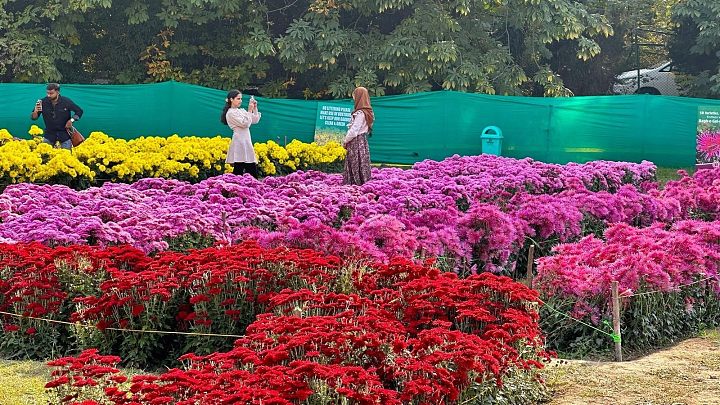
The changing colours are now being accompanied by another attraction. Kashmir’s autumn, traditionally defined by its chinar foliage, is acquiring a floral identity of its own with the emergence of Bagh-e-Gul-e-Dawood, the chrysanthemum-themed garden at the Nehru Memorial Botanical Garden in Srinagar.
The garden, which opened for its second season in October, is an attempt by the department of floriculture to give autumn the kind of floral identity that spring enjoys with its famous tulip garden. This year’s display is considerably larger.
Around 3.5 lakh chrysanthemum plants have been arranged, producing an estimated 1.2 crore flowers across more than 70 varieties. Spread over nearly 100 kanal, the garden has been expanded with landscaped flower beds, colourful displays, water features and designated visitor spaces. The flowers, in shades of yellow, red, pink and purple, have transformed the landscape into a spectacle that is markedly different from the familiar autumn scenery of Kashmir.
Director floriculture Mathoora Masoom has described the chrysanthemum project as an effort to ensure that no season in Kashmir is without a distinctive floral attraction. (Image: News18)
Director floriculture Mathoora Masoom has described the project as an effort to ensure that no season in Kashmir is without a distinctive floral attraction. The blooms are expected to last until early December, potentially surviving even a light snowfall. The idea is to establish a seasonal calendar for Kashmir’s tourism, with tulips defining spring and chrysanthemums becoming synonymous with autumn.
The change in the season is particularly visible at the historic gardens of Srinagar. At Nishat Bagh and Shalimar Bagh, the autumn colours create a setting that is difficult to replicate at any other time of the year. Built during the Mughal period, these gardens were designed around the relationship between water, architecture and the natural landscape.
Nishat Bagh, established in 1633 by Asif Khan, stands along the eastern banks of Dal Lake with the Zabarwan Mountains providing its backdrop. Its twelve terraces, lined with chinar and cypress trees, descend toward the lake.
Shalimar Bagh, meanwhile, was commissioned by Jahangir in 1619 for his wife Nur Jahan. Its cascading water channels, fountains, pavilions and towering chinar trees have made it one of Srinagar’s most recognisable historical landscapes.
Hundreds of tourists visit these gardens each year and, in autumn, they acquire a different character. The green canopy gives way to shades of rust, orange, red, and gold. Fallen leaves gather along pathways, while the water channels and old stone structures offer a striking contrast to the changing foliage.
The UNESCO tentative nomination for the Mughal gardens of Kashmir describes this seasonal transformation as one of their distinctive ecological and aesthetic qualities, with the foliage moving from the greens of summer to the warm tones of autumn before becoming stark and subdued in winter.
Further ahead, Harwan offers another experience of the season. Unlike the formal symmetry of the Mughal gardens, its appeal lies in its natural setting, expansive lawns, flower beds, and a canal bordered by chinar trees. Located on the outskirts of Srinagar, it is also a gateway to the Dachigam Wildlife Sanctuary.
The UNESCO tentative nomination for the Mughal gardens of Kashmir describes this seasonal transformation as one of their distinctive ecological and aesthetic qualities, with the foliage moving from the greens of summer to the warm tones of autumn. (Image: News18)
Together, these gardens offer different ways of experiencing the same season – from the carefully designed terraces of the Mughals to the more open, natural landscape of Harwan. For Kashmir’s tourism industry, the emergence of the chrysanthemum garden could also be significant.
For years, the Valley’s tourism calendar has largely revolved around spring tulips, summer holidays and winter snowfall. Autumn, despite its extraordinary natural beauty, has not always enjoyed the same organised floral attraction or visibility.
The new garden is an attempt to change that. By introducing a large-scale floral attraction when most seasonal flowers have disappeared, the administration hopes to encourage visitors to explore Kashmir beyond its conventional tourist seasons.
There is also something distinctive about the timing. The chrysanthemum blooms coincide with the period when chinars and maples shed, allowing visitors to experience two different expressions of autumn in the same landscape.
But Kashmir’s autumn is not merely a story of tourism, flowers and changing foliage. It is also a season of transition, when the days grow shorter, temperatures fall and the Valley prepares for winter. The first snowfall in the higher reaches signals the approaching end of the colourful season.
And this year, the contrast has been particularly stark. While visitors walk through gardens photographing flowers and golden leaves, the gunfire in Kulgam has brought back the uncomfortable reality that beauty and violence can occupy the same landscape.
The leaves will eventually fall, the flowers will fade and winter will settle over the Valley. But for a few weeks every year, Kashmir offers a landscape unlike any other – one where history, nature and the changing seasons come together.