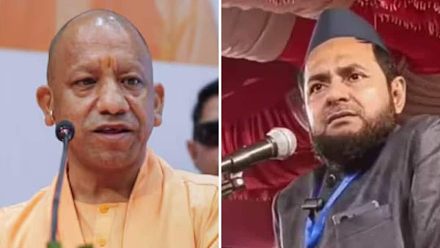
‘If Yogi Adityanath Government Returns…’: Maulana Jarjis Ansari's Remarks Trigger Political Row In UP
A controversial speech by Maulana Jarjis Ansari, delivered at a gathering in Auraiya on October 29, has triggered a political and religious row in Uttar Pradesh after he warned that “Muslim houses could be burnt and bull
Ni Oliver Fredrick··170K nabasa
‘If Yogi Adityanath Government Returns…’: Maulana Jarjis Ansari's Remarks Trigger Political Row In UP
A controversial speech by Maulana Jarjis Ansari, delivered at a gathering in Auraiya on October 29, has triggered a political and religious row in Uttar Pradesh after he warned that “Muslim houses could be burnt and bulldozers deployed if the Yogi Adityanath-led Bharatiya Janata Party (BJP) government returned to power.
Invoking the situation in Palestine and the 2002 Gujarat riots, the Maulana appealed to Muslims to overcome their differences and unite politically, arguing that the community should not allow the BJP to return to power in the 2027 Assembly elections.
A video of his speech surfaced on social media on November 2, drawing sharp reactions from the BJP, opposition parties and religious leaders. While the BJP accused him of deliberately creating fear among Muslims and attempting to provoke communal sentiments, the Samajwadi Party (SP) sought to distance itself from his specific remarks but used the controversy to attack the state government over alleged one-sided action.
THE SPEECH
In his address, Jarjis claimed that Muslims in Uttar Pradesh were living under an atmosphere of fear and apprehension. Referring to the possibility of the present government returning to power, he said people feared that their houses would be demolished and bulldozers deployed.
He warned that if the government returned, Muslim homes could be set on fire and demolished. He also urged the community not to remain divided, arguing that political disunity could benefit its opponents.
The Maulana invoked Palestine as a warning, asking Muslims to consider the situation there and cautioning against allowing Uttar Pradesh to reach a similar situation.
He argued that Muslims needed to unite and stand together politically, insisting that the BJP government should not return to power.
Referring to West Bengal, he claimed that divisions within the Muslim community had resulted in political setbacks and urged people in Uttar Pradesh not to repeat what he described as mistakes made there.
He also referred to the 2002 Gujarat riots, invoking the brutal violence against Muslims, including accounts of pregnant women being attacked during the communal violence.
The Gujarat riots followed the burning of the Sabarmati Express at Godhra on February 27, 2002, in which 59 people were killed. The subsequent communal violence claimed numerous lives, with Muslims forming the majority of the victims. Human Rights Watch documented killings, sexual violence and attacks on women during the riots.
Jarjis also referred to the Citizens for Justice and Peace (CJP) protest at Jantar Mantar, describing it as a development that had helped him by diverting attention from the controversy surrounding his earlier remarks.
BJP ACCUSES MAULANA OF SPREADING FEAR
The BJP strongly criticised the speech, accusing Jarjis of attempting to create insecurity among Muslims and exploit religious sentiments ahead of the Assembly elections.
BJP leaders alleged that the Maulana was deliberately invoking Palestine and the possibility of bulldozer action to polarise voters. The party also sought to link his remarks with the opposition, alleging that such statements were aimed at benefiting the Samajwadi Party and Congress.
The BJP maintained that the remarks were an attempt to spread fear rather than raise any genuine issue concerning the community.
WHAT SP SAID
The Samajwadi Party sought to avoid directly endorsing or rejecting the Maulana’s remarks, with party spokesperson Deepak Ranjan describing them as possibly his personal opinion.
“Maulana kya keh rahe hain aur kya nahi keh rahe hain, is par main nahi jaana chahta. Yeh unka vyaktigat bayan ho sakta hai,” Ranjan said.
However, he used the opportunity to target the Yogi Adityanath government, alleging that Uttar Pradesh was being run by an authoritarian administration that resorted to one-sided action against people.
“Aaj Uttar Pradesh mein atyachari aur tanashahi sarkar chal rahi hai, jo logon ko ek hi chashme se dekhti hai aur ek tarfa karwai karti hai,” he said.
WHAT MUSLIM COMMUNITY SAID
Interestingly, the Maulana’s remarks have also drawn strong criticism from within the Muslim religious establishment, with several prominent clerics questioning his comparison between Uttar Pradesh and Palestine.
Maulana Saif Abbas Naqvi, chairman of the Shia Chand Committee, accused Jarjis of repeatedly making controversial statements to remain in the public eye.
“The Maulvi Sahib always comes up with controversial statements, and he wants to stay in the media by giving these controversial statements,” Naqvi said.
Rejecting the suggestion that Muslims in Uttar Pradesh were living in fear, he said: “If a Muslim is scared, then he fears only Allah, nobody else.”
Criticising the Palestine reference, Naqvi said such comparisons were regrettable because India was governed by its Constitution and laws. Maulana Shahabuddin Razvi Barelvi, national president of the All India Muslim Jamaat, also strongly condemned the remarks. “The things that Maulana Jarjis has said are utterly reprehensible. I strongly condemn them,” he said.
“The residents of Uttar Pradesh will never allow Uttar Pradesh to become Palestine. Not just Uttar Pradesh, but no part of India can become Palestine, because the Constitution is in force here,” Razvi added.
He alleged that the remarks were intended to create fear among Muslims and demanded government intervention and legal action.
Another Islamic scholar, Mohammad Jameel Hayat, urged Jarjis to exercise restraint, saying that such comments were inappropriate for the prevailing political atmosphere in Uttar Pradesh.
Mufti Intizab Qadri of Moradabad also questioned the suggestion that Muslims were living in fear in the state.
“If Maulana Jarjis himself is scared, I cannot say anything about that, but I do not see Muslims in Uttar Pradesh or the country living in fear,” he said.
He also objected to comparing the situation of Indian Muslims with that of Palestinians, arguing that such statements could create tensions between the communities.
AYODHYA MAHANT REACTS
The remarks also drew a sharp reaction from Mahant Vishnu Das of Ayodhya, who accused Jarjis of attempting to provoke Muslims by repeatedly invoking Palestine.
Vishnu Das said: “Maulana Jarjis Ansari is only trying to provoke Muslims. He is their enemy and is only frightening them.”
He demanded action against the Maulana and alleged that his statements could disturb communal harmony.
NOT THE FIRST TIME
This is not the first time that Jarjis Ansari has found himself at the centre of a controversy over his religious and political statements.
In July this year, his remarks concerning Hindu deities Lord Krishna and Lord Ram triggered widespread criticism. He reportedly described Lord Krishna as a person who offered namaz five times a day and linked the teachings of Hindu deities with Islam.
His earlier statements concerning Muslims shifting to West Bengal had also drawn criticism.
The controversy comes as Uttar Pradesh gradually moves towards the 2027 Assembly elections, with issues of law and order, minority security, bulldozer action and communal polarisation likely to remain part of the political debate.
For the BJP, the controversy offers an opportunity to question the opposition’s political positioning and accuse its rivals of encouraging divisive rhetoric. The SP, meanwhile, has sought to maintain distance from the Maulana’s individual statement while continuing its criticism of the state government’s administrative actions.