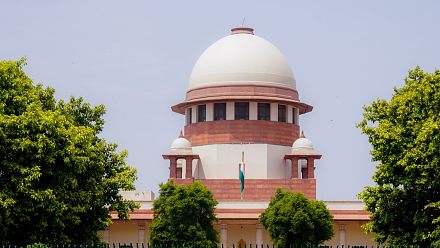
'Have To Draw A Line Somewhere': On Leniency To Death Row Convicts, SC Says 'Forgiving Nature Must End'
The Supreme Court has questioned its approach to commuting death sentences to life imprisonment, with Justice Dipankar Datta observing that the judiciary’s “forgiving nature” must come to an end somewhere as he raised co
Ni Apoorva Misra··47K nabasa
'Have To Draw A Line Somewhere': On Leniency To Death Row Convicts, SC Says 'Forgiving Nature Must End'
The Supreme Court has questioned its approach to commuting death sentences to life imprisonment, with Justice Dipankar Datta observing that the judiciary’s “forgiving nature” must come to an end somewhere as he raised concerns over the changing nature of crime in the country.
Bar and Bench reported that a bench of Justices Dipankar Datta and Sheel Nagu made the observations on Thursday while hearing a plea seeking premature release filed by a convict whose death sentence had earlier been commuted to life imprisonment.
“Times have changed. In earlier days, murder leading to death (sentence) was on the basis of rarest of rare cases, because murders were rare. Is it the same now? Now murder is not a rare (offence),” Justice Datta observed.
The judge also referred to a previous case in which the Supreme Court had commuted a death sentence, only for the convict to commit another murder after being released on parole.
“It is because of our forgiving nature that India is facing these problems. Forgive, forgive, forgive, you have to draw a line somewhere,” Justice Datta said, questioning whether the court’s approach to granting relief in serious criminal cases needed to be reconsidered.
The remarks came during proceedings concerning Sanjeev Kumar, who is serving a life sentence after his death penalty was commuted by the Supreme Court in 2014 on account of delays in deciding his mercy petition. The court has reserved its verdict in the current case.
The Case That Prompted The Supreme Court’s Remarks
During the hearing, Justice Datta recalled a case involving a man who had been convicted of raping and murdering his elder daughter. The man was sentenced to life imprisonment based on the testimony of the children’s mother.
After being released on parole, the man murdered his wife in front of their younger daughter, Justice Datta recounted. The younger daughter’s testimony subsequently led to the man being sentenced to death. However, the Supreme Court later commuted that death sentence to life imprisonment on the ground that the man had not murdered the younger daughter.
Justice Datta cited the case to illustrate his concerns about the consequences of commuting death sentences in particularly grave criminal cases.
Who Is Sanjeev Kumar And Why Is He Seeking Premature Release?
The case before the bench concerns Sanjeev Kumar, who was convicted of multiple murders and sentenced to death in May 2004.
The Punjab and Haryana High Court initially commuted his death sentence to life imprisonment in 2005. The Supreme Court reversed that decision in 2007 and restored the death penalty.
After the Governor and the President rejected his mercy petitions, Kumar again approached the Supreme Court. In January 2014, the court commuted his death sentence to life imprisonment because of delays in deciding his mercy plea. After completing 20 years of his actual sentence, Kumar applied for premature release under Haryana’s 2002 remission policy.
In August 2024, the state government rejected his application and directed that he remain in prison for the rest of his life. Authorities cited his conduct in prison, including an attempted escape by digging a tunnel in 2008 and an instance of absconding from furlough for nearly three years. They also pointed out that his death sentence had been commuted on procedural grounds rather than on the merits of the case.
Kumar challenged the decision before the Punjab and Haryana High Court. In December 2025, the high court set aside the state’s order, holding that the authorities could not rely on misconduct falling outside the prescribed five-year period preceding the premature-release application. It directed the state to reconsider his case and granted him interim bail.
The state subsequently challenged the high court’s decision before the Supreme Court, bringing the matter before the bench of Justices Datta and Nagu.
What Is The ‘Rarest Of Rare’ Doctrine?
The Supreme Court’s observations also bring renewed attention to the legal framework governing the death penalty in India.
Under the ‘rarest of rare’ doctrine, established by the Supreme Court in the landmark Bachan Singh v State of Punjab judgment in 1980, capital punishment is to be imposed only in the most exceptional cases. Courts must consider the circumstances of the crime as well as mitigating factors relating to the convict before deciding whether a death sentence is warranted.
The doctrine seeks to ensure that the death penalty is not imposed routinely, even in cases involving grave crimes.
The process of commuting a death sentence is distinct from the decision to impose capital punishment in the first place. A sentence may be commuted in appropriate circumstances, including delays in deciding mercy petitions, as recognised in Supreme Court judgments.