Festive Homecoming Gets Costlier: Families Forced To Cancel, Squeeze Plans As Airfares Skyrocket
For millions of Indians who leave their hometowns for jobs in Delhi-NCR, Mumbai, Bengaluru, Hyderabad and other Tier-1 cities, the festive season is often the one time of the year when the distance between work and home
Ni Pragati Ratti··68K nabasa
Festive Homecoming Gets Costlier: Families Forced To Cancel, Squeeze Plans As Airfares Skyrocket
For millions of Indians who leave their hometowns for jobs in Delhi-NCR, Mumbai, Bengaluru, Hyderabad and other Tier-1 cities, the festive season is often the one time of the year when the distance between work and home feels less painful.
Durga Puja, Diwali and Chhath are not just holidays. They are the annual homecoming, a few days of family, familiar food, old friends and celebrations that make living away from home worthwhile.
But this year, getting home is becoming an expensive proposition. Domestic airfares on several key routes have shot up sharply ahead of the festive season, with some routes witnessing increases of more than 50 per cent year-on-year. According to a report in The Economic Times, average one-way fares between September 1 and November 10 were up 68 per cent on Delhi-Hyderabad, 51 per cent on Mumbai-Kolkata, 39 per cent on Delhi-Goa and 37 per cent on Mumbai-Bengaluru.
IndiGo, India’s largest airline, has announced a price hike on October 5, saying the increased will apply to all new bookings made from October 6. IndiGo said the latest month-on-month increase in fuel prices has exceeded 14 per cent, taking ATF costs to among their highest levels in the past decade.
IndiGo passengers flying up to 500 km will now be paying a fuel charge of Rs 375. For flights between 501 km and 1,000 km, the charge will be Rs 600, while journeys between 1,001 km and 1,500 km will attract a charge of Rs 900.
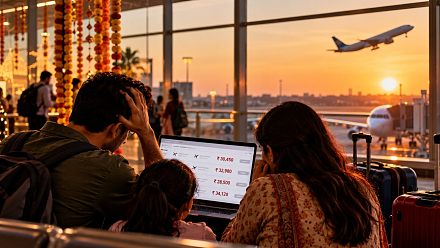
For people whose hometowns are a flight away from the cities where they work, the festive premium can turn a routine annual journey into a major financial decision. And for families travelling together, the maths gets even more painful.
‘A Thailand Trip On That Budget’: Why Some Are Cancelling Plans
For Prashant Pramod (name changed), a media professional based in Noida, this was supposed to be the first festive homecoming for his family since Covid. But the numbers changed the plan.
“Flight tickets from Delhi to Darbhanga (or other busy airports in Bihar) usually skyrocket before Diwali (from Delhi) and post Chhath Puja (to Delhi). This year though the increase appears to be higher than previous years,” Pramod told News18.
The difference is substantial. According to him, a round trip for a family of three around the Diwali-Chhath period is now costing more than Rs 90,000. “A round trip for a family of three around the Diwali and Chhath Puja period costs over Rs 90,000 as on date. One can do a Thailand trip on that budget,” he said.
The comparison captures the dilemma facing many urban professionals: spend tens of thousands of rupees simply to get home for a few days, or postpone the trip and wait for fares to return to normal.
Pramod’s family eventually chose the latter. “We had to cancel our plans to travel home by air as the cost for the to and fro journey became too high to bear, almost making it unfeasible considering the already high cost of living,” he said.
The contrast becomes even starker outside the festive window. Pramod said the same round trip a week after the festive season could cost around Rs 40,000-45,000. That is a difference of nearly Rs 50,000 simply for travelling around the dates when families actually want to be together.
Early Planners Feeling The Pinch Too
For Rusha Hazra, a marketing professional based in Noida, skipping the festive journey was not an option. Kolkata is home, and Durga Puja is an annual ritual.
She did what most frequent travellers are advised to do: book early.
But even booking almost two months in advance did not protect her from the festive surge. “Although I booked my tickets almost two months in advance, the fares were still quite high. On top of that, there was a festive premium because my travel dates were close to the festive period. I ended up paying almost 80 per cent more than what I would normally pay for the same flight,” Hazra told News18.
The fare spike has also forced her to plan around the ticket price rather than around family convenience. “I had to plan my travel date and time around the most affordable fare I could find,” she said.
And waiting until the celebrations are over does not necessarily offer immediate relief. “Even after the festive period ends, the fares don’t come down for another five days. I tried pushing my return date to see if I could get a somewhat normal fare, but the pricing…what can I say!” she added.
What’s Leading To Higher Airfares This Festive Season?
The festive airfare surge is being driven by a combination of strong demand, constrained capacity and higher operating costs, according to Jainam Shah, Aviation Analyst at Equirus Securities.
“Historically festive periods have always seen higher airfares. However, the overall fare base is already higher than last year due to elevated fuel costs. On top of this, limited capacity and strong festive demand are pushing fares significantly higher on popular routes,” Shah told News18.
Durga Puja, Diwali and Chhath compress a huge wave of travel demand into a relatively narrow window, with millions of people trying to return to their hometowns and then head back to the cities where they work. At the same time, passengers do not have unlimited flight options on several popular routes. This creates a supply-demand imbalance, driving prices up.
And unlike a purely seasonal spike, this year’s festive fares are starting from a higher base. Domestic aviation turbine fuel (ATF) prices rose by Rs 16 per litre from October 1, reaching around Rs 137 per litre, after increases in August and September. Fuel is one of the biggest expenses for airlines and accounts for roughly 30-40% of their operating costs.
The West Asia crisis has added another layer of uncertainty to global energy markets, while airlines also remain exposed to other dollar-linked costs such as aircraft leases and maintenance.
Shah, however, believes travellers should distinguish between the temporary festive premium and the more structural increase in the cost of flying. “Fares should normalise once the festive peak is over, so the current festive premium is unlikely to sustain,” he said.
But that does not necessarily mean tickets will return to last year’s levels. “The portion of the fare increase driven by higher fuel costs will remain, which means fares could continue to be around 20–25 per cent higher than the base year, as is currently the case,” Shah added.
That could offer some relief to travellers willing to postpone their journeys, but it also means the era of significantly cheaper domestic flying may not immediately return once Diwali and Chhath are over.
Airlines also face dollar-denominated expenses such as aircraft leases and maintenance, making them vulnerable to currency movements as well.
However, for families already dealing with rent, school fees, EMIs and the rising cost of everyday life in India’s biggest cities, a Rs 50,000-90,000 airfare bill can force an uncomfortable choice between tradition and finances. That means the annual festive homecoming, once treated as non-negotiable, is increasingly becoming a luxury.