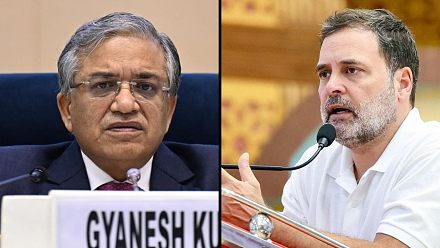
The Election Commission of India has pushed back against allegations made by Congress leader Rahul Gandhi over the use of Form 6 in the voter enrolment process, seeking to clarify what the form is meant for and how appli
The Election Commission of India has pushed back against allegations made by Congress leader Rahul Gandhi over the use of Form 6 in the voter enrolment process, seeking to clarify what the form is meant for and how applications are processed.
Gandhi has repeatedly raised questions over the addition of voters and alleged irregularities in electoral rolls, particularly in the context of the Special Intensive Revision (SIR) exercise. His latest claims have brought Form 6, the application used by eligible citizens to seek inclusion of their names in the electoral roll, into focus.
The EC, however, has disputed the interpretation of the process and sought to set the record straight on several points raised by the Congress leader.
What Is Rahul Gandhi’s Form 6 Allegation?
Gandhi has questioned how Form 6 applications could be used to add voters to electoral rolls and has alleged that the process could facilitate the inclusion of ineligible voters.
ALSO READ | ‘Let’s Be Very Clear’: Supreme Court Says It Didn’t Approve Modified Form 6, Asks Who Made Changes
The Congress has argued that the scale of voter additions and the manner in which applications are processed warrant greater scrutiny, particularly in states where the party has flagged discrepancies in electoral rolls.
What Does Form 6 Actually Do?
Form 6 is the prescribed application for a person seeking inclusion of their name in the electoral roll. It can be submitted by eligible citizens who are not already registered as voters.
But filing the form is not, by itself, the final step in enrolment. An application goes through the prescribed verification process before an electoral registration officer takes a decision on whether the applicant meets the eligibility requirements.
What Is The EC’s Response?
The EC called Rahul Gandhi’s claim “misleading” and gave two points:
• The Bihar SIR order was not a unilateral decision by Gyanesh Kumar: The commission said the June 24, 2025, order launching the Bihar SIR was issued with the “unanimous approval of the commission” and was subsequently upheld by the Supreme Court in its May 27, 2026, judgment.
Fact Check
❌The statement made in this post is misleading
✅1) The order for SIR in Bihar issued on 24 June 2025 was issued with the unanimous approval of the Commission. This order has been upheld by the Hon’ble Supreme Court of India in its judgment dated 27 May 2026
✅2) In its Press Note No. 120 dated 26 September 2026, in Point 1(iii), ECI has stated that, "The declaration attached to Form 6 for SIR has been upheld by the Hon’ble Supreme Court."
#ECIFactCheck
— Election Commission of India (@ECISVEEP) October 5, 2026
• The declaration attached to Form 6 for SIR had been upheld by the Supreme Court, according to the EC: The commission referred to its September 26, 2026, Press Note No. 120, specifically Point 1(iii), which said: “The declaration attached to Form 6 for SIR has been upheld by the Hon’ble Supreme Court.”
However, the EC did not directly say “Gyanesh Kumar did not change Form 6” or explain who actually introduced the modified online Form 6. That remains the issue the Supreme Court has now asked the commission to clarify.
The Supreme Court was explicit on Monday as it said: “Any modified Form 6 has not been approved by us. Let’s be clear. When the record is produced, we would like to see who has modified it.”
Why Does Form 6 Matter In The SIR Debate?
Form 6 has assumed greater significance amid the ongoing debate over the Special Intensive Revision of electoral rolls.
ALSO READ | Why Has No Chief Election Commissioner Ever Been Impeached In India & What Does It Actually Take To Remove CEC?
During the revision exercise, the commission has been focusing not only on identifying voters who may need to be removed from rolls but also on ensuring that eligible citizens who were left out can get themselves enrolled.
This is where Form 6 becomes important. People who are eligible to vote but whose names are missing from the electoral roll can use the form to seek inclusion.
The political disagreement, therefore, is not simply over the form itself but over how applications are scrutinised and whether the safeguards are sufficient to prevent wrongful additions.
The exchange between Gandhi and the EC comes amid a broader political confrontation over electoral rolls and the SIR exercise.
While the Congress has alleged that the revision process could result in legitimate voters being excluded and has questioned the addition of voters, the Election Commission has maintained that the exercise is intended to clean up electoral rolls while ensuring that every eligible voter gets an opportunity to be registered.