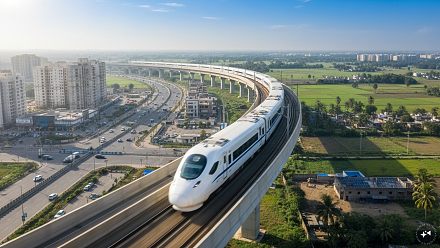
Delhi To Lucknow In 2 Hours, Varanasi In 3.5: UP Travel Map To Change As Bullet Train Corridor Gets Nod
Uttar Pradesh is set to witness a major transformation in intercity connectivity, with the proposed Delhi-Varanasi bullet train corridor expected to bring several important cities of the state a few hours away from the n
Ni Oliver Fredrick··68K nabasa
Delhi To Lucknow In 2 Hours, Varanasi In 3.5: UP Travel Map To Change As Bullet Train Corridor Gets Nod
Uttar Pradesh is set to witness a major transformation in intercity connectivity, with the proposed Delhi-Varanasi bullet train corridor expected to bring several important cities of the state a few hours away from the national capital.
With Prime Minister Narendra Modi approving the proposed corridor, railway minister Ashwini Vaishnaw said the Delhi to Varanasi journey could be completed in approximately three-and-a-half hours.
Vaishnaw made the announcement on Saturday (October 31) while addressing a press interaction, where he said the proposed high-speed rail corridor had received Modi’s approval.
The proposed journey timings indicate the scale of the change. The journey between Delhi and Agra is expected to take only 59 minutes, while Delhi-Kanpur could be completed in approximately an hour and 45 minutes.
The Delhi-Lucknow journey is projected to take around two hours and 12 minutes, significantly reducing travel time between the national capital and Uttar Pradesh’s administrative hub. Further east, the proposed journey between Lucknow and Varanasi is estimated at an hour and 21 minutes, while Varanasi and Prayagraj could be connected in just 33 minutes. The Delhi-Varanasi journey is expected to take approximately 3 hours and 33 minutes, compared with an earlier estimate of 3 hours and 50 minutes.
Varanasi could also be connected with Patna in around one hour, strengthening high-speed connectivity between eastern UP and Bihar. These are projected journey times and not operational train schedules.
The proposed two hours and 12 minutes between Delhi and Lucknow could have significant implications for the state’s administrative, commercial and business ecosystem. At present, travel between the two cities involves several hours by conventional rail, while road journeys depend on traffic and expressway conditions. A high-speed connection could make same-day travel more practical for business meetings, official engagements, court-related work and medical consultations.
The connectivity could also strengthen Lucknow’s position as a regional hub for businesses operating across Uttar Pradesh. Companies could potentially coordinate operations between Delhi and Lucknow with reduced travel time, while professionals and entrepreneurs could have greater flexibility in conducting business across the two cities.
The proposed connectivity between Lucknow, Prayagraj and Varanasi could have wider implications for eastern Uttar Pradesh. The projected 33-minute journey between Varanasi and Prayagraj is particularly significant, considering that both cities are major religious, educational and administrative centres. Faster connectivity could facilitate travel for pilgrims, students, professionals and business travellers.
The proposed one-hour journey between Varanasi and Patna could also strengthen economic and social links between eastern UP and Bihar. People travelling for education, healthcare, business and religious tourism could benefit from improved connectivity.
Varanasi, which has emerged as an important religious tourism destination, could become more accessible to visitors travelling from Delhi and other parts of the country. Faster connectivity could also support hospitality, transport, retail and other tourism-linked businesses.
The corridor could change the way tourists plan visits to Uttar Pradesh. Agra, Ayodhya, Prayagraj and Varanasi are among the state’s prominent tourism and religious destinations. Faster rail connectivity could make multi-city travel more convenient, particularly for visitors coming from Delhi and other parts of the country.
Ayodhya’s inclusion in the proposed corridor is particularly noteworthy given the growth of religious tourism following the inauguration of the Ram temple. Its connectivity with other major destinations could facilitate travel across the state’s religious tourism circuit.
Whereas for Varanasi, the proposed 3-hour-33-minute connection with Delhi could further strengthen its position as a destination for religious tourism, cultural visits and business activity.
Apart from the bullet train corridor, Vaishnaw also spoke about the development of Kashi railway station as a major transport hub. He indicated that the station would be connected with the Namo bridge and developed with facilities on both sides.
The proposed development is aimed at improving passenger movement and strengthening connectivity with northern and northeastern India. He also highlighted the role of Vande Bharat sleeper trains in overnight connectivity between Delhi and Varanasi, offering passengers another option for travelling between the two cities.
However, questions related to the detailed project report, final alignment, station locations, land acquisition, funding, construction schedule and implementation timeline will be crucial in determining when the proposed benefits translate into actual passenger services. The Mumbai-Ahmedabad high-speed rail project, India’s first bullet train corridor, illustrates the scale of execution involved in developing such infrastructure.