'Create Fear In The Minds Of Culprits': SC's 5 Big Observations On Women's Safety In Delhi
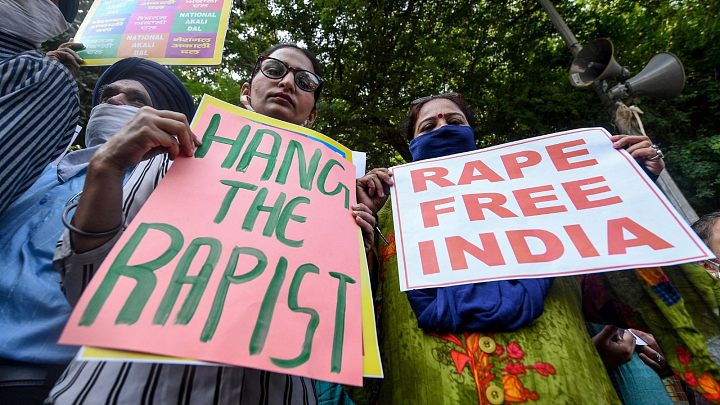
The Supreme Court on Monday said authorities must create such a strong deterrent that those contemplating crimes against women fear the consequences, stressing that merely putting safety measures on paper will not work.
Ni News Desk··88K nabasa
'Create Fear In The Minds Of Culprits': SC's 5 Big Observations On Women's Safety In Delhi
The Supreme Court on Monday said authorities must create such a strong deterrent that those contemplating crimes against women fear the consequences, stressing that merely putting safety measures on paper will not work.
“If you’re not able to create a fright of ‘ab kuch kiya toh marr jaayenge’ in the minds of the hooligans, culprits,” the court observed during the hearing of its suo motu case on recent rape incidents in Delhi-NCR.
The bench led by Justice JB Pardiwala was examining what the Centre and Delhi Police were doing to prevent sexual offences and make public spaces safer for women. The court also questioned whether authorities had a mechanism to continuously monitor vulnerable pockets in Delhi and respond promptly when an incident takes place.
The observations came after the Supreme Court had taken suo motu cognisance of a series of disturbing sexual offences in Delhi-NCR, including the rape of a 17-year-old at Aastha Kunj Park, the rape and murder of a teenage girl in Swaroop Nagar and the sexual assault of a minor inside a moving sleeper bus.
1. ‘Create fear in the minds of culprits’
The court said the policing system must be capable of creating a genuine fear of consequences among those who may be inclined to commit crimes. The bench stressed that deterrence cannot remain merely theoretical. Authorities have to ensure that potential offenders know that committing an offence will result in swift and serious consequences.
“You need to create fear in the mind of a man who is prone to commit a crime. Unless you create fright in the mind of the goon—ab kuch kiya toh marjayenge—you will not be able to prevent it,” Justice Pardiwala said.
The court specifically asked whether there was a mechanism to continuously monitor vulnerable areas and ensure an immediate response. “You need to work at grassroots level. We are in a country like India where putting all this in paper will not work. If you have to be strict, don’t hesitate. There will be people raising a hue and cry about Article 21. Our endeavour is to ensure rape is done away with.”
2. Every woman must feel safe, even at 10pm
The court said the benchmark for public safety should be whether women actually feel secure while moving around Delhi.
“We have to ensure that every woman in NCT Delhi should feel safe whether walking at 10pm or by Metro or road,” the court observed.
The emphasis was therefore not limited to isolated crime-prone locations. The court’s concern extended to everyday mobility—walking on roads, using public transport and travelling through the city after evening hours.
3. ‘Every girl raped or molested is our mother and sister’
During the hearing, the court underlined the human dimension of crimes against women and girls, saying that every girl who is raped or molested should be viewed as part of society’s own family.
The observation came against the backdrop of multiple recent cases involving women and minor girls in Delhi-NCR.
In its earlier order initiating the suo motu proceedings, the Supreme Court had said the recent incidents pointed to a systemic failure by law-enforcement and civil administrative authorities to guarantee basic public safety.
4. ‘You need to work at grassroots level’
The court also stressed that safety cannot be ensured merely through official reports, circulars or measures recorded on paper.
“We are in a country like India where putting all this in paper will not work,” the court said, emphasising the need for authorities to work at the grassroots level.
The court further indicated that officials should not hesitate to take strict measures where required, even if such action attracts objections. The court’s earlier order had similarly directed authorities to examine whether announced safety measures were actually operational on the ground rather than simply existing on paper.
5. ‘Interact with society’, not just review files
The court questioned whether authorities were directly engaging with people to understand safety concerns on the ground. “Today, what is important is one to one interaction with the society. Should you not hold interaction with the public?” the court asked.
The observation puts the focus on local intelligence and feedback from residents, rather than relying exclusively on official assessments of crime-prone areas.
In its September 28 order, the Supreme Court had already sought information on measures covering parks, roads, public transport, markets, educational institutions and other places frequented by women and children.