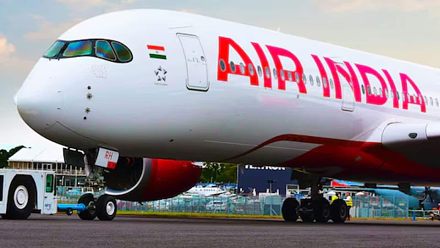
Code 7500 Mystery: Was A Radar Glitch Behind Air India's False Hijack Scare? Probe Underway
A false hijack alert involving an Air India flight from Frankfurt to Delhi on Wednesday triggered a security scare, forcing the aircraft carrying 306 people to divert to Jaipur.
Ni Karishma Jain··67K nabasa
Code 7500 Mystery: Was A Radar Glitch Behind Air India's False Hijack Scare? Probe Underway
A false hijack alert involving an Air India flight from Frankfurt to Delhi on Wednesday triggered a security scare, forcing the aircraft carrying 306 people to divert to Jaipur.
Although the flight was eventually cleared to resume its journey, questions have emerged over what caused the warning when there was reportedly no emergency on board.
Aviation and security agencies have launched an investigation into the incident, with attention turning to a recently installed air traffic control (ATC) radar system in Mumbai.
Mumbai ATC Radar System Under Scanner
According to a Times of India report, the pilots operating Air India flight AI2030 did not transmit transponder code 7500, which is internationally used to signal a hijacking or unlawful interference.
However, Mumbai ATC’s newly installed radar system reportedly generated an alert indicating a possible hijack involving the Boeing 787-9 aircraft, registered VT-TSE, which previously operated under Vistara.
Following the warning, Mumbai ATC contacted the flight crew, who confirmed that operations were normal and there was no emergency on board. Despite the clarification, established aviation security protocols required the aircraft to be diverted to Jaipur as a precautionary measure.
Mumbai ATC has been handling en-route air traffic for Indian aircraft travelling between Delhi and western destinations as longer flight paths have become necessary amid disruptions to traditional routes.
Investigators are now examining whether a technical malfunction in the new radar system could have triggered the false warning. The exact cause of the alert has not yet been established.
Could Hijack Code 7500 Have Been Activated Accidentally?
The investigation has also raised questions about whether the emergency code could have been transmitted inadvertently from the aircraft.
On a Boeing 787, pilots must manually enter the four-digit transponder code through cockpit controls. Each digit requires a separate input, making accidental activation extremely unlikely.
Senior Boeing 787 pilots quoted by TOI described the possibility of the code being entered unintentionally as a “one in a trillion” chance, pointing out that there is no single button that could be pressed accidentally to trigger such an alert.
Senior air traffic controllers explained that when an aircraft transmits code 7500, its symbol on the radar display turns red and an alarm sounds, alerting controllers to a possible hijacking.
The reported absence of any such transmission from the cockpit has brought the ground-based ATC system under scrutiny.
Passengers Face Hours-Long Delay In Jaipur
Following the diversion, the aircraft landed safely in Jaipur at around 9’35 am on Wednesday and was directed to a remote parking bay. Passengers and crew remained on board for approximately two hours before being asked to disembark for mandatory security checks.
Security agencies screened those on board, inspected their baggage and examined the aircraft before granting clearance for the flight to continue.
After completing the necessary procedures, the passengers reboarded the aircraft, which was cleared to depart for Delhi after 2.30 pm with the same crew.
What Air India Said
Air India confirmed that flight AI2030 had been diverted to Jaipur following a perceived security concern.
“Air India flight AI2030 operating from Frankfurt to Delhi on Oct 14 was diverted to Jaipur following a perceived security concern. The aircraft landed safely in Jaipur. The relevant security agencies carried out the necessary checks and have cleared the aircraft and crew. All passengers disembarked, underwent security checks, and have since reboarded the aircraft. The flight is expected to continue its journey to Delhi shortly,” the airline had said in a statement.
“Air India teams worked proactively with authorities to minimise passenger inconvenience. We sincerely regret the inconvenience caused to our passengers due to this unforeseen disruption and appreciate their patience and understanding. The safety and security of our passengers and crew remain Air India’s highest priority,” it added.
Vacancies At AAI Draw Attention
The incident has also brought attention to vacancies in key leadership positions at the Airports Authority of India (AAI), which oversees air navigation services.
The post of Member (Air Navigation Services) has remained vacant for some time, while AAI is also reportedly functioning without a regular chairman, according to TOI.
The vacancies raise broader questions about oversight of air traffic management operations.