Amit Shah's Next Mission After Naxal-Mukt Bharat: Make India Drug-Free By December 31, 2029
After declaring India free of Naxalism, Union Home Minister Amit Shah has set his sights on another ambitious national security goal: making India drug-free by December 31, 2029. The deadline marks the next phase of a po
Ni Pragati Ratti··135K nabasa
Amit Shah's Next Mission After Naxal-Mukt Bharat: Make India Drug-Free By December 31, 2029
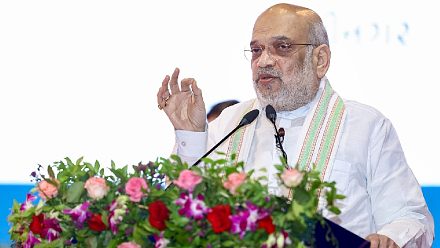
After declaring India free of Naxalism, Union Home Minister Amit Shah has set his sights on another ambitious national security goal: making India drug-free by December 31, 2029. The deadline marks the next phase of a political and administrative approach that has increasingly revolved around setting firm timelines for challenges the BJP has long promised to address.
The announcement, made on October 21 during Police Commemoration Day at the National Police Memorial in Delhi, follows the government’s declaration that India had achieved its target of eliminating Left-Wing Extremism by March 31, 2026. For Shah, the fight against narcotics is now another national mission, with implications that extend beyond law enforcement to public health, economic security and the future of India’s youth.
“We will fight together against the scourge of drugs and free the country from this menace by December 31, 2029,” Shah said, calling on police forces across the country to implement the roadmap for a ‘Nasha Mukt Bharat’. He described the drug problem as a threat that weakens future generations, burdens the economy and can finance organisations with anti-national intentions.
Naxal-Free India To Drug-Free India
The new deadline follows a significant milestone in the government’s campaign against Maoist insurgency. On August 24, 2024, Shah announced that Naxalism would be eliminated by March 31, 2026. The Centre subsequently intensified security operations, intelligence coordination, infrastructure development and surrender-and-rehabilitation initiatives in affected areas.
According to figures presented by Shah in April 2026, 706 Maoists had been killed in encounters during 2024, 2025 and the first three months of 2026. Another 2,218 were arrested and 4,839 surrendered during the same period. The government also reported that the number of districts most affected by Naxalism had fallen from 35 in 2014 to zero, while the number of districts affected by the insurgency had dropped from 126 to two.
The March 31 deadline was subsequently declared achieved by the government, marking what it described as the effective end of Left-Wing Extremism as a major internal security challenge.
The drug-free mission now faces a different challenge. Unlike an armed insurgency concentrated in identifiable regions, narcotics networks operate across international borders, transport corridors, cities and villages. Tackling them requires not only seizures and arrests but also financial investigations, prosecution, prevention and treatment for addiction.
A Three-Year Roadmap
Shah’s anti-drug campaign is not limited to a broad political declaration. The Ministry of Home Affairs and the Narcotics Control Bureau have outlined a 2026-2029 strategy built around four pillars: intelligence-led enforcement, control of precursor chemicals and synthetic drugs, demand reduction and rehabilitation, and stronger institutional capacity and coordination.
The government has said it aims to dismantle 100 international and interstate drug networks, bring 100 narcotics-related fugitives back to India and destroy 100 clandestine drug laboratories. The campaign also envisages reaching 50 crore citizens, creating one lakh ‘Nasha Mukt Mitras’ and expanding the network of de-addiction centres to 1,751.
The scale of the problem is reflected in the government’s own seizure figures. Between 2014 and 2024, more than 1.19 crore kilograms of drugs, valued at approximately Rs 1.89 lakh crore, were seized, according to Shah’s October 2026 roadmap briefing. More than 48.66 lakh kilograms were also reported destroyed. These figures underline the scale of enforcement activity, but seizures alone cannot establish whether drug availability, addiction or the reach of trafficking networks has declined proportionately.
The proposed strategy therefore seeks to shift the focus from the quantity of narcotics seized to the dismantling of entire supply chains, including their financiers, international connections and local distribution networks. It also places greater emphasis on synthetic drugs, online trafficking and the diversion of chemicals used in manufacturing narcotics.
Article 370: Another Long-Standing Promise Fulfilled
Shah’s latest mission also fits into a wider political narrative built around the fulfilment of commitments made by the BJP over several decades.
One of the most prominent was the abrogation of Article 370, which granted Jammu and Kashmir special constitutional status. The move was implemented in August 2019, following the BJP’s return to power for a second term under Prime Minister Narendra Modi.
Shah, who piloted the Jammu and Kashmir Reorganisation Bill in Parliament, presented the decision as the fulfilment of a long-standing nationalist commitment. At a rally in Haryana later that month, he said the government had achieved in 75 days what previous governments had not accomplished in 70 years. He also declared that the removal of Article 370 had fulfilled Atal Bihari Vajpayee’s dream.
The decision remains a defining moment in the BJP’s political record, although its longer-term consequences for political representation, civil liberties, security and development in Jammu and Kashmir continue to be debated.