A Long Goodbye On Raisina Hill: The Final Exit Of The Armed Forces From South Block
For anyone in uniform, transfers and new postings are part of military life. But for the officers preparing to leave South Block this November, the move is different.
Ni Akash Sharma··60K nabasa
A Long Goodbye On Raisina Hill: The Final Exit Of The Armed Forces From South Block
For anyone in uniform, transfers and new postings are part of military life. But for the officers preparing to leave South Block this November, the move is different.
They are the last generation of military officers to work out of this iconic building. Once they move out, the armed forces will no longer have a presence in the sandstone landmark that has housed India’s top military leadership for decades.
Early in my career, a senior reporter gave me a piece of advice: “You cannot cover defence without going to South Block.”
At the time, it sounded like routine guidance for someone new to the beat. Over the years, I understood what they meant.
If you wanted to know how India was preparing for a conflict, dealing with a military crisis or engaging with another country on defence matters, South Block was where you had to be. The service chiefs, their deputies and senior military officers worked out of this building.
For defence correspondents, it was the centre of the country’s military establishment. That is about to change.
South Block also had a way of keeping the outside world at a distance. Entry was restricted to authorised visitors. Mobile phones were not allowed inside. For years, my afternoon routine remained largely unchanged.
Around 2 pm, I would call the CNN-News18 newsroom from outside the reception and inform them that I would be unreachable for the next hour or two. My phone would then be deposited at the gate.
Inside, all I carried was a diary or a few sheets of paper to take notes. The constant noise of television alerts and breaking news gave way to face-to-face conversations.
Meetings were often unhurried. Many discussions took place off the record. You listened, took notes and tried to understand what was being said beyond the official position.
Last week, during one such visit, a senior officer mentioned that the first consignment of their belongings would soon be moved to Shaurya Bhawan. He said it almost casually. But the remark stayed with me. The departure was no longer a plan on paper. It was happening.
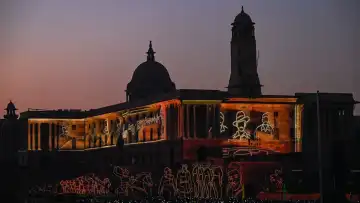
Designed by Herbert Baker as part of the imperial secretariat complex planned alongside Edwin Lutyens, South Block was built to house the administration of British India. After Independence in 1947, it became one of the most important centres of decision-making in the Indian Republic.
Some of India’s most consequential military decisions were taken within these walls. From the Kashmir conflict of 1947-1948 and the 1962 war with China to the wars of 1965 and 1971 as well as the Kargil conflict in 1999, South Block remained central to India’s military and political response to crises.
Maps were studied, assessments exchanged and decisions taken in its offices and conference rooms. More recently, the building also housed high-level deliberations during Operation Sindoor.
Generations of army, navy and air force officers have worked from these corridors. The building has been a witness to changing military priorities, wars and the evolution of India’s defence establishment.
Now, that association is coming to an end.
By the end of November, army chief General Dhiraj Seth, his vice chief and seven principal staff officers are scheduled to move to Shaurya Bhawan in Delhi Cantonment. The army’s directorate general of military operations and its war room are also moving out of South Block.
Navy chief Admiral Krishna Swaminathan and the navy’s senior leadership are moving out as well. Their offices are transitioning to the new defence infrastructure, including Sena Bhavan and Nausena Bhavan in Delhi Cantonment. The navy had begun moving to Nausena Bhavan in 2024.
The civilian ministry of defence (MoD) has already moved out. Defence Minister Rajnath Singh and his secretariat moved in April. The ministry is functioning from Kartavya Bhavan-2 at present.
The next phase of the relocation will bring the defence leadership together under a common administrative complex. Once Kartavya Bhavan-6 and Kartavya Bhavan-7 are ready, the MoD will move into its permanent premises. The three service chiefs and the Chief of Defence Staff will also have dedicated offices in Kartavya Bhavan-6.
There is a practical reason behind the move. While the top military leadership operated from South Block, several important army directorates were spread across different locations.
Some functioned from old World War II-era hutments. Others were based at Sena Bhawan, RK Puram and Shankar Vihar. Officers often had to travel between these locations to coordinate work and move files.
South Block was never designed for the requirements of a modern defence establishment. Secure digital networks, integrated working spaces and contemporary communication systems are now essential.
Adapting a century-old heritage building to these requirements has its limitations. The new complexes are expected to provide more integrated working arrangements for the military leadership.
There is also a new future for South Block.
On November 11, the Union cabinet approved an allocation of Rs 3,230 crore for the conversion of North and South Blocks into the Yuge Yugeen Bharat Museum. The project will be implemented in phases up to 2030-31.
The buildings that once housed India’s highest levels of political and military decision-making will become a public cultural space. The security gates will no longer mark the entrance to offices where military commanders and senior bureaucrats worked.
Visitors, including schoolchildren, will eventually walk through galleries dedicated to India’s history and civilisational heritage. For the armed forces, however, the departure is not simply an administrative exercise.
Speak to officers preparing to move and there is a sense of attachment to the building. It is not something they openly dwell on. The relocation is part of a larger transition and the work has to continue.
But South Block has been their workplace for years. For many, it has also been the setting for some of the most important moments of their military careers.
The feeling is familiar among defence correspondents too. Over the past few days, reporters have been stopping outside the building for photographs. Some are taking one last look at the familiar sandstone facade. For journalists who have spent years coming here for briefings, interviews and developments during military crises, South Block has been more than an address.
I have spent countless afternoons waiting outside the offices, hoping for a few minutes with a senior officer. I have watched Guard of Honour ceremonies on the lawns and walked through corridors where some of the country’s most important defence decisions were discussed.
Soon, the familiar nameplates will disappear. Offices will be emptied. Secure communication systems will be moved to new premises. The military leadership will begin a new chapter elsewhere.
South Block will remain on Raisina Hill. Its history will be preserved and opened to the public. But its association with the day-to-day functioning of India’s armed forces will come to an end.
For those who worked here, and for those who reported from its corridors, it will be a difficult goodbye.