MADE IN INDIA IS COOL NOW: How Indian Craft Is Finding A New Language Of Luxury
From the loom to the runway, from centuries-old techniques to contemporary design, Indian craftsmanship is entering a new chapter, one where heritage is no longer simply preserved, but reimagined, refined and recognised
Ni Swati Chaturvedi··29K nabasa
MADE IN INDIA IS COOL NOW: How Indian Craft Is Finding A New Language Of Luxury
From the loom to the runway, from centuries-old techniques to contemporary design, Indian craftsmanship is entering a new chapter, one where heritage is no longer simply preserved, but reimagined, refined and recognised as luxury on its own terms.
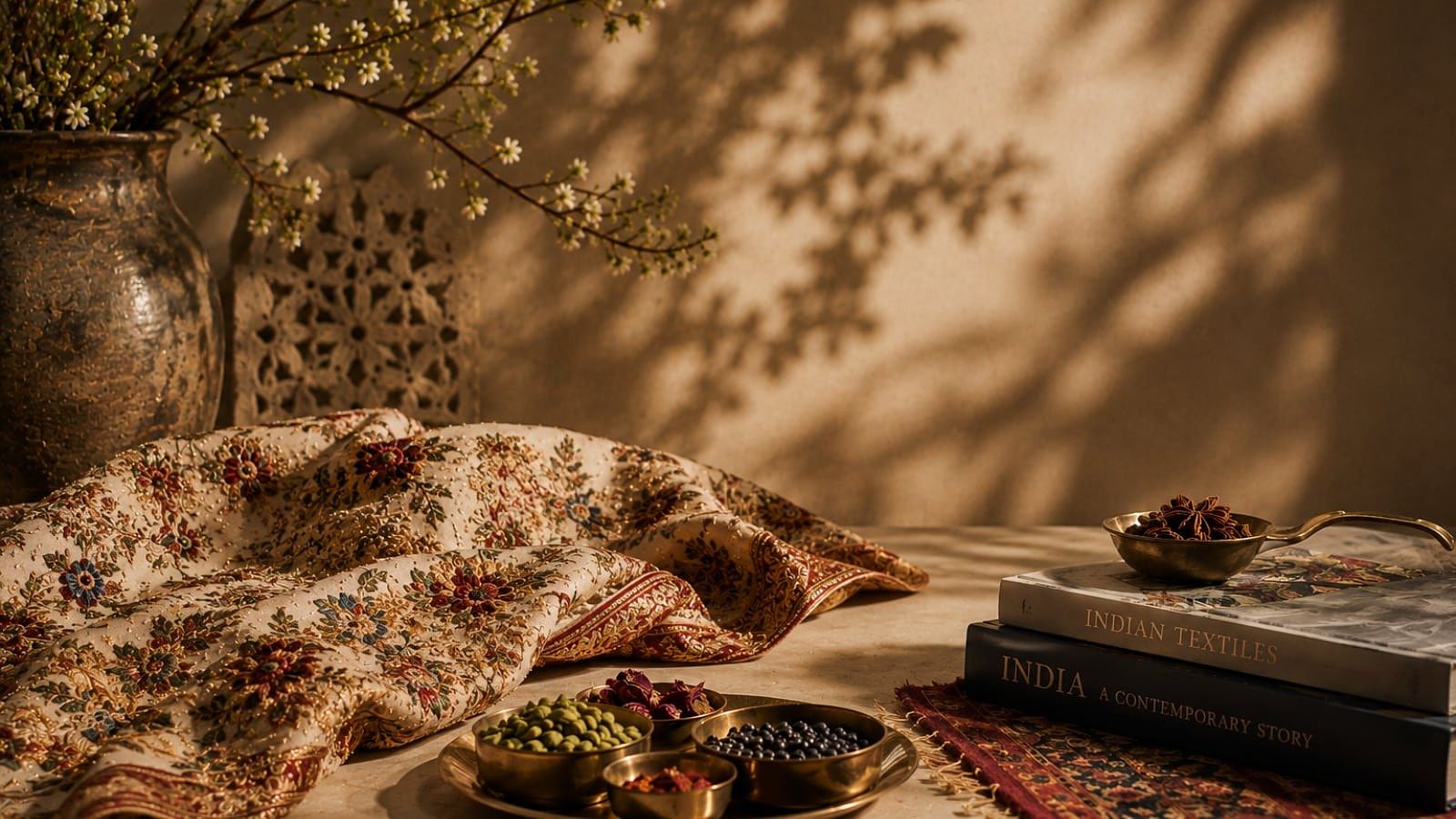
There is a particular kind of luxury in knowing that something could not have been made anywhere else. It might be a textile that carries the memory of a centuries-old weaving tradition, a rug whose imperfections reveal the presence of the human hand, a garment painstakingly finished by artisans, or a spirit whose ingredients and techniques are rooted in a landscape and culture of its own. For much of the world, luxury has historically been associated with European maisons, their archives, ateliers and inherited codes. But something is shifting.
India, with its extraordinary vocabulary of textiles, embroidery, weaving, metalwork, leather, jewellery, artisanal techniques and decorative traditions, is beginning to enter the global luxury conversation not merely as a repository of heritage, but as a contemporary creative force.
And perhaps the most telling part of this transformation is that Indian designers are no longer asking the world to look at their craft through the lens of nostalgia.
They are asking it to look at India as design.
“Indian craftsmanship and the idea of India are almost the soul behind everything we do,” says designer Rahul Mishra. “Our silhouettes and the way we treat them become the contemporary body for that soul.”
That distinction matters. Because the future of Indian luxury may depend less on preserving the past exactly as it was, and more on understanding how to carry its essence forward.
When Heritage Stops Being a Relic
For centuries, India’s craft traditions have survived precisely because they were never static.
They were worn, adapted, repaired, reinvented and passed from one generation to another. Today, that same instinct for evolution is becoming one of India’s greatest advantages in luxury.
“Heritage cannot remain frozen in the past,” says Mishra. “It has to evolve, surprise you and find a new expression.”
The challenge, he believes, is not to modernise Indian craft by stripping away its identity, but to allow the design language surrounding it to move forward. The result is an increasingly sophisticated proposition: something unmistakably Indian in origin, yet entirely at home on an international stage.
Designer Payal Khandwala approaches the idea from a similarly contemporary starting point. “We approach heritage through a contemporary design lens to begin with,” she says. “So, my practice doesn’t rely on nostalgia or repackaging the past.”
Her objective, instead, is to build a vocabulary relevant to the lives of women today and potentially to future generations.
“Craft then, quite simply, becomes the vehicle through which we try to achieve this language,” she adds, “whilst simultaneously becoming the cornerstone of our house aesthetic.”
It is a subtle but important shift. Craft is no longer the story being told. Craft becomes the language in which the story is told.
The End of the Apology
For a long time, “Made in India” came with an invisible footnote. It signalled heritage, tradition and authenticity, certainly but luxury was often still measured against a European vocabulary. Indian brands could be admired for their craftsmanship while being perceived as regional rather than truly global.
That hierarchy is becoming harder to sustain.
At Nappa Dori, Gautam Sinha, Founder and Creative Director, sees a fundamental change in the way Indian design is being perceived. “Made in India is no longer something that needs to be explained or qualified,” he says. “For a long time, Indian luxury was defined largely by heritage and craftsmanship. Today, we are seeing a new design language emerge which is rooted in our own point of view.”
That confidence is perhaps the defining characteristic of India’s new luxury generation.
The ambition is no longer to make an Indian interpretation of an established global product. It is to create products whose Indian identity is part of what makes them desirable.
“Indian design doesn’t need to imitate what the world considers luxury; it can define its own vocabulary,” says Sinha.
And increasingly, the world appears willing to listen.
From Appreciation to Understanding
There is another, deeper change taking place: the luxury consumer is becoming more curious. Craftsmanship alone is no longer enough. Consumers increasingly want to know who made something, where it came from, how it was made and why the technique matters.
For Anita Dongre, that represents a meaningful turning point. “India has a craft culture that is thousands of years old,” she says. “These traditions survived drought, flood, famine, and colonisation, not because they were preserved under glass, but because they were worn, lived in, and loved.”
That endurance, she believes, is itself a form of luxury.
For years, the world borrowed from Indian craft without necessarily understanding its provenance. Today, Dongre sees a more informed form of interest emerging.
“There is a growing desire to understand more. To know the name of the weave, the community behind it, the centuries of knowledge it carries,” she says.
“The world is moving from appropriation to appreciation.”
It is a powerful distinction and one that places responsibility alongside opportunity. The renewed global interest in Indian craft cannot simply benefit the brands that package it beautifully. It must also recognise the artisans and communities who have kept these traditions alive.
The Human Hand as the New Status Symbol
Luxury has always been about scarcity. But in an increasingly automated world, scarcity is beginning to mean something different.
Time is scarce. Patience is scarce. Human skill is scarce. This is where India’s craft economy has an extraordinary proposition.
Yogesh Chaudhary, MD, Jaipur Rugs Ltd, describes the evolution of “Made in India” as a movement away from heritage and traditionalism alone towards “unique cultures, cutting-edge design, innovation and relevance.”
For him, the appeal of Indian luxury lies precisely in the collision between the old and the new: generations of artisanal knowledge meeting contemporary design sensibilities.
“Crafted in India luxury represents human artistry at its best,” he says, describing it as an amalgamation of rich traditions and progressive design.
At Jaipur Rugs, this philosophy is especially rooted in the belief that luxury resides in people and their abilities. “True luxury lies in people and their abilities,” Chaudhary says.
It is an idea that feels increasingly resonant in a world where consumers are beginning to value the human story behind the object as much as the object itself.
Can ‘Made in India’ Become a Luxury Signature?
The question, then, is no longer whether India possesses the craftsmanship required to produce luxury. It unquestionably does.
The more interesting question is whether “Made in India” can become a recognisable global mark of luxury in its own right.
For Aseem Kapoor, Creative Director, Satya Paul, the opportunity is significant but geography alone will never be enough.
“I don’t think relevance comes from changing the identity of Indian craft; it comes from changing the way we frame it,” he says.
India’s extraordinary visual and craft vocabulary does not need to be presented through nostalgia to be understood, Kapoor believes. Techniques, materials and sensibilities can be placed within a contemporary context and allowed to speak to consumers who may have no personal connection to their origins.
“When you allow Indian craftsmanship to exist as design rather than simply as heritage, it becomes much more universal,” he says.
The same principle applies to the “Made in India” label itself.
“For ‘Made in India’ to become a mark of luxury, it has to stand for more than geography,” Kapoor says. “It should communicate a certain level of design, craftsmanship, detail and integrity.”
In other words, the label must become a promise, not merely a place of manufacture.
The Luxury of Knowing Where Something Comes From
Perhaps this is why the next chapter of Indian luxury feels less about grand declarations and more about provenance. Karishma Manga Bedi, Founder & CEO, IDAAYA, describes a time when “Made in India” often had to be explained, particularly in categories where European reference points dominated.
“What is changing now is confidence,” she says. With IDAAYA, that confidence meant beginning not by creating an Indian version of something the world already understood, but by looking inward.
“We didn’t set out to create an Indian version of a global spirit,” Bedi says. “We went looking for what was already ours.”
That philosophy captures something fundamental about the new Indian luxury movement.
The opportunity is not to manufacture heritage. It is to recognise value in what already exists and then subject it to the same rigour, design thinking and execution expected of any world-class luxury product.
Bedi believes that Indian brands should ultimately be judged not because they are Indian, but because they are excellent.
“We should be judged on the same things as any world-class product: quality, craft, originality and the experience it creates,” she says.
That may be the most important benchmark of all.
A Luxury Language of Our Own
For Khandwala, the relationship between craft and luxury is deeply personal to India’s cultural history. “There is something sophisticated but also quietly poetic about a textile woven on a loom by hand,” she says. “An impeccably made garment, created from such a textile, is a luxury few can afford.”
Yet India’s distinction is that this extraordinary artisanal inheritance is not an exotic discovery, it is embedded in the country’s cultural fabric.
“We have entire ancient texts dedicated to craftsmanship, taste and connoisseurship,” Khandwala says, pointing to the fact that ideas now central to the contemporary luxury conversation have long existed within Indian culture.
Her own practice works with craft clusters across India, while garments are hand-finished in Colaba, Mumbai.
“Made in India is a tag we wear with humility and pride,” she says, “and uphold it with a sense of responsibility.” That final word may be the one that defines the future.
Because India’s luxury opportunity is not simply commercial. It is cultural.
The Future Is Not About Looking Back
The most compelling thing about India’s emergence on the global luxury stage is that it does not require India to become less Indian.
Quite the opposite.
Rahul Mishra speaks of creating work that is “deeply rooted in India, yet feels completely relevant anywhere in the world.” Aseem Kapoor argues for allowing Indian craftsmanship to exist as design rather than merely heritage. Gautam Sinha believes Indian design can define its own vocabulary. Anita Dongre sees the movement from appropriation to appreciation. Yogesh Chaudhary sees the human hand becoming central to the luxury proposition. Payal Khandwala sees craft as the vehicle for a contemporary language. And Karishma Manga Bedi sees a generation of Indian brands becoming confident enough to let the work speak for itself.
Together, their perspectives point towards the same conclusion.
The future of Indian luxury will not be built by making India look like Paris, Milan or London. It will be built by making India unmistakably itself and making the world want it.
For Independence Day, that feels like a particularly fitting evolution of the phrase Made in India.
Not a label seeking validation. Not heritage preserved behind glass. Not nostalgia packaged for export. But a living, evolving language of design, craftsmanship, provenance and imagination.