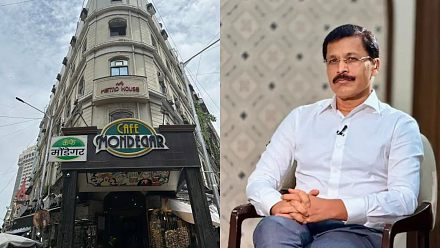
Cafe Mondegar Licence Suspended: What Tukaram Mundhe’s Team Found at Mumbai’s Iconic Café
For generations of Mumbaikars, Cafe Mondegar has been more than a place to grab a meal. The Colaba institution, known for its irreverent Mario Miranda murals, jukebox and unmistakable old-Mumbai character, has been part
Ni Swati Chaturvedi··15K nabasa
Cafe Mondegar Licence Suspended: What Tukaram Mundhe’s Team Found at Mumbai’s Iconic Café
For generations of Mumbaikars, Cafe Mondegar has been more than a place to grab a meal. The Colaba institution, known for its irreverent Mario Miranda murals, jukebox and unmistakable old-Mumbai character, has been part of the city’s social fabric since 1932.
Now, one of Mumbai’s most recognisable cafés has found itself on the wrong side of the city’s increasingly aggressive food-safety crackdown.
The Maharashtra Food and Drug Administration (FDA), led by Commissioner Tukaram Mundhe, has suspended the food licence of Cafe Mondegar after an inspection found a series of food-safety, hygiene and structural deficiencies at its Colaba outlet. The inspection was conducted at the restaurant’s Metro House premises on September 12, with the licence suspension announced on September 15.
And the findings were not limited to a dirty kitchen or a paperwork issue. According to the FDA, inspectors found problems with food temperature control, thawing and cooling practices, drainage, flooring and equipment sanitation, all areas that can have direct implications for food safety.
The temperature problem
One of the most significant findings concerned something most diners would never see: the temperature at which food is stored and held before it reaches the plate.
The FDA said hot food at Cafe Mondegar was not being maintained above the prescribed 60°C, while cold storage was not being maintained below 5°C. Both temperature controls are important because keeping food outside safe temperature ranges for prolonged periods can allow harmful microorganisms to multiply.
Inspectors also found improper thawing practices and inadequate rapid cooling of cooked food, according to the FDA’s findings.
These may sound like technical kitchen details, but they are precisely the kinds of behind-the-scenes practices food-safety regulations are designed to control.
A restaurant can look immaculate from the dining room and still have serious food-safety vulnerabilities in its kitchen.
Then came the drainage and flooring concerns
The FDA inspection also flagged physical conditions at the premises. Officials found dampness that had damaged the flooring, while the drainage system near the food-preparation area was considered inadequate and capable of creating a potential cross-contamination risk. Equipment was also found not to have been adequately cleaned and sanitised.
Again, these are not cosmetic complaints. In a professional kitchen, drainage, moisture control and sanitation are part of the food-safety chain. Poor drainage can allow contaminated water or waste to come into contact with food-preparation areas, while inadequate cleaning of equipment can create another route for contamination.
The FDA’s action therefore appears to have been based on multiple deficiencies rather than one isolated lapse.
Why is Tukaram Mundhe targeting restaurants so aggressively?
The Cafe Mondegar action is part of a much larger food-safety campaign underway across Maharashtra. Since taking over as Maharashtra’s FDA commissioner in May, Mundhe has launched a highly visible crackdown on food adulteration, unsafe food handling and hygiene violations. Reuters reported in August that his teams had carried out more than 3,000 food-safety raids, covering everything from street vendors and eateries to major restaurant chains. Several establishments had already faced licence suspensions.
The timing is significant. Maharashtra is entering a period packed with festivals, beginning with Ganeshotsav and followed by Navratri, Dussehra and Diwali. That means a huge seasonal increase in demand for sweets, dairy products, khoya, ghee, farsan and other foods.
The FDA has introduced a Festival Enforcement Calendar specifically to increase surveillance during these periods, with Mundhe arguing that existing food-safety laws need to be enforced more strictly when demand and therefore the opportunity for adulteration or unsafe practices rises.
Cafe Mondegar’s suspension comes directly amid that intensified festival-season inspection drive.
It’s not just Cafe Mondegar
The Colaba restaurant was not the only Mumbai establishment to face action. The FDA also suspended the licences of Maharashtra Biryani Centre in Kandivali East, Tribhuvan Dairy Farm in Ghatkopar West and Mahavir Cashew & Foods Pvt Ltd in Ghatkopar East after inspections found violations.
During its special festival campaign in Greater Mumbai between September 11 and 14, the FDA said it inspected 38 food establishments and collected 47 samples for analysis, including samples of milk, khoya, ghee and sweets.
The scale of the wider operation is even more striking. Across Maharashtra, the department said it seized 4,138.7 kg of dairy products and sweets and 30 litres of milk, with the seized material valued at approximately ₹15.58 lakh. The products included khoya, paneer, ghee, peda, halwa, shrikhand, butter and milk powder.
In Mumbai alone, nine establishments were suspended for deficiencies during the festival drive, according to the FDA’s reported figures.
And the FDA is watching your Ganpati sweets too
There is a particularly interesting connection between the Cafe Mondegar action and the ongoing Ganesh Chaturthi season. The FDA has not limited its campaign to restaurants.
Ahead of Ganeshotsav, it organised awareness programmes for Ganesh mandals on the safe preparation and distribution of prasad and mahaprasad. Five workshops were conducted for mandal representatives, with 320 participants attending. The FDA and BMC also conducted a training workshop for around 110 self-help groups involved in making modaks.
The message is fairly straightforward: festive food is still food and the fact that it is being prepared for a religious celebration does not make food-safety rules optional.
The department has specifically been focusing on the products that see a seasonal surge in demand: sweets, dairy products, khoya, paneer, ghee and farsan.
What happens to Cafe Mondegar now?
A licence suspension is not necessarily the end of the story for the restaurant. The FDA’s action is intended to compel establishments to rectify deficiencies and comply with food-safety requirements before their licences can be restored.
For a restaurant with Cafe Mondegar’s history and cultural cachet, however, the episode is a reminder that nostalgia doesn’t come with an exemption from regulation.
The café may be famous for its murals, its old-school atmosphere and its place in Mumbai’s collective memory.
But behind the red-and-white interiors and Mario Miranda cartoons is still a working commercial kitchen.
And that kitchen has to meet the same basic food-safety expectations as everyone else’s.
A new era for Mumbai’s food scene?
Mundhe’s approach has already become one of the more talked-about food-safety stories in Mumbai. His aggressive enforcement has won public support from people frustrated by unhygienic food practices, but it has also attracted criticism from some business owners who argue that the regulator’s methods can be heavy-handed. Reuters reported that some businesses have challenged his approach legally, even as his inspections have forced many operators to tighten food-handling practices.
There is also a recent legal caution worth noting. The Bombay High Court ordered the Maharashtra FDA to pay ₹5 lakh in compensation to a Pune sweet shop after questioning the continued suspension of its licence when a follow-up inspection reportedly found the establishment compliant with 35 of 36 food-safety parameters.
That case does not relate to Cafe Mondegar and does not change the findings of the September 12 inspection. But it does underline the larger tension surrounding the current crackdown: food safety needs to be enforced firmly, while regulatory action itself must also follow due process.
For now, Cafe Mondegar joins the growing list of Mumbai food businesses facing action under Mundhe’s FDA.
The restaurant’s iconic status may be a part of Mumbai’s history. But when it comes to food safety, the FDA’s message is clear: history doesn’t get a free pass.