Amazing, Unforgettable, And Beyond Imagination: When Mount Kailash Calls, Only Then Do You Receive Its Darshan
Some journeys are measured in kilometres, while others are measured by the transformation they bring within. The Kailash–Mansarovar Yatra belongs to the latter. It is not merely a pilgrimage through the Himalayas but a p
Ni Priti Sompura··14K nabasa
Amazing, Unforgettable, And Beyond Imagination: When Mount Kailash Calls, Only Then Do You Receive Its Darshan
Some journeys are measured in kilometres, while others are measured by the transformation they bring within. The Kailash–Mansarovar Yatra belongs to the latter. It is not merely a pilgrimage through the Himalayas but a profound spiritual journey that tests your faith, endurance and inner strength, leaving you forever changed.
Mount Kailash is not just a mountain; it is an experience, an energy and a divine presence that cannot truly be described in words. It can only be felt.
There is a popular belief among devotees that you do not choose to visit Mount Kailash; Mount Kailash chooses to call you. Only when Lord Shiva wills it do you receive the blessing of its sacred darshan.
This is the story of my long-awaited pilgrimage: a journey of unwavering faith, unexpected challenges, breathtaking landscapes and an unforgettable spiritual awakening.
For centuries, Mount Kailash has stood in majestic silence, revered by Hindus, Buddhists, Jains and followers of the Bon faith. Hindus worship it as the eternal abode of Lord Shiva and Goddess Parvati. Buddhists regard it as the sacred cosmic mandala. Jains believe it is where the first Tirthankara, Lord Rishabhdev, attained liberation. Despite these diverse traditions, one belief unites every pilgrim: you do not go to Kailash because you wish to—you go only when Kailash calls you.
I had heard this saying for years. It sounded beautiful, almost mystical. But it was only after completing the Kailash–Mansarovar Yatra that I truly understood its meaning.
My journey to Kailash did not begin in Tibet. It began twenty-six years ago.
In 2000, as a young journalist, I interviewed a family from Mulund that had just returned from the Kailash–Mansarovar pilgrimage. As they described the breathtaking landscape, the physical challenges and the indescribable spiritual experience, a quiet dream took root in my heart. I promised myself that one day, no matter how long it took, I too would stand before Mount Kailash.
Life moved on. Journalism took me across conflict zones, natural disasters and major national events. Deadlines replaced dreams, but somewhere deep inside, Kailash continued to wait.
Nearly two decades later, another conversation rekindled that dream. In 2019, I met journalist Rashmi Puranik, who had just returned from Kailash. Listening to her experiences, I realised that my time had finally arrived. I began preparing with determination—long-distance walking, running, yoga and pranayama became part of my daily routine.
Then came the pandemic.
Covid-19 brought the world to a standstill. The pilgrimage was suspended, and even after the pandemic, Indian pilgrims were unable to travel because the route remained closed. When the pilgrimage finally reopened in 2025, I was committed to another endurance challenge—the 90-kilometre Comrades Marathon. Once again, Kailash had to wait.
Perhaps, I told myself, Lord Shiva had not called me yet.
Finally, in 2026, the opportunity arrived again. This time, there was no hesitation. I trained harder than ever before, completed a 65-kilometre ultra run in Lonavala, continued my fitness regimen and prepared mentally for one of the toughest pilgrimages in the world.
Initially, fourteen of us planned to undertake the journey together. One by one, however, fellow travellers withdrew because of personal commitments. Eventually, I found myself preparing to travel almost alone. For a moment, doubt crept into my mind. Was it wise to undertake such a demanding expedition without familiar companions?
But faith is often stronger than fear.
I reminded myself of the promise I had made years earlier. Whatever happened, I would complete the Kailash Parikrama.
Little did I know that the real test had only just begun.
Before I even reached the sacred mountain, I was struck by severe tooth pain in Nepalgunj, followed by a stomach infection in Simikot. High altitude, freezing temperatures and physical exhaustion would soon become constant companions. Yet with every obstacle, my resolve only grew stronger.
Looking back today, I realise those hardships were not interruptions to the journey—they were part of it.
Because Kailash does not merely test your physical endurance.
It tests your faith.
And once you surrender to that faith, every step towards the sacred mountain becomes a blessing.
The journey had finally begun.
Glimpses of the yatra. Images: Priti Sompura/News18
Ashtapad, Nandi Parvat and Yam Dwar: Where the Spiritual Journey Truly Begins
The pilgrimage begins from Darchen, gradually ascending towards Ashtapad and Nandi Parvat, two of the most sacred vantage points from which Mount Kailash reveals its divine presence. Situated at an altitude of nearly 17,000 feet, Ashtapad opens up a vast, silent panorama where the southern face of Mount Kailash is meant to be seen, while the majestic Nandi Parvat stands directly opposite, as if eternally guarding the abode of Lord Shiva.
According to Jain tradition, Ashtapad is the sacred site where the first Tirthankara, Lord Rishabhdev (Adinath), attained moksha (liberation), making it one of the holiest places in Jainism.
As I arrived at Ashtapad, the landscape unfolded in stillness. Only Nandi Parvat and the surrounding Himalayan expanse were visible. Mount Kailash itself remained completely hidden behind dense layers of cloud. For a few moments, a quiet uncertainty arose—whether I would be granted its darshan at all.
Then, almost imperceptibly, the clouds began to shift.
Slowly, as if responding to an unseen rhythm, the silhouette of Mount Kailash started to emerge.
First came the Meru Danda—the vertical rock formation revered as the symbolic spine of Lord Shiva. Moments later, the mountain’s sacred contours, resembling Shiva’s Third Eye and His divine face, became distinctly visible.
The experience was overwhelming.
For a brief, timeless moment, it felt as though Lord Shiva Himself stood before me, silently blessing every pilgrim present in that sacred silence.
What makes Ashtapad truly unique is that it is the only point in the entire Kailash Parikrama from which Ashtapad, Nandi Parvat, and Mount Kailash can be seen together in a single, uninterrupted panorama.
The spiritual atmosphere of this place is beyond description. Standing there brings an immediate stillness; thoughts dissolve, the mind quiets, and an inexplicable inner peace takes over. Some experiences are not meant to be narrated; they are meant to be absorbed.
It is from this profound stillness at Ashtapad that the journey naturally transitions from vision to pilgrimage, from witnessing the divine to beginning the sacred circumambulation itself.
Yam Dwar: The Gateway to the Divine
The following day marks this transition in a tangible form, as the Kailash Parikrama formally begins from Yam Dwar, located at an altitude of approximately 15,500 feet.
The journey from Ashtapad’s silent revelation to Yam Dwar’s ritual threshold feels like moving from inner realisation to outward action.
The name Yam Dwar literally means “The Gateway of Yama”, the Hindu god of death. It serves as the sacred entrance to the Kailash Parikrama and holds deep spiritual significance in Hindu tradition.
According to ancient belief, every pilgrim must pass through Yam Dwar before entering the sacred realm of Lord Shiva. It is said that Yama himself stands as the guardian of Shiva’s eternal abode.
In Hindu philosophy, Yama is the divine judge who evaluates every soul according to its deeds after death. Yet tradition also holds that when a devotee passes through Yam Dwar with sincere faith, Chitragupta, the celestial keeper of karmic records, symbolically forgives past sins and grants the pilgrim a spiritual rebirth. Chitragupta is believed to maintain the account of every individual’s good and bad deeds.
For Tibetan Buddhists, Mount Kailash is revered as the sacred abode of Demchok (Chakrasamvara). Every year at Tarboche, colourful prayer flags are ceremonially raised as expressions of faith, compassion, and spiritual aspiration.
These prayer flags are far more than decorative symbols. Each colour represents one of the five universal elements:
● Blue – Sky
● White – Air
● Red – Fire
● Green – Water
● Yellow – Earth
Together, they represent the balance and harmony that sustain all existence.
Tibetan tradition believes that no negative force can cross this sacred gateway. In Hindu belief as well, Yama is seen as a protector of Lord Shiva’s devotees, fulfilling his divine role with reverence and duty.
It is also believed that the true beginning of the Kailash pilgrimage is marked only when one passes through Yam Dwar with full devotion. Those who do so are said to receive not only the blessings of Lord Shiva but also the promise of spiritual liberation.
More than a physical entrance, Yam Dwar represents the threshold between the ordinary and the sacred—a conscious departure from fear, ego, worldly attachments, and karmic burden, before stepping into one of the most revered spiritual journeys on Earth.
The First Day of the Parikrama: Walking in the Presence of Mount Kailash
The first day of the Kailash Parikrama begins from Yam Dwar, covering a distance of nearly 13 kilometres. Compared to the days that follow, this stretch is considered relatively gentle. The trail is not technically difficult, yet the freezing winds, biting cold, intense Himalayan sun and the ever-increasing altitude make every step physically demanding.
Throughout the journey, the western face of Mount Kailash appears again and again, as if the sacred mountain is quietly accompanying every pilgrim on the path. Small tea houses and resting points along the route offer warm drinks and simple meals, providing moments of comfort amidst the harsh Himalayan landscape.
Yet the greatest source of strength does not come from food or rest—it comes from the silent presence of Kailash itself.
Guided by that unseen divine energy, I completed the first day’s trek and reached Dirapuk, one of the holiest halts on the pilgrimage. The guesthouse where I stayed faced the northern face of Mount Kailash. From the window of my room, the sacred mountain stood in all its magnificent glory.
It felt as though Lord Shiva Himself was standing before me, showering His silent blessings upon every devotee.
Unable to resist the call of the mountain, I climbed nearly 200 metres above the guesthouse.
Then, suddenly, Mount Kailash stood before me in its full majesty.
No words can truly describe that moment.
My eyes filled with tears. My mind became completely still. Every thought dissolved into silence. I could not even blink. My gaze remained fixed upon the mountain, as though time itself had stopped.
It was no longer a mountain of rock and snow.
It was a living presence.
It was a moment of complete surrender.
While I stood immersed in that silence, a group of Tibetan pilgrims arrived to offer prayers and capture photographs. Looking at their faces, I realised that the same devotion, the same reverence and the same spiritual longing shone in their eyes as in the heart of every Hindu pilgrim.
That is the unique greatness of Mount Kailash.
It belongs to no single religion, yet it belongs to all.
For Hindus, it is the eternal abode of Lord Shiva and Goddess Parvati.
For Tibetan Buddhists, it is revered as the Sacred Mandala, the cosmic centre of the universe.
For Jains, it is the sacred mountain where the first Tirthankara, Lord Rishabhdev (Adinath), attained liberation.
Followers of the ancient Bon tradition worship it as the dwelling place of their revered deity.
Few places on Earth unite so many faiths in a single expression of devotion.
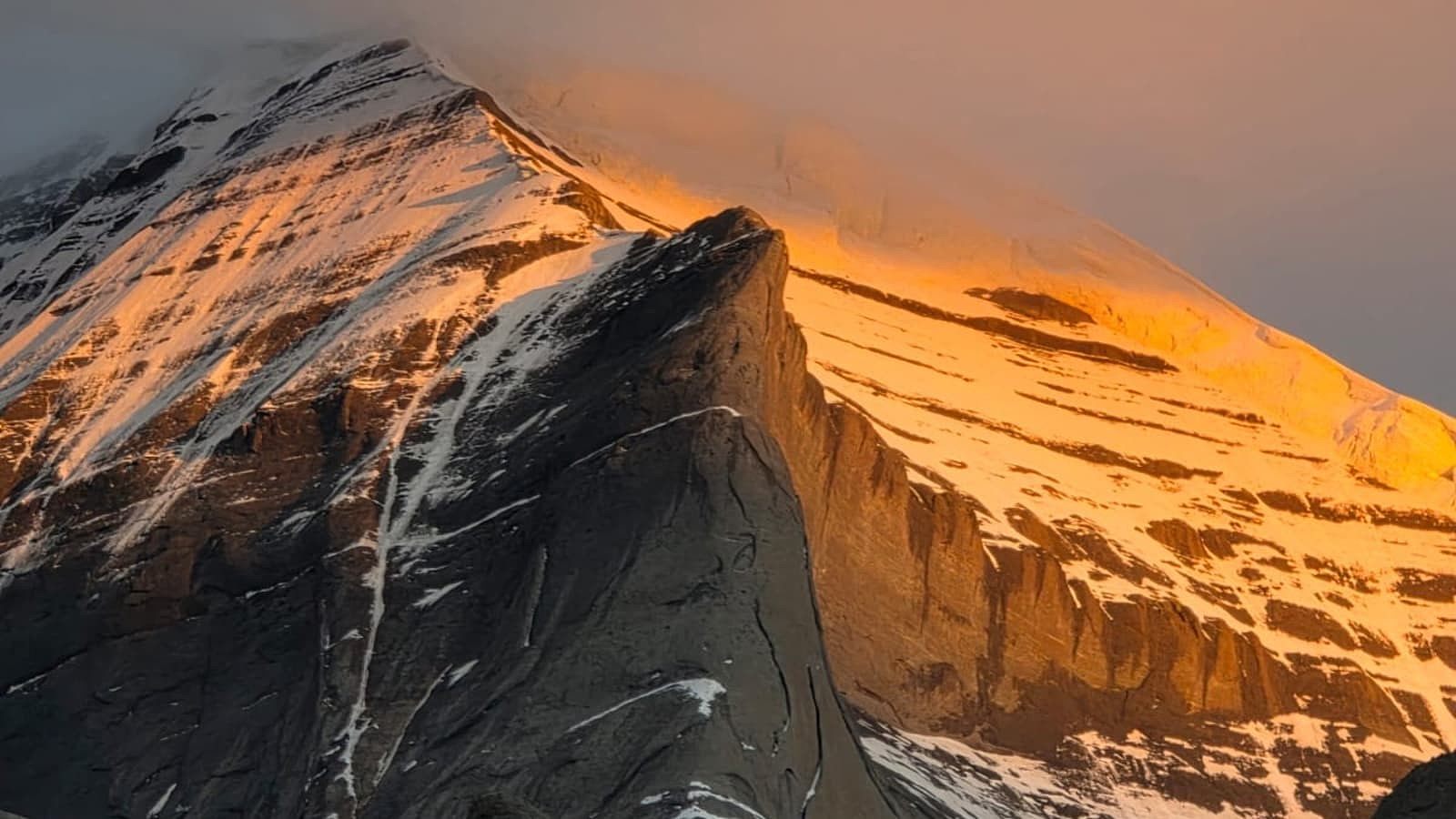
As the first day’s Parikrama drew to a close, the eastern face of Mount Kailash unfolded before me. I stood motionless, unable to take my eyes away. It felt as though every cell in my body was being filled with a new current of life, a new awareness and an indescribable spiritual energy.
Then came sunset.
Slowly, the final rays of the sun touched the snow-covered summit.
Within moments, Mount Kailash was transformed into a mountain of gold.
The entire peak shimmered with a radiant golden glow.
It seemed as though Surya, the Sun God Himself, had arrived to offer His final prayers to Lord Shiva, illuminating the sacred mountain with His celestial light before disappearing beyond the horizon.
Time seemed to stand still.
There was no sound.
No movement.
Only Mount Kailash… and an overwhelming silence that could not be explained, only experienced.
In that timeless moment, I realised that Kailash is not merely a destination to be reached—it is a divine presence to be felt. Every step of the Parikrama strips away a little more of the ego, quietens the restless mind, and draws the pilgrim closer to the eternal stillness that resides within.
Dolma-La Pass, Gauri Kund and a Pilgrimage That Transforms Life
The second day of the Kailash Parikrama is widely regarded as the most demanding—and the most spiritually significant—part of the entire pilgrimage. The journey begins at Dirapuk, ascends to the sacred Dolma-La Pass, and finally descends to Zuthulpuk.
As the trail climbs higher, the eastern face of Mount Kailash comes into view, revealing yet another awe-inspiring aspect of the sacred mountain. The six-kilometre ascent from Dirapuk to Dolma-La is physically exhausting. Every step tests the limits of human endurance. The steep climb, rapidly thinning oxygen, freezing temperatures, fierce Himalayan winds and laboured breathing transform the trek into more than a physical challenge—it becomes an act of devotion.
At that altitude, you no longer walk with the strength of your body alone.
You walk on faith.
As the climb rises from nearly 16,040 feet to 18,471 feet, reaching the summit of Dolma-La Pass brings an indescribable feeling of accomplishment. It feels as though you have crossed not only the highest point of the pilgrimage but also one of the greatest tests of your life.
Dolma-La Pass is dedicated to the Tibetan goddess Dolma (Tara), the embodiment of compassion and liberation. Pilgrims believe that crossing this sacred pass washes away the burdens of past karma and marks the beginning of a new spiritual life. Colourful Tibetan prayer flags flutter endlessly in the mountain winds, carrying prayers of hope, gratitude and blessings across the Himalayas.
Just beyond the pass lies one of the most sacred sites of the pilgrimage—Gauri Kund, the emerald-green glacial lake revered as the lake of Goddess Parvati.
According to the Shiva Purana, this is the sacred place where Goddess Parvati created Lord Ganesha from the sandalwood paste (ubtan) applied to Her body and breathed life into Him. She appointed Him as the guardian of Her abode while She bathed. When Lord Shiva arrived, Ganesha, unaware of His identity, stopped Him from entering. In His anger, Shiva severed the child’s head. Moved by Parvati’s grief, He later restored Ganesha to life by placing the head of an elephant upon Him, giving the world the beloved deity who is worshipped before the beginning of every auspicious undertaking.
Standing before Gauri Kund, surrounded by snow-covered peaks and absolute silence, the ancient legend feels astonishingly alive.
Its beauty is serene, timeless and deeply moving.
After descending nearly four kilometres from Dolma-La, the most difficult part of the second day’s Parikrama comes to an end. The remaining eight kilometres to Zuthulpuk are comparatively gentle, allowing both the body and mind to recover after the day’s extraordinary challenge.
Following an overnight stay at Zuthulpuk, the third and final day begins with a relatively easy 6.5-kilometre walk. Mount Kailash is no longer visible along this stretch, yet its presence never leaves you.
By then, Kailash is no longer before your eyes.
It has entered your heart.
Completing the final steps of the Parikrama, we returned by bus to Darchen, marking the official conclusion of the pilgrimage.
Yet, in truth, the journey does not end there.
The Kailash Yatra is far more than a trek through the Himalayas. It is a pilgrimage of the soul.
When you return, you do not return as the same person.
The mind becomes quieter.
The heart becomes lighter.
Your perspective on life changes forever.
A new awareness, a renewed sense of purpose and an indescribable inner peace begin to guide your life.
Before undertaking the pilgrimage, I had often heard a fascinating belief. It is said that if a devotee performs the Kailash Parikrama while wearing a Rudraksha mala, there comes a moment when the mala mysteriously slips away somewhere along the route. Devotees believe that it is Lord Shiva’s way of accepting the Rudraksha as an offering at His sacred feet.
The same happened to me.
Until the end of the second day’s Parikrama, the Rudraksha mala was around my neck. Sometime during the final day, without my noticing, it disappeared.
I searched for it.
I never found it.
Surprisingly, I felt no sadness.
Instead, an overwhelming sense of gratitude filled my heart.
Perhaps the Rudraksha had simply found its true destination—at the feet of Lord Shiva.
That moment taught me the greatest lesson of Kailash.
You do not return from Kailash carrying more.
You return carrying less.
You leave behind your ego, your fears, your doubts and the burdens that have weighed upon your heart for years.
And in return, Kailash blesses you with something infinitely more precious: inner peace, humility, clarity, unwavering faith and the quiet realisation that the greatest pilgrimage is not around a sacred mountain, but within yourself.