Who Will Hold Generals Accountable?' ANP Chief's Questions On Pakistan's Terror Policy | Exclusive
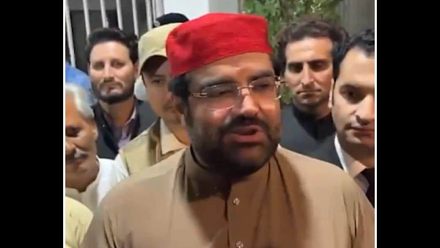
Awami National Party (ANP) chief Aimal Wali Khan has accused Pakistan’s military establishment and political leadership of enabling terrorist groups, questioning whether the state is genuinely committed to eliminating mi
লেখক Manoj Gupta··87K বার পড়া
Who Will Hold Generals Accountable?' ANP Chief's Questions On Pakistan's Terror Policy | Exclusive
Awami National Party (ANP) chief Aimal Wali Khan has accused Pakistan’s military establishment and political leadership of enabling terrorist groups, questioning whether the state is genuinely committed to eliminating militancy. He has also criticised the imposition of emergency rule in Khyber Pakhtunkhwa (KP), alleging that the move could be aimed at weakening provincial autonomy and altering the country’s federal structure.
Khan has named Pakistan Muslim League-Nawaz (PML-N) leaders Nawaz Sharif, Prime Minister Shehbaz Sharif and Rana Sanaullah among those he accuses of supporting or facilitating terrorist groups.
Arguing that the state’s policies have contributed to the persistence of terrorism, Khan questioned why the country’s powerful decision-makers, including military generals, were not being held accountable for their alleged role in nurturing militant organisations.
He also alleged that billions and trillions of rupees were linked to the state’s approach towards terrorism, arguing that the policies pursued by Pakistan’s establishment did not
reflect a genuine effort to eradicate militancy.
‘Excuses And Drama’: Aimal Wali Khan Questions KP Emergency
Khan has described the proposed imposition of governor’s rule and emergency in Khyber Pakhtunkhwa as “excuses and drama”, opposing the removal or suspension of an elected provincial government in the name of counterterrorism.
His remarks come amid a deepening political confrontation over the federal government’s decision to impose emergency rule in the province, which has been governed by Imran Khan’s Pakistan Tehreek-e-Insaf (PTI).
Pakistan’s President Asif Ali Zardari declared emergency rule in KP on October 11, suspending the provincial government. The federal government has defended the move by citing worsening security conditions and accusing the provincial administration of failing to cooperate adequately in the fight against terrorism.
Federal officials have also alleged that the PTI-led government failed to prevent militant groups from operating in the province. PTI has rejected accusations of links with militants and has challenged the federal government’s actions.
Khan, however, has questioned the logic of using terrorism as a justification for removing an elected government. He argued that if the existence of terrorism was sufficient grounds to dismiss a provincial administration, the same standard should be applied to the entire political and governing system.
He also questioned why responsibility for the persistence of terrorism was being placed on a provincial government while the role of the military establishment and other powerful state institutions remained under scrutiny.
Warning Over 18th Amendment And NFC Award
The ANP chief has also alleged that the emergency in KP could be part of a broader political plan to undermine provincial autonomy, weaken the 18th Constitutional Amendment and interfere with the National Finance Commission (NFC) Award.
The 18th Amendment, passed in 2010, devolved significant powers from the federal government to Pakistan’s provinces. The NFC Award governs the distribution of financial resources between the federation and the provinces.
Khan has warned that emergency rule could provide a pretext for changes to the existing federal arrangement, including the creation of new provinces and administrative units.
His concerns place the controversy beyond the immediate question of law and order, raising the issue of whether extraordinary measures taken in the name of security could also have consequences for provincial powers and resource allocation.
The ANP has previously opposed the imposition of governor’s rule or emergency in KP, arguing that such measures would not resolve the province’s security problems and could further aggravate the political situation.
The federal government, meanwhile, has maintained that the emergency is necessary to address the deteriorating security situation and improve coordination in counterterrorism operations.
The dispute has intensified an already fraught confrontation between Islamabad and the PTI-led provincial leadership, with questions over security, constitutional powers and the military’s role in politics now central to the debate.