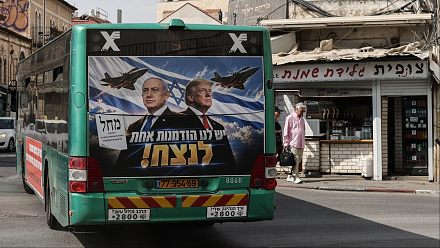
Netanyahu Dials Trump 'Every Day', Pushes Him For Renewed US Strikes On Iran
Israeli Prime Minister Benjamin Netanyahu has been calling US President Donald Trump every day to push for a resumption of military action against Iran, even as Arab and Muslim leaders intensify efforts to persuade Washi
লেখক Vani Mehrotra··68K বার পড়া
Netanyahu Dials Trump 'Every Day', Pushes Him For Renewed US Strikes On Iran
Israeli Prime Minister Benjamin Netanyahu has been calling US President Donald Trump every day to push for a resumption of military action against Iran, even as Arab and Muslim leaders intensify efforts to persuade Washington to give diplomacy more time, a Financial Times report said.
The report, citing a person briefed on the discussions, said regional leaders were urging Trump not to escalate the conflict and instead prioritise negotiations with Tehran. The diplomatic push comes amid growing concerns that a renewed US offensive could plunge the region into a deeper crisis.
“Netanyahu calls him every day [to urge him to resume the war]. Those who don’t want a war within the White House and outside have been trying to combat that,” a person briefed on the discussions was quoted as saying.
“The regional leaders are telling him not to escalate and prioritise negotiations,” the person added.
Netanyahu, who remains caretaker Prime Minister following Israel’s inconclusive elections, has been lobbying for renewed US-Israeli strikes aimed at forcing the collapse of Iran’s regime. However, a person familiar with the situation in Israel said that while Netanyahu wanted military action to resume, there was currently no “push” to persuade Trump to launch another offensive.
Trump Says Fresh US Strikes On Iran ‘Quite Unlikely’
Trump’s remarks following a meeting with Qatari Prime Minister Sheikh Mohammed bin Abdulrahman al-Thani at the White House have indicated a possible shift towards diplomacy.
The US President said there was “positive momentum” towards ending the conflict and suggested that another round of American strikes against Iran was unlikely.
“We are seeing positive momentum toward an end to this Conflict, and will ensure that America’s interests are at all times protected,” Trump wrote on his Truth Social platform.
He maintained that the US was “locked and loaded and ready to go”, but added that further military action “seems to be quite unlikely”.
Trump also said that Qatar, Saudi Arabia, the United Arab Emirates (UAE), Bahrain, Kuwait and other countries preferred maintaining the status quo, referring to the US naval blockade and Operation Iron Gate.
A diplomat briefed on the discussions described the meeting between Trump, Vice-President JD Vance and Sheikh Mohammed as “positive”, adding that there was an “agreement that diplomacy is the preferred way forward to get a deal”.
The leaders who have spoken to Trump in recent days include Saudi Crown Prince Mohammed bin Salman, UAE President Sheikh Mohamed bin Zayed al-Nahyan, Qatar’s Emir Sheikh Tamim bin Hamad al-Thani and Turkish President Recep Tayyip Erdoğan, according to people briefed on the calls.
At least four Arab and Muslim leaders have sought to convince Trump to hold off on fresh strikes, particularly amid concerns that he could launch a new offensive after his Republican Party’s poor performance in last Tuesday’s midterm elections.
The unpopularity of the US-Israeli war against Iran and its impact on fuel prices were among the key issues in the elections.
Arab Leaders Fear Wider Regional Crisis
The leaders pushing for restraint include Saudi Crown Prince Mohammed bin Salman, UAE President Sheikh Mohamed bin Zayed al-Nahyan, Qatar’s Emir Sheikh Tamim bin Hamad al-Thani and Turkish President Recep Tayyip Erdoğan.
There is a broad consensus among Arab and Muslim leaders that renewed military escalation could trigger a severe Iranian retaliation targeting their countries.
Anwar Gargash, diplomatic adviser to the UAE President, said the priority should remain diplomatic efforts to achieve a sustainable regional balance.
“The priority must remain the pursuit of political diplomatic solutions capable of producing a more sustainable regional balance,” Gargash said.
He also expressed hope that the outcome of the US midterm elections would reinforce diplomatic efforts to secure lasting peace and stability in the Gulf.
Iran, meanwhile, has warned that it is prepared to respond to any fresh attacks. Tehran has threatened to target undersea cables in the Strait of Hormuz and data centres in the region, besides expanding the conflict beyond the Middle East.