How Israeli Arab Parties Could Be Kingmaker After Exit Polls Projected They Won 18 Seats
Israeli Arab parties could emerge as kingmakers in the formation of the next government after exit polls projected that they would win 18 seats in the 120-member Knesset, potentially giving them a decisive role in determ
লেখক Vani Mehrotra··59K বার পড়া
How Israeli Arab Parties Could Be Kingmaker After Exit Polls Projected They Won 18 Seats
Israeli Arab parties could emerge as kingmakers in the formation of the next government after exit polls projected that they would win 18 seats in the 120-member Knesset, potentially giving them a decisive role in determining whether Prime Minister Benjamin Netanyahu or his opponents can secure a parliamentary majority.
According to exit polls published by Israel’s three major television channels, Ra’am and the Joint List were projected to win a combined 18 to 19 seats, marking a significant increase from their five seats each in the outgoing parliament, The Jerusalem Post reported.
The projections came as neither Netanyahu’s bloc nor the bloc led by his main rival, Gadi Eisenkot, appeared to have secured the 61 seats required to form a majority coalition government.
Revised exit polls, however, suggested a slight improvement in support for Netanyahu.
According to The Associated Press (AP), the updated projections indicated that his Likud party would emerge as the largest in parliament with around 27 seats, while both the broader Netanyahu-led bloc and the bloc led by Eisenkot were projected to win approximately 51 seats each.
The Arab-led parties were projected to win the remaining 18 seats, potentially placing them in a pivotal position in the post-election negotiations. However, the projections are not final results, and the official outcome could alter the political calculations.
How Arab Parties Could Influence Government Formation
Although the Arab-led parties are unlikely to join a governing coalition, they could still help determine which bloc is able to form a government.
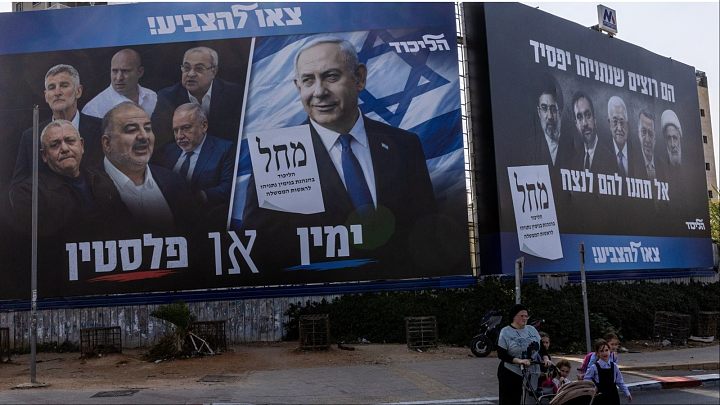
Parties allied with Netanyahu’s Likud, particularly those led by far-right leaders Itamar Ben-Gvir and Bezalel Smotrich, have ruled out including Arab parties in a government.
Opposition figures Naftali Bennett and Avigdor Liberman have also ruled out such an arrangement.
However, Ra’am or the Joint List could potentially support a government from outside the coalition, giving either bloc additional parliamentary backing without the Arab parties formally joining the government.
The AP reported that one possible route to a government would involve Eisenkot partnering with Arab-led parties. Such an arrangement, however, could prove politically difficult and risk alienating other opposition factions.
The coalition-building process is expected to involve negotiations among parties seeking to assemble the numbers needed to govern.
If no bloc manages to secure a majority, Israel could face weeks of political uncertainty, with the possibility of another election if negotiations fail.
Who Are Ra’am And The Joint List?
Ra’am and the Joint List are Israel’s two main Arab political parties or electoral groupings highlighted in the exit polls.
The Joint List comprises Hadash, described by The Jerusalem Post as a left-wing Arab-Jewish communist party; Ta’al, a secular Arab nationalist party; and Balad, a left-wing Palestinian nationalist party.
The projected gains would represent a substantial increase in their combined representation compared with the outgoing parliament, potentially strengthening their influence during negotiations over the next government.
The AP reported that Arab voters celebrated the exit-poll projections, while supporters of far-right parties aligned with Netanyahu expressed disappointment.
Higher Arab Voter Turnout Draws Attention
Arab voter participation became a major focus during the election campaign, with reports indicating significantly higher turnout in Arab communities than in previous years.
According to The Jerusalem Post, the Central Elections Committee reported a significant increase in Arab Israeli turnout.
The report cited the unrecognised Bedouin village of Atuana, where turnout had reached 64 per cent by early noon, the highest recorded in the country at that point. Two other villages ranked second and fourth, with turnout of 47.9 per cent and 47.8 per cent, respectively.
Reuters reported that turnout had reached 55.7 per cent in the first nine hours of voting, the fastest pace on record.
Arabs, most of whom are of Palestinian heritage, account for about 21 per cent of Israel’s population, Reuters reported, and have traditionally voted at lower rates than Jewish Israelis.
Arab politicians criticised what they described as inflammatory rhetoric directed at Arab voters during the campaign.
Reuters reported that Netanyahu warned supporters that Arab parties were receiving substantial support and that Arab voters were turning out in large numbers.
Final Results To Determine The Next Steps
The final election outcome will determine whether the exit-poll projections translate into an effective bargaining position for the Arab-led parties.
The AP reported that Israel’s President would ask the party leader considered most likely to form a government to assemble a coalition. If Likud emerges as the largest party, Netanyahu could argue that he has the strongest claim to lead that process, even if his bloc falls short of a majority.
However, the number of seats won by individual parties will not, by itself, guarantee a government. The decisive factor will be whether either side can secure sufficient support from other parties to reach the 61-seat threshold.
If the official results broadly match the exit polls, Ra’am and the Joint List could become crucial to negotiations, even without formally joining a coalition.