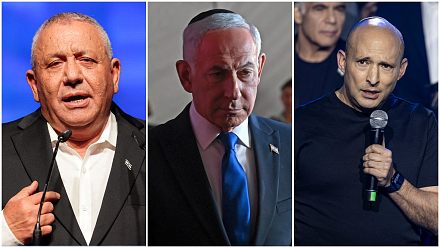
From Ex-Army Chief To Ex-PMs: Who Are Netanyahu's Key Challengers As Israel Braces For Polls
Israeli Prime Minister Benjamin Netanyahu faces a crucial electoral test as voters prepare to cast their ballots on Tuesday, with his long-held position under pressure from a field of rivals but no clear alternative emer
লেখক News Desk··80K বার পড়া
From Ex-Army Chief To Ex-PMs: Who Are Netanyahu's Key Challengers As Israel Braces For Polls
Israeli Prime Minister Benjamin Netanyahu faces a crucial electoral test as voters prepare to cast their ballots on Tuesday, with his long-held position under pressure from a field of rivals but no clear alternative emerging as a potential winner.
The election is taking place amid continuing regional tensions following the Hamas-led attack on Israel on October 7, 2023, which triggered wars in Gaza and Lebanon and a wider confrontation involving Iran.
Netanyahu’s Likud party has faced a decline in support since the attack, which raised questions about the government’s handling of national security. However, the race has tightened, leaving the outcome and the shape of the next government uncertain.
Under Israel’s proportional representation system, voters choose parties rather than individual candidates. Parliamentary seats are distributed according to each party’s share of the vote, making coalition-building crucial to securing power.
Netanyahu Fights To Retain Power
Netanyahu, 77, has been one of Israel’s most dominant political figures, serving as prime minister for much of the period since 2009, following an earlier term in the 1990s.
His supporters view him as a strong leader capable of protecting Israel in a volatile region. Critics, however, have questioned his security record and policies on religion and state affairs.
Netanyahu is also standing trial in Israel on corruption charges, which he denies. The International Criminal Court has issued an arrest warrant over alleged war crimes in Gaza, accusations he rejects.
Despite the challenges, Netanyahu remains a seasoned political operator and has said he wants to form a “broad national” government if his bloc secures enough support.
Ex-Army Chief, Former PMs Lead Challenge
Among his prominent challengers is former military chief Gadi Eisenkot, 66, who leads the centrist Yashar party. He has presented himself as a security-focused alternative to Netanyahu, drawing on his military background and personal loss after his son was killed while fighting in Gaza.
Former prime minister Naftali Bennett, 54, has joined forces with another former premier, Yair Lapid, in the Together party. The alliance brings together right-wing and centrist figures, with a campaign focused on national recovery and political change. Bennett and Lapid previously joined hands to remove Netanyahu from office in 2021.
Avigdor Lieberman, 68, a former defence minister and once a close Netanyahu ally, is another prominent challenger. He left the prime minister’s government in 2018, accusing him of being too soft on Palestinian militants. His Israel Our Home party draws considerable support from voters of former Soviet Union origin.
Former general Yair Golan, 64, leads the Democrats, a left-wing alliance built around Labour and Meretz’s political legacy.
Far-Right Allies And Smaller Parties Matter
Netanyahu’s political future also depends on his right-wing and ultra-Orthodox partners. Finance Minister Bezalel Smotrich and National Security Minister Itamar Ben-Gvir have attracted international criticism for their hardline policies towards Palestinians, including support for settlement expansion and proposals to remove Palestinians from Gaza.
The ultra-Orthodox parties Shas and United Torah Judaism have also been important coalition partners. Their opposition to compulsory military service for much of their community has become a contentious election issue during wartime.
Meanwhile, Arab parties Raam and the Joint List, along with smaller right-wing and centre-right groups, could influence the balance of power if neither main bloc wins a clear majority.