Eisenkot Invited Opponent Netanyahu To Join His ‘Unity’ Govt, But Bibi Has 3 Other Options Too: What Are They?
Following Israel’s general election on October 27, which left both main blocs short of a parliamentary majority, President Isaac Herzog has officially tasked Gadi Eisenkot, leader of the Yashar party, with forming the ne
লেখক Manjiri Joshi··57K বার পড়া
Eisenkot Invited Opponent Netanyahu To Join His ‘Unity’ Govt, But Bibi Has 3 Other Options Too: What Are They?
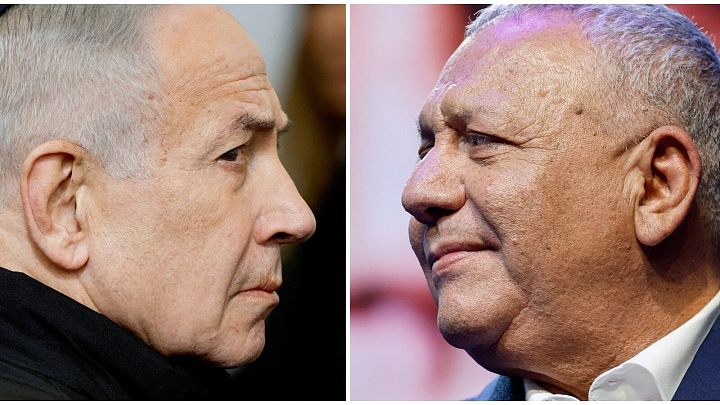
Following Israel’s general election on October 27, which left both main blocs short of a parliamentary majority, President Isaac Herzog has officially tasked Gadi Eisenkot, leader of the Yashar party, with forming the next coalition government. Eisenkot explicitly invited his opponent Benjamin Netanyahu’s Likud party and even his far-right ally, Bezalel Smotrich, to join a broad, national emergency unity government.
Is that possible? Who will be in opposition then? Will Netanyahu take up the offer? What if he does and doesn’t?
Neither bloc secured a 61-seat majority in the 120-seat Knesset during the October election. Eisenkot’s four-party alliance secured 48 seats, while Netanyahu’s right-wing and religious bloc won 53 seats. Because Eisenkot has ruled out partnering with the Arab-led parties (who won 19 seats), bringing Netanyahu’s Likud party into a unity government represents a primary path to achieving a majority.
THE POSSIBILITIES
1. The Broad Unity Government (Eisenkot’s Proposal)
Eisenkot has explicitly invited Netanyahu’s Likud party and Bezalel Smotrich to join a broad, national emergency unity government.
Eisenkot insists this government must be strictly under his leadership and principles. Under this framework, Netanyahu would serve as a senior minister (likely holding a portfolio like Foreign Affairs or Defense) but would step down as Prime Minister.
The roadblock: Netanyahu has spent his entire career avoiding the role of junior partner. It is highly unlikely he will agree to surrender the premiership voluntarily, especially while managing his ongoing legal trials, say experts.
2. A Rotational Prime Minister Deal (The Gantz Precedent)
To break the deadlock, negotiators could look to the 2020 Netanyahu-Gantz power-sharing agreement. Netanyahu and Eisenkot could agree to a rotating premiership. For example, Eisenkot serves as Prime Minister for the first two years, followed by Netanyahu for the final two years (or vice versa).
This shares top-tier executive power and gives both leaders a victory to present to their respective bases, say reports.
The roadblock: In the 2020 deal, Netanyahu triggered an early election before Benny Gantz could take his turn as prime minister. Eisenkot’s center-left and centrist allies will fiercely oppose any deal relying on Netanyahu’s future compliance.
3. Netanyahu Splintering Eisenkot’s Bloc
Instead of Netanyahu joining an Eisenkot-led government, Netanyahu could attempt to dismantle Eisenkot’s 48-seat four-party alliance.
Netanyahu’s right-wing bloc holds 53 seats. He only needs to convince 8 lawmakers from Eisenkot’s diverse coalition to defect and join him to reach the 61-seat majority.
The strategy: Analysts note that Netanyahu is using his current position as caretaker prime minister to stall. If he can pressure individual hawkish or ultra-Orthodox-adjacent members of Eisenkot’s bloc to jump ship during Eisenkot’s 28-to-42-day negotiating window, Netanyahu could successfully form a government without ever bowing to Eisenkot.
4. Direct Failure and Passing the Mandate
Neither leader budges. Eisenkot refuses to serve under Netanyahu, and Netanyahu refuses to serve under Eisenkot, say reports.
If Eisenkot cannot convince Netanyahu to join him or successfully court the ultra-Orthodox parties on his own, his mandate will expire after a maximum of six weeks. The mandate would then likely pass to Netanyahu, forcing the exact same mathematical dilemma in reverse, or ultimately triggering yet another snap election.
WHO WILL BE IN OPPOSITION?
Arab-Led Parties (19 seats): Having won a historic 19 seats in the October 27 election, these parties would decisively lead the opposition benches. Although they officially endorsed Eisenkot for the mandate to block Netanyahu, Eisenkot has firmly ruled out partnering with them to form a government.
While Eisenkot specifically extended an invitation to Netanyahu’s far-right ally, Finance Minister Bezalel Smotrich (Religious Zionist Party), ultra-nationalist figures may refuse to serve under a centrist, ex-military chief like Eisenkot. If Smotrich or Itamar Ben-Gvir’s factions opt out, they will join the opposition from the right.
Eisenkot heads a diverse four-party alliance holding 48 seats. Certain factions within this bloc ran on a strict platform of never sitting in a government alongside Netanyahu due to his ongoing legal and political controversies. If Eisenkot seals a deal with Netanyahu, these hardline anti-Netanyahu lawmakers may defect from the coalition to sit in the opposition.
If a full “Grand Unity” agreement succeeds, Israel would see a highly unusual parliamentary dynamic where the opposition is overwhelmingly dominated by the 19 seats of the Arab-led parties, alongside any ideological holdouts from the far-right or center-left who refuse to compromise, say analysts.