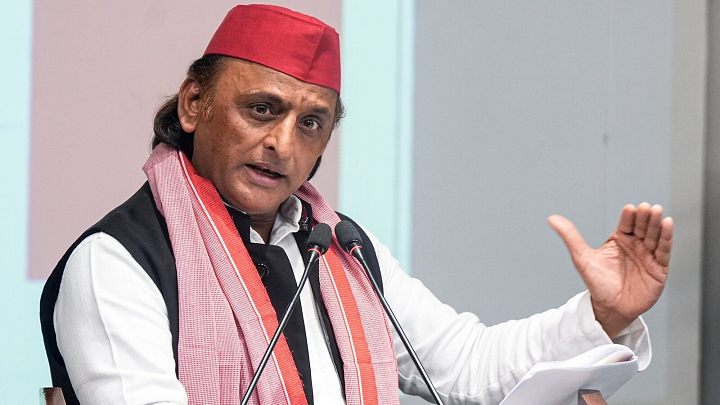
Akhilesh’s New 2027 Strategy: 75 Districts, 75 Manifestos — Why SP Is Going Hyper-Local
Can a single election manifesto address the very different political, economic and social needs of all 75 districts of Uttar Pradesh? Samajwadi Party chief Akhilesh Yadav appears to be answering that question with a new
লেখক Oliver Fredrick··109K বার পড়া
Akhilesh’s New 2027 Strategy: 75 Districts, 75 Manifestos — Why SP Is Going Hyper-Local
Can a single election manifesto address the very different political, economic and social needs of all 75 districts of Uttar Pradesh? Samajwadi Party chief Akhilesh Yadav appears to be answering that question with a new electoral experiment: one state, but a separate manifesto for every district.
For the 2027 Uttar Pradesh Assembly elections, the SP plans to prepare district-wise manifestos in addition to its broader state manifesto, with local issues, aspirations and development priorities forming the core of the exercise. Akhilesh Yadav announced the plan on September 10, saying the party would not restrict itself to a state-specific document but would prepare district-level manifestos focusing on issues specific to each area.
The move represents a significant change in the party’s traditional manifesto politics. For decades, parties have generally presented voters with a common set of promises for the entire state. Akhilesh’s plan seeks to take the manifesto from the state level to the district and grassroots level.
The political message is simple: Uttar Pradesh may have one election, but its voters do not have one set of problems.
Why One Manifesto May Not Be Enough
Uttar Pradesh’s 75 districts have sharply different economic structures, social compositions and political priorities.
The concerns of an industrial and rapidly urbanising district such as Gautam Buddh Nagar are unlikely to be identical to those of a predominantly agricultural district in Bundelkhand. Purvanchal has its own concerns around migration, employment and infrastructure, while western Uttar Pradesh has a strong agricultural, sugar and industrial economy.
Even within regions, local political equations can differ substantially.
The SP’s new approach is therefore aimed at identifying what matters to voters district by district, rather than assuming that a promise that works across the state will have the same electoral appeal everywhere.
According to the plan, district-level party functionaries have been asked to identify key problems, stalled or neglected projects, existing employment opportunities and local aspirations. An earlier SP exercise had also focused on preparing detailed lists of social, economic and developmental issues specific to different regions.
Political analyst Dr Shashikant Pandey, Head of the Department of Political Science at Dr Bhimrao Ambedkar University, Lucknow, sees the move as part of a broader attempt by Akhilesh Yadav to make the SP’s electoral strategy more responsive to the state’s diversity.
“The importance of a district-wise manifesto is that it takes the political conversation from a broad state-level narrative to the issues that people experience in their own area. Uttar Pradesh is socially and economically diverse, and local priorities can vary significantly from one district to another. This approach can help the Samajwadi Party make its campaign more directly relevant to voters.”
From PDA To Local Issues
The timing of the strategy is equally significant.
Akhilesh Yadav enters the 2027 contest with the SP having emerged as the single largest party from Uttar Pradesh in the 2024 Lok Sabha elections, winning 37 of the state’s 80 seats. The BJP’s tally fell to 33, while the Congress won six.
The SP’s 2024 performance was widely linked to its PDA — Pichhada, Dalit, Alpsankhyak — strategy, through which the party attempted to expand beyond its traditional Muslim-Yadav support base.
But the 2027 Assembly election requires a different kind of mobilisation.
Unlike a Lok Sabha election, where national leadership and national issues can dominate, an Assembly election brings governance closer to the everyday life of the voter. Roads, electricity, irrigation, schools, hospitals, jobs, farmers’ issues and local infrastructure can become much more important.
The district manifesto strategy could therefore provide the SP with a way to combine its larger PDA narrative with hyper-local issues.
Dr Pandey said this could also help the party’s organisational machinery.
“This is not simply an exercise in writing 75 documents. If implemented properly, it can become an exercise in political feedback. The party gets to know what people in different districts are demanding, while its local organisation gets a concrete agenda around which it can mobilise voters.”
The caste equation also changes from district to district
There is another electoral calculation behind the strategy.
Uttar Pradesh’s caste arithmetic is not uniform. The relative strength of different OBC communities, Dalit sub-groups, upper castes and minority voters changes across regions and districts.
A statewide manifesto cannot easily accommodate these differences.
A district-specific document, however, gives the SP greater flexibility to highlight issues that have particular resonance in that area while keeping its larger statewide political framework intact.
This becomes particularly relevant for the SP as it tries to consolidate the social expansion achieved through the PDA strategy.
Dr Pandey has previously described Akhilesh’s effort to broaden the party beyond its traditional Muslim-Yadav base as a continuation of a longer process of social expansion.
“The district-level approach can complement the PDA strategy because social coalitions themselves are not identical across Uttar Pradesh. The challenge for the SP will be to maintain a common statewide political message while simultaneously responding to the different social and developmental expectations of individual districts,” Dr Pandey said.
What Will The District Manifestos Contain?
The SP’s exercise is expected to focus on practical issues rather than simply reproducing the promises contained in a state manifesto.
Party workers have been asked to identify five key problems in each district, along with projects that have remained incomplete or neglected and employment opportunities that can be developed locally.
Education and healthcare, employment and industry, farmers and artisans, infrastructure and tourism are among the broad areas expected to feature in the exercise.
That could mean a district manifesto for a tourism-heavy area may emphasise connectivity, tourism infrastructure and local employment, while an agricultural district could receive greater focus on irrigation, procurement, storage, farmers’ income and agro-based industries.
The strategy could also allow the party to identify district-specific employment models rather than relying only on generic promises of job creation.
Youth, Women And The New Electorate
The SP’s broader 2027 preparations indicate that the party is also trying to expand its appeal among younger voters, women and the IT sector.
The party is looking at issues concerning Gen-Z and Gen-Alpha, including employment, education and competitive examinations. Its emerging manifesto agenda has also included issues such as preventing paper leaks and expanding Lucknow’s IT ecosystem.
This fits naturally with the district manifesto experiment.
The aspirations of a young voter in Lucknow, Noida or Kanpur may be very different from those of a young voter in a smaller eastern UP district. A district-wise exercise gives the SP the opportunity to identify those differences.
A direct challenge to BJP’s development narrative
The move also comes at a time when the BJP has intensified its own district-level outreach.
Chief Minister Yogi Adityanath has visited more than 44 of Uttar Pradesh’s 75 districts since May and launched or laid the foundation stones for development projects worth more than ₹38,000 crore across 115 Assembly constituencies. These include roads, schools, hospitals, water and electricity projects, tourism and skill-development initiatives.
The BJP’s approach is effectively to take development projects to the constituency. The SP’s response is to take political promises to the district. That could make local development a major battleground of the 2027 election.
Dr Pandey believes the SP will have to ensure that its new strategy goes beyond presentation.
“The BJP has the advantage of government machinery and can showcase completed and ongoing development projects directly before voters. For the SP, therefore, the district manifesto will have value only if the promises are specific, credible and connected to issues people genuinely face. Otherwise, 75 manifestos could become only a larger version of one manifesto.”
The Real Test: Implementation
The biggest challenge for Akhilesh Yadav will be converting this ambitious exercise into an effective electoral instrument.
Preparing 75 documents is considerably easier than ensuring that every document contains realistic and measurable commitments.
There is also the risk of creating contradictions between district-specific promises and the party’s overall state policy. The SP will have to maintain a balance between localisation and a coherent statewide vision.
But politically, the strategy gives Akhilesh an opportunity to change the nature of the 2027 campaign.
Instead of asking voters to respond only to the question of who should govern Uttar Pradesh, the SP can frame the contest around another question: What will an SP government specifically do for your district?
That could prove particularly important in an election expected to be closely fought across 403 Assembly constituencies.
The strategy also reflects how the SP’s campaign is evolving. The party is no longer relying solely on its traditional social coalition or a single statewide manifesto. It is attempting to combine PDA politics, youth outreach, local grievances and district-level development demands into one electoral framework.