The Millennial Mom | Postpartum, Breastfeeding, And The Bittersweet Reality No One Prepared Me For
We came home with our twins – something we had dreamt of for far too long. We were happy, celebrating, but cautious. Like a typical millennial mother, I was wary of people coming in too early to meet my babies, more so b
লেখক Pragati Ratti··11K বার পড়া
The Millennial Mom | Postpartum, Breastfeeding, And The Bittersweet Reality No One Prepared Me For
We came home with our twins – something we had dreamt of for far too long. We were happy, celebrating, but cautious. Like a typical millennial mother, I was wary of people coming in too early to meet my babies, more so because they were premature and, therefore, more sensitive. But as cautious as a mother can be, some things are simply beyond your control.
Both my babies’ jaundice levels kept rising and, two days later, they were back in the NICU. And then came the hardest part – leaving them there and coming home without them.
I remember constantly crying at the hospital at the very thought of going home without them, and then crying again as I entered our home without them, just two days after we had welcomed them into it. In those two days, I had already gotten used to their presence – their tiny bodies, their sounds, their smell, the fact that there were suddenly two babies in our home. Leaving them at the NICU and coming back without them completely tore me apart. That was one of the most difficult days of my life. Yes, one of the most difficult. I’ll talk about the most difficult day some other time.
But sunshine returned. The very next day, the twins were doing better and we could bring them home.
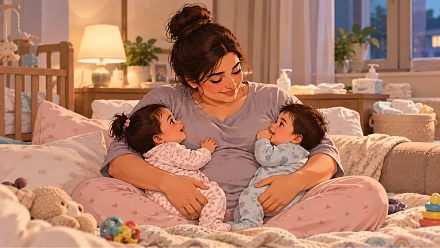
The next few weeks, and then months, felt like they went by far too quickly. The first few days were a complete blur. I was just soaking in motherhood – cuddling my babies, talking to them, staring at them for no reason at all. There is something completely magical about becoming a mother for the first time, and I think that magic becomes even more intense when you have waited for it for so long. Their tiny hands gripping your fingers, those little fingers trying to touch your cheeks and your nose – it makes you want time to stand still. Except time seems to fly faster than it ever has.
Their first smile. The way they smiled while sleeping. Those blink-and-you-miss-it moments that come with being a new mother. And with two babies, I was constantly trying to make sure I didn’t miss the firsts of either of them. Burping them, holding them, laying them both on me – if I could go back in time, I probably would.
But that’s one side of new motherhood.
The uglier side of postpartum is something no one really prepares you for. And I say this with utmost responsibility: I had a C-section delivery. The most beautiful thing about it was that I was fully conscious and aware when my babies came out of my body. But that was about it.
After the C-section, I was back in my hospital room while my babies were taken to the NICU. Which meant that if I wanted to see them, I had to get up and go there. Doctors encourage skin-to-skin contact for babies in the NICU, and I wanted to do everything I could for my babies. But to do that, I first had to get off my hospital bed.
A few hours after coming back to my room, it was time to stand up. I had been told that there would be bleeding when I got up after the C-section. But nobody had prepared me for the sheer amount of blood I was about to see.
First came the struggle to get out of bed. I couldn’t believe my body was just not in sync with my mind. I kept wondering, why the hell is simply getting up feeling this impossible?
My mother eventually held me and helped me up. And then came reality check, part two – the blood.
I could hear it flowing, almost like someone had opened a tap and forgotten to turn it off. I was crying, partly from the pain, partly from the shock. If you’re a mother who has been through this phase, I want to give you a hug right now.
I don’t know what women are made of, to be able to go through moments like these and somehow leave them behind us and keep moving.
The next thing I knew, there was a wheelchair in front of me to take me to the NICU. Thank God, I don’t have to walk to the NICU, I remember thinking.
By the time I reached the NICU, I had completely forgotten how I had struggled to get out of bed just minutes earlier. Because I was standing beside my babies. I was waiting to pick them up, one by one, hold them and feel them.
And just when I held my baby girl for the first time, a doctor walked in with reality check, part three.
It was time to breastfeed.
I thought I was completely ready for it. I mean, how difficult could breastfeeding possibly be? Until the latching practice began.
That first latch was basically me thinking, “What just happened?”
Breastfeeding for the first time was extremely painful. I kept wondering how something could hurt so much when the baby didn’t even have a single tooth. It genuinely felt like I was being bitten by someone with absolutely no teeth.
And as much as I wanted to exclusively breastfeed both my babies, in that moment I thought, How am I going to do this if it hurts this much?
And this was just one baby. The second baby was yet to latch.
But there was another difficult truth waiting for me when I started breastfeeding: I wasn’t making enough milk.
If you’re a mother who has been in the same boat, you probably know the feeling. You start wondering if your body is failing you. I had examples all around me – a sister who was exclusively breastfeeding her child, friends who were producing so much milk that they were freezing it for later. And here I was, trying everything I could, but my body simply wasn’t producing enough to satisfy two babies.
My babies had to have a combination of breastmilk and formula, and I won’t lie – I kept beating myself up over it.
I tried everything. Making them latch one by one. Breastfeeding both simultaneously – tandem feeding, as it’s called. Pumping. Pumping again. Pumping at night. Feeding when they were awake. Trying to increase my supply.
But it still wasn’t enough.
My doctor kept telling me not to beat myself up over it. What mattered was that the babies were well fed, whether that milk came from me or from formula. But sometimes knowing something intellectually and actually accepting it emotionally are two very different things.
I was pumping while the babies slept at night, breastfeeding when they were awake, and somehow trying to keep myself functioning in between. I was hardly sleeping. And slowly, I could feel myself losing my sanity.
Eventually, I gave in.
I made peace with whatever amount of milk my body was able to produce and fed my babies a combination of breastmilk and formula.
And then came another reality of having newborns – you have to feed them constantly, every two hours. Those early months meant feeding them through the night too. And how do you do that with twins?
We tried keeping our twins on a schedule and feeding them simultaneously with bottles. My husband would feed one baby, I would feed the other. It was the only way we could survive those nights.
But here’s another problem – while my maternity leave was six months, his paternity leave was just 15 days. That’s a problem. A big one. A father has to be as present as a mother in those first few weeks. So why does he have to return to work in 15 days? We need better parental leave policies here.
I had an incredible support system at home, and I still do. My in-laws live with us and have been there ever since we did our embryo transfer during IVF. My parents have always turned up whenever I needed them. I had help, love and people around me.
And yet, there were some things I had to do on my own. The most difficult one, surprisingly, was taking care of myself.
I had heard a lot about “breastfeeding makes you lose weight.” Whoever started that rumour, I would like to have a word.
While I produced whatever quantity of milk I could, I was hungry all the time. I was eating pretty much every few hours. And then there was the food new mothers in India are traditionally encouraged to eat – lots of ghee, rich panjiri, laddoos and everything that is supposed to “build your strength”.
Here’s the number game for you. I was 60 kg when I started IVF. I was 74 kg on the day I delivered my twins. Over the next couple of weeks, I came down to 70 kg. And then, my dear friends, within the next eight to ten months, I touched the milestone of 80 kg.
At that point, my body didn’t even feel like mine. But I didn’t have the capacity to do anything about it. Mentally, I was full. Physically, I had no energy left. I was barely sleeping and, after six months, I was back at work full-time.
And when I restarted work, I realised something: even six months of maternity leave had felt too short.
But here’s the thing – I wasn’t thinking about my weight then. I wasn’t looking at myself and wondering what had happened to my body. I wasn’t making fitness plans or worrying about getting back into shape. I was completely focused on being the perfect mother to my two babies while simultaneously trying to remain present in my career.
Somewhere in that process, I disappeared a little.
Cut to today. It’s been about two years since those chaotic months. The kids are now over three years. I feel better. But I still won’t say I’m completely out of the trenches.
Oh, and the weighing scale says 55 kg. How? Well, that’s a story for another Friday.