Mumbaikars, Are You Ready To Get Bewitched By Sandwiches?
For decades, Mumbai’s sandwich culture has been defined by the humble roadside sandwich — toasted bread, potato, chutney, cheese, vegetables and a generous swipe of butter or green chutney. The city has also had its icon
লেখক Abigail Banerji··26K বার পড়া
Mumbaikars, Are You Ready To Get Bewitched By Sandwiches?
For decades, Mumbai’s sandwich culture has been defined by the humble roadside sandwich — toasted bread, potato, chutney, cheese, vegetables and a generous swipe of butter or green chutney. The city has also had its iconic vada pav, a food that can be eaten on the move for a few rupees. But in the last few months, a very different kind of sandwich has been making its way into Mumbai’s food scene.
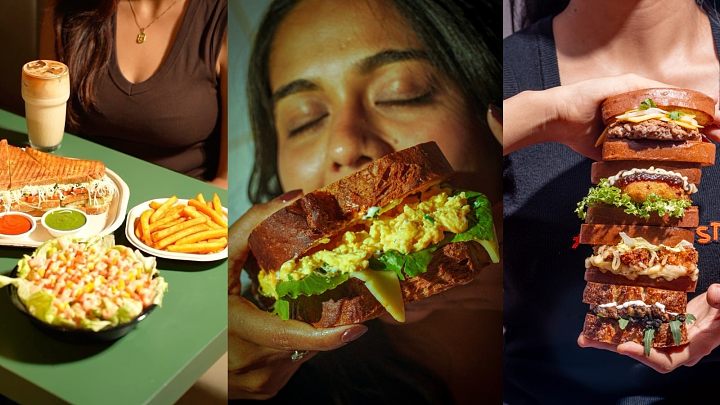
From Bandra to Khar, chefs and founders are increasingly building restaurants around the sandwich as a hero product rather than treating it as one more item on a café menu.
This year, Staqx was among the first of the new wave to build its restaurant concept around sandwiches, followed by Angry Toast and Even Steven. Rost in Khar, meanwhile, puts French toast at the heart of its menu but also has sandwiches as part of its offering. And while the format feels new again, Mumbai has had a specialist in the category for decades: Sandwizzaa, which opened its first outlet in Santacruz in 1986 and spent four decades building a business around the category.
The timing may be new, but the thinking behind it is surprisingly simple: sandwiches are familiar enough to be comforting, versatile enough to work across meals and flexible enough to give chefs room to experiment. More importantly, they can occupy a space between everyday food and a premium dining experience.
“The sandwich has finally started getting recognised as a category in its own right rather than just something you find somewhere on a café menu,” says Pankaj Sharma, Director, Sandwizzaa. “It is familiar, easy to understand and yet gives chefs enormous freedom to experiment with breads, fillings, formats and flavours.”
That versatility is one of the reasons chefs are now asking whether the sandwich deserves the same attention that pizza, burgers and handmade pasta have received over the years.
For Chef Karishma Sakhrani of Rost in Khar, the shift is connected to the way people want to eat today. “There’s been a real shift towards food that is casual, convenient and familiar, but still exciting enough to feel like an experience,” she says. “Sandwiches sit right in that space.”
And Chef Christopher Fernandes, Consultant Chef at Even Steven in Bandra, is keen to agree. A sandwich can be much more than a “quick, convenient meal and” and he says, “We wanted to give it the attention usually reserved for other food formats.”
Why sandwiches, and why now?
Unlike a restaurant built around a more elaborate cuisine, a sandwich-focused concept comes with an instantly understandable proposition. You know what you are walking in for. For founders, that clarity can also become part of the brand identity.
At Angry Toast in Bandra, founder Kedarnat Shetty says the idea was to make the proposition deliberately uncomplicated. “Mumbai has many places that serve sandwiches, but very few that are truly focused on sandwiches as a category,” he says. “We wanted to create a brand where the focus is very clear that it is good sandwiches and good coffee, and nothing else.”
Sandwiches also have an all-day quality to it that is perhaps one of its biggest advantages. A burger can be lunch or dinner; a pizza can work across meals, but a sandwich can move effortlessly from breakfast to an evening snack without feeling out of place.
At Staqx in Bandra, Chef Beena Norohna says her decision was driven less by market data and more by the creative possibilities of the format. “There was definitely an international movement towards focused concepts, but for me it was more instinct than data,” she says. “Mumbai has always travelled for that one great vada pav, dosa, kebab or sandwich. I liked the idea of creating a place people would know for one thing.”
For her, the sandwich also works almost like a blank canvas. “I’ve worked with many different cuisines, so sometimes an idea starts with a completely unrelated dish and I think, can I turn this into a sandwich? That’s what keeps it exciting for me.”
At Rost, Sakhrani sees the same flexibility as a reason the category has room to grow. “There’s something incredibly democratic about a sandwich. It’s familiar, portable and comforting, but it also gives you a huge amount of creative freedom.”
The premium sandwich vs the Rs 50 roadside sandwich
This is where Mumbai’s new sandwich culture gets interesting. The city already knows how to make a sandwich cheaply, quickly and well. So what happens when the same basic format moves into a restaurant and costs several times more?
At Angry Toast, Shetty points out that the premium proposition does not necessarily mean abandoning Mumbai’s sandwich traditions. “Honestly, we’re also serving something as simple as a Mumbai toastie like potato masala, chutneys and cheese. Instead of a Rs. 50 sandwich, ours may be around Rs. 200, but you’re getting better-quality bread, ingredients and oils.”
The question, then, is how much this premium sandwich costs the customer?
The customer has options at Angry Toast, with 2 pieces of the milk bread-made ‘Mumbai Toastie’ (the cheapest on the menu) costing you Rs 195 and Rs 375 for 4 pieces. If you opt for Sourdough, the ‘Olive and Mushroom Tapenade’ is the least expensive sandwich on the menu at Rs 325 and Rs 375, and the Jerk Chicken is Rs 325 (2 pieces) and Rs 625 (4 pieces)
At Rost, ‘The Samurai’, a brioche sando, starts from Rs 325, with the most costly dish being the ‘Prawn Star’ – Rs 625. A customer will pay anywhere from Rs 550 to Rs 700 for a vegetarian sandwich, while a non-vegetarian sando can cost from Rs 650 for a ‘Pesto Chicken Sando’ and the ‘Fried Chicken Donut’ to Rs 925 for ‘Pain Suisse Smash’ at Even Steven.
After ‘School Special’, a delicious yet simple green chutney sandwich at Staqx costs Rs 350, the least expensive. Sandwiches like ‘Like A Chic’ and ‘The Drip Dealer’ have a price tag of Rs 625 and Rs 875, respectively.
Across these restaurants, the prices work out to an average of ₹550 per sandwich — a considerable jump from Mumbai’s roadside sandwich. But the chefs argue that customers are not simply paying for bread and filling. They are paying for the quality and labour behind those components.
Fernandes says the sandwiches are built around “house-made sauces, carefully considered fillings and completely customised breads that are developed to work with each combination.” The restaurant also uses what he describes as “exceptional-quality meats that don’t come from cold storage”.
At Angry Toast, the bread itself has been a major part of the development process. Shetty says, “We make our breads completely in-house. Bread quality is a very important part of our product. It took us a year to get the shape, consistency and quality right.”
At Rost, the premium is similarly about technique rather than simply adding expensive ingredients. “The bread needs to work with the filling, the filling needs to have enough flavour, and there has to be a balance of textures,” says Sakhrani. “The sauces are also really important because they can bring the whole thing together.”
Staqx takes the same approach to ratios. “I’m very particular about sauces, condiments, bread and especially ratios,” says Chef Beena. “You can have an amazing filling, but too much bread or sauce can ruin the whole sandwich.”
Sandwizzaa got here first
Long before sandwich-only concepts began appearing across Bandra and Khar this year, Mumbai already had a brand built around the idea.
Sandwizzaa opened its first outlet in Santacruz in 1986, making it one of the city’s early dedicated sandwich businesses. Forty years later, its sandwich-first identity remains central even as the brand has expanded into cafés, beverages, coffee, fries, delivery and newer formats.
For Sharma, the current wave is less about a sudden discovery and more about a category finally getting the attention it has always deserved. “When Sandwizzaa began, the thinking was quite simple. Rather than trying to be known for ten different things, we wanted people to know us for one thing,” he says.
And the new restaurant continues to face the same pressure when they choose to focus on a single dish. When you are serving multiple cuisines or categories, you can theoretically have a weak dish hidden among several strong ones. A sandwich-only restaurant does not have that luxury.
“If you’re telling people sandwiches are what you do, they have to be good every single time,” says Chef Beena.
Fernandes describes the same pressure: “Keeping the menu focused also means there’s nowhere to hide. When you’re putting your name behind one thing, every component has to deliver.”
And for a city that has been eating sandwiches for generations, this new wave is not about replacing the humble sandwich but making way for a new way to present a much-loved dish.