Kangana Ranaut’s Himachali Style Had a Story to Tell: From a Statement Topi to a Kullu Shawl for President Murmu
Kangana Ranaut brought a distinctly Himachali touch to her meetings with President Droupadi Murmu in Manali, choosing traditional clothing that placed the region’s textiles, embroidery and cultural symbols at the centre
লেখক Swati Chaturvedi··22K বার পড়া
Kangana Ranaut’s Himachali Style Had a Story to Tell: From a Statement Topi to a Kullu Shawl for President Murmu
Kangana Ranaut brought a distinctly Himachali touch to her meetings with President Droupadi Murmu in Manali, choosing traditional clothing that placed the region’s textiles, embroidery and cultural symbols at the centre of both appearances.
The actor and BJP MP from Mandi first met President Murmu at the historic Hidimba Devi Temple and later joined her for a courtesy meeting at Paridhi Grih. For the second occasion, Kangana also presented the President with a traditional Kullvi shawl, making her choice of clothing feel particularly fitting for a visit centred around Himachal Pradesh.
For both appearances, Kangana stayed rooted in the region’s traditional aesthetic, wearing velvet separates, colourful embroidered detailing, a Himachali topi and a Kullu shawl.
View this post on Instagram
A post shared by Kangana Ranaut (@kanganaranaut)
Kangana Ranaut’s Himachali look at Hidimba Devi Temple
For her visit to the Hidimba Devi Temple, Kangana chose an olive-gold crushed velvet kurta with a matching salwar. The silhouette was relatively relaxed, with a straight cut and wide sleeves, allowing the intricate detailing around the neckline and cuffs to take centre stage.
The embroidered yoke brought most of the colour into the otherwise muted look. Panels in pink, royal blue, green and orange were arranged in geometric patterns, including diamonds and triangles reminiscent of motifs traditionally seen in Kullu textiles.
The same detailing continued along the wide cuffs, while a line of small woollen pom-pom buttons in pink and blue added a distinctly handcrafted finish to the front of the kurta.
She paired the outfit with a two-toned dupatta in emerald green and royal blue, with the colours echoing the embroidery on the kurta. Gold jhumkas, a small red bindi and her hair pulled into a low bun completed the look.
But the accessory that immediately made the outfit recognisably Himachali was her traditional topi.
Kangana’s version featured a pink crown, a green velvet band and a gold brooch placed at the front. The Himachali cap is closely associated with the cultural identity of the state and is often worn as a symbol of regional pride. Decorative gold or silver ornaments attached to the cap are traditionally known as Chand or Joth, with the crescent-shaped versions particularly associated with the style.
For President Murmu meeting, the dupatta made way for a Kullu shawl
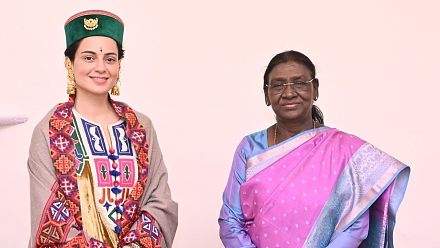
For her later courtesy meeting with President Murmu at Paridhi Grih, Kangana retained the same olive-gold velvet kurta and salwar but changed the styling.
Instead of the emerald-and-blue dupatta, she draped a traditional Kullu shawl over her shoulders. The soft grey-beige base allowed its colourful border to stand out, with bands of red, orange, pink and blue arranged in geometric patterns.
She kept the green Himachali topi and gold jhumkas from the earlier look, while adding rings and a gold watch.
The styling also created a visual contrast with President Murmu, who wore a pink and lilac silk saree with a silver border.
Why the Kullu shawl matters
The shawl Kangana presented to President Murmu was more than a formal gift. Kullu shawls are among Himachal Pradesh’s most recognised traditional crafts and are known particularly for their colourful geometric borders.
Traditionally, the shawls are woven using twill techniques and can be made from local sheep’s wool as well as finer fibres such as pashmina, angora and merino. The distinctive borders are created using an extra-weft technique, with traditional weavers developing intricate patterns without relying on graph paper or detailed sketches.
Historically, Kullu shawls were also made in simpler plain, checked and plaid designs. Master weaver Tanjenram Bhagat is widely credited with developing the more distinctive Kullu shawl style in 1942, helping shape the craft’s visual identity as it is recognised today. The craft received a Geographical Indication (GI) tag in 2004.
That history made Kangana’s choice particularly significant. As an elected representative from Mandi, her decision to wear regional textiles while meeting the President and to gift her a Kullvi shawl during a visit to Himachal, brought attention to a craft deeply connected to the landscape and communities of the state.
Rather than treating traditional Himachali clothing as simply ceremonial dressing, Kangana’s two looks showed how the region’s textiles, embroidery and accessories can become the centre of a contemporary fashion moment while still retaining their cultural meaning.