Is Seed Cycling Good For Hormones? Here’s What An Expert Says About This Wellness Trend
For most women, periods already come with enough scheduling. There are apps to track it, reminders to carry a pad, and if you’re like me, calculations for when the cramps might arrive. And, now, apparently, there’s a see
লেখক Mallika Bhagat··10K বার পড়া
Is Seed Cycling Good For Hormones? Here’s What An Expert Says About This Wellness Trend
For most women, periods already come with enough scheduling. There are apps to track it, reminders to carry a pad, and if you’re like me, calculations for when the cramps might arrive. And, now, apparently, there’s a seed timetable too.
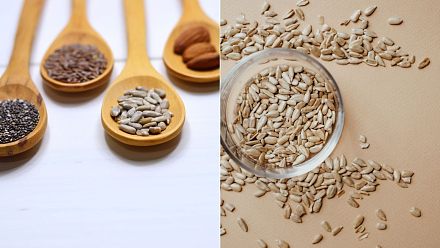
This wellness trend (which isn’t exactly new) is called seed cycling, a practice that matches different seeds with different phases of the menstrual cycle. One must eat flax and pumpkin seeds during the follicular phase, then switch to sesame and sunflower seeds during the luteal phase. The practice has become popular among people looking for food-based ways to support menstrual and hormonal health, and has been endorsed by celebs like Kourtney Kardashian and Rakul Preet Singh. But there is an important distinction between eating nutrient-rich seeds as part of a balanced diet and claiming that eating particular seeds on particular days can directly “balance” hormones.
What Is Seed Cycling?
Seed cycling, also called seed rotation, involves eating specific seeds during the two main phases of the menstrual cycle. We spoke to Tanisha Bawa, an award-winning certified nutrition coach and gut & hormone health expert to understand more about the practice. She says, “Seed cycling is a simple nutritional practice that involves consuming specific seeds during different phases of the menstrual cycle. Traditionally, flax and pumpkin seeds are consumed during the follicular phase, while sesame and sunflower seeds are consumed during the luteal phase.”
The suggested rationale comes from the nutritional profile of these seeds. Flaxseeds contain lignans and fibre, while pumpkin and sunflower seeds provide nutrients including magnesium, zinc and vitamin E. Sesame seeds are also rich in minerals, healthy fats and plant compounds. Bawa adds, “The reason I recommend this practice is because these seeds provide a combination of healthy fats, fibre, minerals, antioxidants and lignans that can support the body’s natural hormonal pathways. Flax seeds, for example, contain lignans that are involved in estrogen metabolism, while pumpkin and sunflower seeds provide nutrients such as zinc, magnesium and vitamin E that help boost progrestrone.”
View this post on Instagram
A post shared by Tanisha Bawa – Gut Health & Hormone Health Expert (@tanisha.bawa)
Why are different seeds linked to different phases?
The theory behind seed cycling is based on the idea that nutritional needs may differ across the menstrual cycle. The first half of the cycle is dominated by the follicular phase, when follicles develop and estrogen rises towards ovulation. After ovulation, the luteal phase begins and progesterone becomes more prominent. “The two phases of the cycle have different nutritional requirements. Supporting estrogen metabolism during the first half of the cycle and providing nutrients that support progesterone production and the luteal phase in the second half can be particularly useful,” Bawa adds.
This is where the claims surrounding seed cycling need some context. Individual seeds do contain compounds that can interact with biological pathways. Flaxseed, for instance, is particularly rich in lignans, and research has investigated whether flaxseed consumption can influence hormone metabolism. However, that does not automatically establish that following the specific four-seed rotation will regulate hormones in the way social media claims often suggest.
A 2025 systematic review specifically examining seed cycling in relation to PMS and PCOS found some promising associations, including improvements in menstrual regularity, PMS symptoms and selected hormonal and metabolic measures. But the review included only 10 studies involving 635 participants, and the authors described the evidence as limited by small sample sizes and moderate-quality evidence. They called for larger, better-designed randomised trials.
There is also some research on individual seeds and combinations of seeds in women with PCOS. One 2023 study of a combined seed intervention reported changes in some hormonal measures, but it was a relatively small study and seed cycling was used alongside a portion-controlled diet, making it difficult to isolate the effect of the seeds themselves. In other words, the seeds themselves are nutritious, but the evidence that timing four specific seeds according to menstrual phases produces a predictable hormonal effect is still developing.
Bawa, meanwhile, says she has observed benefits among her clients: “In practice, I have seen women report improvements in PMS symptoms, breast tenderness, bloating, cravings, mood fluctuations and overall cycle experience when seed cycling is incorporated consistently alongside a well-balanced diet.”
She adds, “This is something I have also observed repeatedly with my clients over the years. Of course, seed cycling is not something I look at in isolation – hormonal health is influenced by blood sugar regulation, gut health, stress, sleep, movement and overall nutritional status but adding these nutrient-dense seeds can be a very simple piece of that larger picture.”
She explains how no single food is likely to fix a complex hormonal problem. Menstrual symptoms can have several causes, and persistent irregular periods, severe PMS, very painful periods, fertility concerns or other significant changes warrant proper medical evaluation rather than relying on a dietary trend.
View this post on Instagram
A post shared by Chinu/ Shilarna Vaze (@chefchinuvaze)
How Is Seed Cycling Done?
There isn’t one universally standardised seed-cycling protocol, but the commonly promoted version looks like this:
Follicular phase:
Flax seeds + pumpkin seeds
Luteal phase:
Sesame seeds + sunflower seeds
People typically consume the seeds ground or incorporated into foods such as smoothies, yoghurt, salads, energy bites or oatmeal. The quantities also vary between different versions of the practice, which is another reason not to treat seed cycling as a medically established hormonal treatment. For people who simply enjoy the foods, however, adding a variety of seeds to the diet can be an easy way to increase intake of fibre, unsaturated fats, minerals and other plant nutrients.
The ‘Hormone-Balancing’ Label
“Hormone balance” has become a catch-all phrase in the wellness world, often used for everything from acne and bloating to mood changes and weight fluctuations. But hormones are not simply “good” or “bad”, and the goal isn’t necessarily to keep every hormone at a particular level. Hormones naturally rise and fall throughout the menstrual cycle. That means a diet does not necessarily need to “balance” hormones in the way the phrase suggests. Instead, a nutritious diet can provide the energy, protein, fats, fibre, vitamins and minerals needed for normal physiological functions.
Seed cycling may therefore be better understood as a structured way of adding nutrient-dense foods to the diet, rather than a proven treatment for hormonal disorders.
And one of the biggest challenges with any nutrition routine is sticking to it. Remembering which seeds to eat, buying four different varieties, grinding them and finding ways to incorporate them into meals can become another task on an already crowded to-do list. Bawa says this was one of the reasons she created a seed-cycling product. “One of the reasons I introduced EAT by TAN | 365 Seed Cycling Energy Bites was to make this practice easier to follow consistently. I noticed that many of my clients understood the concept of seed cycling but struggled with the practical side: remembering which seeds to take, measuring them every day, carrying them around or simply getting bored of eating seeds by the spoonful.”
She adds, “I wanted to create something that made seed cycling convenient without compromising on nutrition or taste. That is how our Seed Cycling Energy Bites came about — a simple, ready-to-eat way of incorporating the appropriate seeds into your routine during each phase of the cycle.”
This is why seed cycling has an appealingly simple formula: four seeds, two phases and a routine that can be incorporated into everyday food. There is also a legitimate nutritional reason to eat seeds. Flax, pumpkin, sesame and sunflower seeds contain fibre, healthy fats, minerals and other plant compounds that can contribute to an overall healthy diet. “Seed cycling is not about one food magically fixing hormones. It is about consistently giving the body nutrient-dense foods that support the systems involved in hormonal health — and making that consistency achievable,” the expert adds.