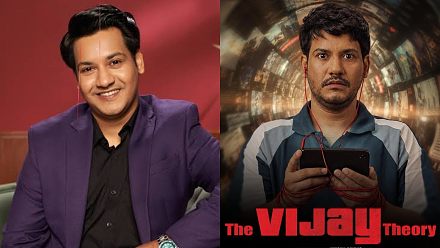
Khushaal On The Vijay Theory And Why Too Many Choices Can Leave You Stuck: ‘You’re Not Hungry Anymore’ | Exclusive
Khushaal has a theory about hunger. Open a food-delivery app, scroll long enough, compare enough restaurants, jump between enough offers and, by the time you have finally decided what to order, you may no longer be hungr
লেখক Yatamanyu Narain··65K বার পড়া
Khushaal On The Vijay Theory And Why Too Many Choices Can Leave You Stuck: ‘You’re Not Hungry Anymore’ | Exclusive
Khushaal has a theory about hunger. Open a food-delivery app, scroll long enough, compare enough restaurants, jump between enough offers and, by the time you have finally decided what to order, you may no longer be hungry at all.
That very ordinary irritation sits somewhere inside The Vijay Theory. Its protagonist does not suffer from one spectacular crisis. He has work to think about, a relationship, family expectations, questions about what he wants from life and, above all, an exhausting abundance of possible answers. Khushaal deliberately refuses to tell us what profession Vijay dreams of pursuing because specificity, in this case, would almost defeat the point. Vijay could be stuck over any career, any relationship, any version of adulthood. The paralysis matters more than the option eventually chosen.
There is a small joke buried in the fact that the man who created Vijay appears constitutionally incapable of behaving like him. Khushaal has produced, written, directed and acted in the film himself. He says the project was partly an opportunity to show a different acting register after years of being associated with lighter, humorous work online. Before that, casting had already given him another sort of film education. Watching actor after actor approach the same audition scene differently taught him that there may be dozens of valid routes into a character. Working on films such as Animal, meanwhile, showed him how firmly a director has to know even the smallest role before asking anybody else to inhabit it.
In an exclusive conversation with News18 Showsha, Khushaal speaks about building The Vijay Theory around choice paralysis, why the film’s rat metaphor only emerged after he had understood Vijay, and what years spent in casting taught him about actors, directors and conviction. He also opens up about using the film as a showcase for his own dramatic range, the frustrations and freedoms of producing for himself, why post-production remains his favourite part of filmmaking, and how years of making short-form internet comedy became an unlikely daily acting workshop long before he could afford to make something longer.
View this post on Instagram
A post shared by Khushaal (@khushaal_pawaar)
Here are the excerpts:
Your protagonist in The Vijay Theory is surrounded by options but seems incapable of choosing any of them. Why did indecision interest you enough to build an entire film around it?
I have observed that there are too many options in the current times, whether you want to start something, buy something or simply take that step and decide on one thing. There are too many options and too much information, and everyone is living that reality.
We usually think having choices is freedom. Your film seems interested in the point at which too many choices become another kind of prison. When did you start noticing that contradiction around you?
I’ve seen it many times. When someone decides to do something, they take time, and during that time, they keep exploring from one tab to another, from one option to another. By the time they decide on one, there is already a new upgrade.
For example, if you want to order food online, there are so many options, and then there are so many apps to choose from as well. By the time you finally decide, you’re not hungry anymore.
Vijay is struggling with work, relationships, family expectations and his own sense of direction. Did you deliberately avoid giving him one dramatic “problem” because his real problem is that everything feels unresolved at once?
Yes, because Vijay doesn’t understand the idea of taking one day at a time and dealing with one problem at a time. That is the reason I did not tell the audience what profession he is interested in or what he wants to do in life, so that everyone can relate it to their own profession and passion.
The rat choosing between multiple food options is a very blunt but effective visual metaphor. Where did that image come from?
It obviously came from the rat race. And today, as I mentioned before, there are a lot of options to choose from, whether in a career or a relationship. The algorithm keeps showing us options.
Did the rat metaphor come first and lead you towards the story, or did you find it only after understanding Vijay?
After I understood Vijay and wrote his character, the rat metaphor came to me.
You spent years watching hundreds of actors interpret the same scene differently. Has casting made you a director who gives actors more freedom because you’ve already seen how many correct versions of a scene can exist?
Yes. Working in casting contributed to me becoming a director because there are a lot of times when you have to set up a scene for an audition, and every actor performs the same scene differently. That made me realise that there can be any number of possibilities when it comes to approaching a scene.
Having sat through thousands of auditions, can you now recognise when an actor is performing what they think a casting director wants rather than actually understanding the scene?
It depends on the conviction in the actor’s performance. If it meets even 30% of the director’s vision, I have seen directors shortlist that actor. But this is totally subjective because every filmmaker has a different approach.
You worked on Animal without being given the complete script and were often casting from descriptions Sandeep Reddy Vanga provided. Did that experience change your understanding of how precisely a director must know a character before the screenplay reaches everybody else?
I have seen directors who have a very clear vision from day one, and it is very important that the director knows the character inside and out. That helps the crew get the best people on board who match that vision.
You have said Vanga would personally meet even actors being considered for very small parts and could not simply be persuaded by a casting team. Did watching that process affect how seriously you now approach the smallest characters in your own films?
No. I was okay with sharing the audition scene for my film, but Sandeep Sir wanted to personally meet the shortlisted actors and talk about the character. He did not want any material to go out before the film’s release.
There’s a nice irony here: Vijay cannot choose, while you have chosen to produce, write, direct and act within the same project. Are you the opposite of your protagonist, or does somebody who does too many things sometimes understand choice paralysis particularly well?
Vijay and I are completely opposite. My main goal was to give myself an opportunity to produce and direct. This film was also a way to showcase my acting abilities and range of emotions.
Most of the time, people have seen me doing something light-hearted or humorous, but I wanted to showcase my acting in such a way that if a director or producer watches it, they are able to see me perform in a professional setup like this. This is sort of a short reel that I would like to send to other production houses and directors.
When you’re producing your own film, there’s nobody above you to blame for a compromise. Did you find that liberating or uncomfortable?
I feel blessed that I can at least produce for myself and follow my passion.
You’ve said post-production is your favourite part of filmmaking. Is that because editing gives you the one thing filmmaking rarely gives you on set: the ability to change your mind privately?
Yes, I do enjoy it, but it requires a lot of focus and patience. Sometimes, it is very mentally tiring to watch the whole film again and again to put everything into the proper perspective and make sure that the storytelling is not changing. There is no compromise in how it is coming out.
Your earlier short film taught you patience when locations, equipment and production problems refused to cooperate. You even continued shooting after discovering a dead pixel in a rented camera. Has low-budget filmmaking made you less precious about technical perfection?
Sometimes, you have to move on from a problem that you can’t control. This time, I have made sure that every department is working properly and there are no technical problems. In filmmaking, every day you have to solve new and different problems.
Your internet career was built on noticing tiny behavioural details very quickly. Has short-form comedy actually trained you to observe people better as a filmmaker?
From the beginning of my internet career, I wanted to do this, but I did not have the power to produce long-format content by myself. So I started with short-form content, and that made me act every day and practise my acting skills every day.
I enjoyed it because it takes less time to create and reaches millions of people.
You have more than a million people who already recognise a particular version of your humour online. When you make something quieter or more dramatic, do you have to resist the temptation to reassure them with comedy?
No. Every story has a different approach.
Social-media characters can become popular enough that audiences keep demanding the same thing. Has success online ever made experimentation harder because the algorithm effectively tells you which version of yourself it prefers?
I always like to experiment and give them something new. I try to package it differently or do something new with the same content so that they are also happy.
You once recalled Varun Dhawan telling you that an actor’s challenge is understanding what function his character serves in the larger film. Has becoming a director finally made that advice fully click?
Yes. You can’t play the same character every time. You have to innovate and give something fresh to the audience.
You’ve worked around filmmakers ranging from Kabir Khan and Nitesh Tiwari to Sandeep Reddy Vanga. What have you noticed about how very different directors communicate authority without necessarily communicating in the same way?
One thing I have observed is that you have to completely surrender to the story. You have to be very passionate and have conviction about how the story is coming out. You have to do whatever it takes to complete the film, and that process can take time, so you need to have a lot of patience.
I have seen this in all these big directors. They have faith and conviction. That’s why they’re able to create films that audiences enjoy.