From Malini Ramani, Mandira Bedi To Urvashi Rautela: Why Indian Fashion Keeps Testing The Flag Code
Urvashi Rautela has spent nearly two decades finding new ways to say she loves her country. And she topped it all at the Miss Universe India 2026 finale in Jaipur, where she found her most literal example yet: a straples
مصنف Mallika Bhagat··9K بار پڑھا
From Malini Ramani, Mandira Bedi To Urvashi Rautela: Why Indian Fashion Keeps Testing The Flag Code
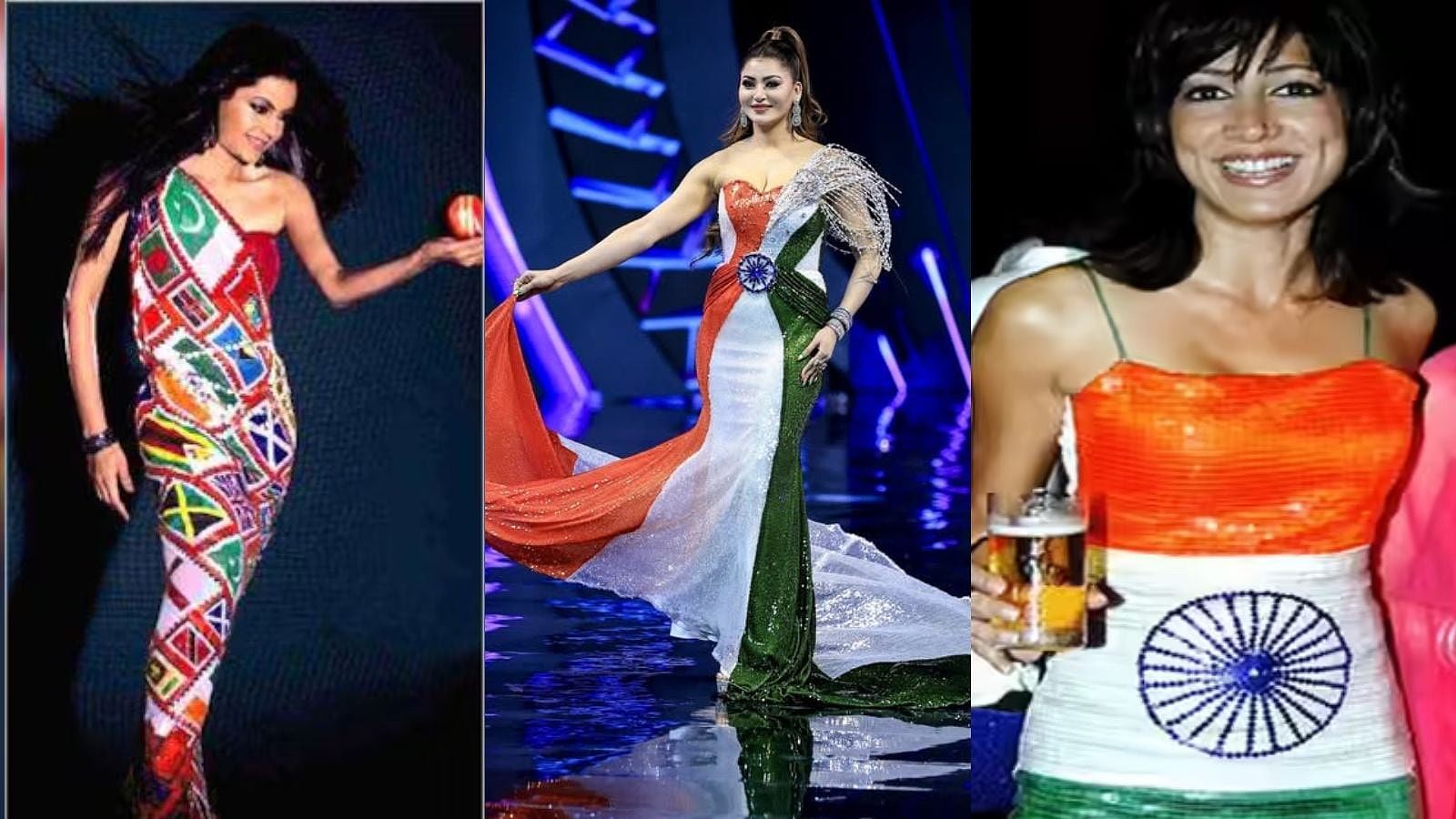
Urvashi Rautela has spent nearly two decades finding new ways to say she loves her country. And she topped it all at the Miss Universe India 2026 finale in Jaipur, where she found her most literal example yet: a strapless, floor-sweeping gown in saffron, white and green, an Ashoka Chakra medallion pinned at the waist. For Rautela, it should have been just another showstopping moment but on social media, her ensemble opened up a conversation that Indian fashion has been having with itself for over twenty years.
What Urvashi Wore At Miss Universe India 2026
Rautela judged Miss Universe India for the third year running where she shared the panel with Sushmita Sen, India’s first Miss Universe, who Rautela calls the woman who “gave her the wings to fly.” And at this pivotal stage, the Bollywood diva’s gown was built for theatrics that she likes: a figure-hugging, strapless silhouette in saffron, white and deep green, flowing into a floor-grazing train, with silver crystal fringe spilling off one shoulder. “I had said, I am India. So, I truly feel like an India today, and I’m wearing this dress, as you all can see, which is inspired by the national flag,” Rautela said. She added, in a separate statement: “At Cannes, when an international journalist asked me what India meant to me, I instinctively answered, ‘I am India.’ Today, while judging Miss Universe India 2026 in a tricolour gown, those words feel even more profound. I am immensely proud to be Indian.”
This opened up a can of worms that always spells trouble.
Rautela wore a strapless, floor-sweeping gown in saffron, white and green, an Ashoka Chakra medallion pinned at the waist (Credit: PTI)
Can You Wear The Indian Flag?
What Rautela wore was ‘tricolour-inspired’; the colours in couture form, with a chakra motif standing in for the real Ashoka Chakra, not an exact copy of it. That gap is the loophole most Indian designers work within. The law doesn’t regulate saffron and green worn together. It regulates the National Flag itself.
The Flag Code of India is clear: the national flag cannot be worn as clothing, a uniform, or any dress material. Printing or embroidering it on napkins, handkerchiefs, cushions or garments is banned outright, and the flag must never touch the ground (a hard rule to keep on a floor-length gown).
Flag Code Of India
The Prevention of Insults to National Honour Act, 1971 backs this up. Under Section 2, disrespecting the flag in public can mean up to three years in prison, a fine, or both. A 2005 amendment added Section 2(e), which bars the flag from being worn below the waist or printed on dress material. Small, respectful lapel pins are allowed. A dress cut and draped in the flag’s image is not.
Rautela’s gown sits in the space between the letter of that law and its spirit. Past controversies tested that space far more directly.
In 2007, while hosting the World Cup final between Sri Lanka and Australia at Kensington Oval, Mandira Bedi had worn a saree designed by Puneet Nanda of Satya Paul (Credit: DNA INDIA)
Mandira Bedi’s Saree, And The Apology That Followed
In 2007, while hosting the World Cup final between Sri Lanka and Australia at Kensington Oval, Mandira Bedi had worn a saree designed by Puneet Nanda of Satya Paul, printed with the flags of every country in the tournament. India’s flag sat in the folds near her knee, close to her foot. TV cameras caught it first, and the rest of the country followed.
Rain after the toss gave Bedi a breather and by the time the showers passed and play resumed, she was back on air in a different saree. But the damage was done. Puneet Nanda had to tender an apology, as per reports: “I didn’t think our flag would end up near Bedi’s foot. I am sorry.” Bedi apologised too, explaining she had saved the saree specially for the final because it carried the flags of all sixteen participating nations. The timing made things worse for her since the same week, the Akal Takht, Sikhism’s highest religious body, had just accepted her apology over a separate matter, a Sikh religious symbol she had tattooed on her body.
Malini Ramani
An older, more popular case belongs to Malini Ramani, flagged, like the Bedi saree, by the Diet Sabya, which resurfaced both while discussing Rautela’s look. Long before she was a known designer, Ramani wore a tricolour dress (with an orange bandeau top, a chakra motif at the midriff and a green skirt) to the opening party of India’s first-ever Fashion Week. Per Diet Sabya’s account, the backlash was strong enough that people called for the Fashion Week to be shut down entirely. Ramani had to publish a public apology in every major Indian newspaper, and the dress itself was taken into police custody, reportedly displayed on a mannequin behind bars. The case took eighteen years to be dismissed and her name cleared.
Ramani wore a tricolour dress (with an orange bandeau top, a chakra motif at the midriff and a green skirt) to the opening party of India’s first-ever Fashion Week (Credit: TOI)
Two decades separate Malini Ramani’s dress from Urvashi Rautela’s gown, and the reaction has cooled considerably. But the tension underneath hasn’t moved. Designers keep reaching for the tricolour to make a statement of identity, and some of the country keeps reading that same gesture as disrespect. The law hasn’t changed either: the national flag, worn as clothing, is still against it, whatever the intent behind it. But what has really changed is how closely a garment has to copy the actual flag before anyone calls the police.