‘Food Is Not The Enemy’: Dr Ridhima Khamesra’s New Book Tackles Food Myths And Nutrition Misinformation
There are few subjects that have become as confusing as food. One day rice is the villain, the next day ghee is. Fruit is questioned for its sugar, potatoes are treated with suspicion, and social media is full of advice
مصنف Swati Chaturvedi··29K بار پڑھا
‘Food Is Not The Enemy’: Dr Ridhima Khamesra’s New Book Tackles Food Myths And Nutrition Misinformation
There are few subjects that have become as confusing as food. One day rice is the villain, the next day ghee is. Fruit is questioned for its sugar, potatoes are treated with suspicion, and social media is full of advice telling us what to eliminate, what to detox and what to never eat again.
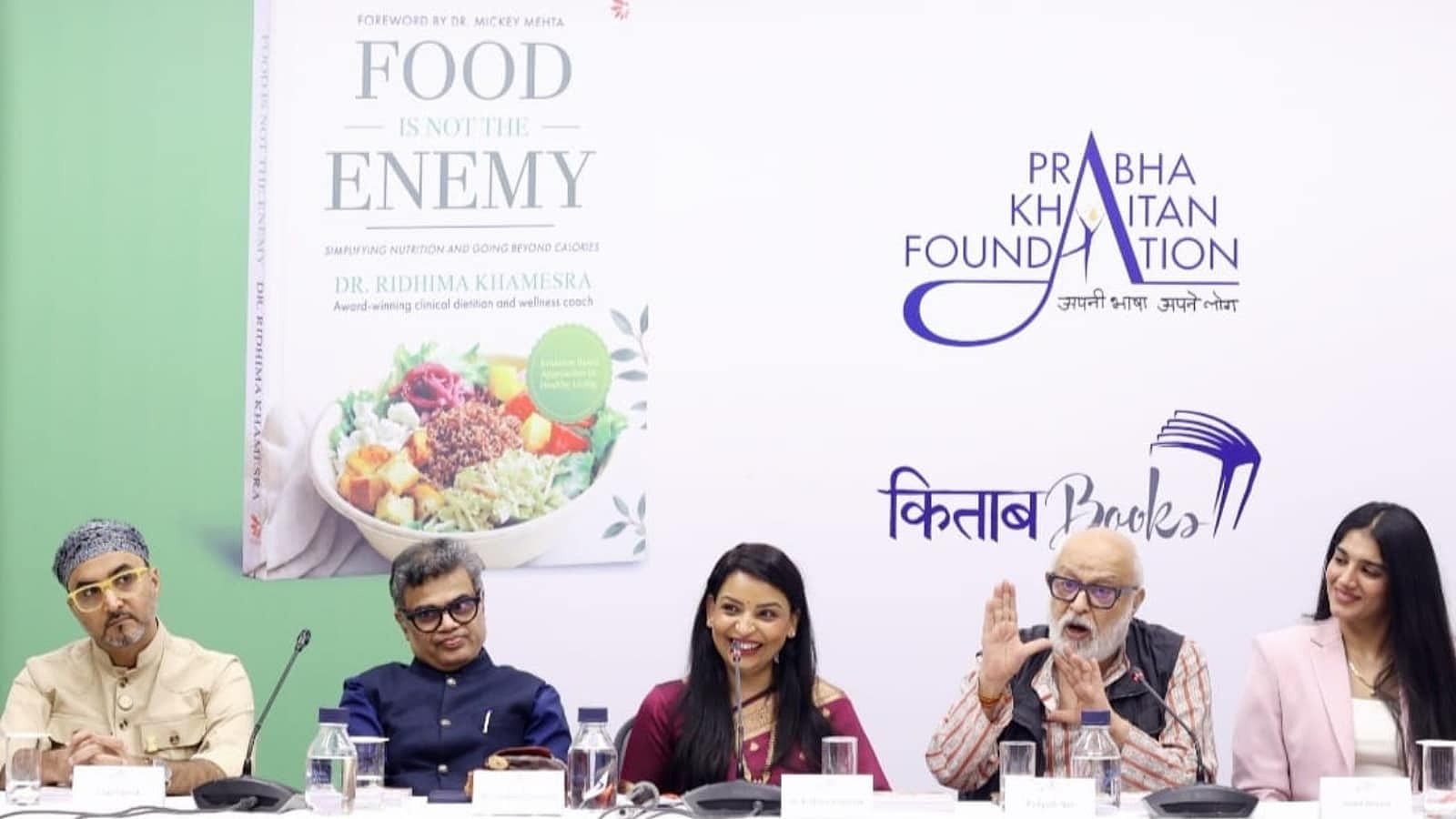
That is precisely the anxiety that Dr Ridhima Khamesra wants to challenge with her new book, Food Is Not The Enemy, launched at the India International Centre in New Delhi.
I attended the launch, and what stayed with me was that the evening wasn’t really about another nutrition book telling people what they should and shouldn’t eat. If anything, it was about trying to make people less afraid of food.
A clinical dietitian, nutritionist and wellness professional, Dr Khamesra has built her practice around personalised nutrition and sustainable lifestyle changes. Her work spans areas including weight management and therapeutic nutrition.
The book, which carries a foreword by Dr Mickey Mehta, brings together 30 chapters covering nutrition basics, everyday eating habits, weight management, diabetes, heart health, gut health, PCOS and perimenopause, before moving into diet trends, supplements and the misinformation surrounding food on social media.
But the larger message of the evening was captured in the title itself.
The Real Problem May Be Our Fear Of Food
In her opening remarks, Dr Khamesra spoke about a shift she has noticed in her clinical practice. She said, “Patients are increasingly asking not just, ‘What should I eat?’ but whether ordinary foods are safe to eat at all.”
That distinction is important. Because somewhere between Instagram reels, celebrity diets, calorie-counting apps and an endless stream of conflicting nutrition advice, food has become something many people approach with suspicion.
Dr Khamesra put it simply, “The problem isn’t necessarily the dal, rice, roti, potato or mango sitting on the plate. It is fear, misinformation and extremes.”
Her book attempts to bring the conversation back to a more balanced understanding of food, one that considers nourishment, lifestyle and individual needs rather than treating individual ingredients as either completely good or completely bad.
That idea felt particularly relevant in a room where almost every panelist approached food from a completely different discipline.
Five Perspectives, One Question: Why Have We Started Fearing Food?
What made the evening particularly interesting was the panel itself. It brought together people who could hardly have approached food from more different directions, food historian and Padma Shri awardee Pushpesh Pant, millet chef Vikas Chawla, robotic and bariatric surgeon Dr Anshuman Kaushal, boxer Nupur Sheoran, and Dr Ridhima Khamesra.
And yet, listening to them, there was a common thread: our relationship with food has become far more complicated than it needs to be.
Pant brought a lighter moment to the discussion when he told the audience that he had just had aloo puris, halwa and kheer for lunch. The admission drew laughter from the room and perhaps explained why he was giving the samosas at the IIC event a miss.
His perspective brought the conversation back to a time when food wasn’t divided into Instagram-friendly categories of good and bad. Seasonal eating, fermentation, spices and regional ingredients were simply part of everyday Indian food culture.
Chef Vikas Chawla, known as the Millet Chef of India, brought the conversation into the modern kitchen, making the case for looking again at India’s own grains and ingredients. The discussion around ragi, jowar, bajra, kangni and kodo was particularly relevant at a time when imported ingredients can become fashionable while traditional Indian foods are suddenly treated as old-fashioned.
Dr Anshuman Kaushal brought the medical perspective, and perhaps the question that most needs asking in the age of Instagram nutrition: how much of the health advice we consume online is actually backed by science? A robotic, GI, minimal-access and bariatric surgeon at CK Birla Hospital, Gurugram, Dr Kaushal has extensive experience across gastrointestinal, bariatric and minimally invasive surgery. His contribution was particularly relevant at a time when health information is increasingly consumed through short videos, reels and social-media posts.
Then there was Nupur Sheoran, bringing the perspective of an elite athlete. A heavyweight boxer and five-time national champion, Sheoran is also the granddaughter of legendary Indian boxer Captain Hawa Singh. Her contribution shifted the conversation from simply eating well to eating for performance, discipline and consistency.
And at the centre of it all was Khamesra herself, whose clinical experience has brought her face-to-face with the growing anxiety people have around eating.
It wasn’t five people giving five versions of a diet plan. It was a historian talking about where our food traditions came from, a chef asking why we’ve stopped valuing what grows here, a surgeon questioning what we believe online, an athlete discussing discipline and performance, and a nutritionist asking us to reconsider why we have become afraid of food in the first place.
India’s Traditional Foods And The New ‘Superfood’ Culture
One of the ideas that stayed with me was the contrast between India’s traditional food wisdom and today’s aspirational food culture.
There is something slightly ironic about the way urban Indians can enthusiastically embrace quinoa, kale and imported “superfoods” while ingredients such as millets, regional grains and traditional preparations are often treated as old-fashioned.
The conversation around millets therefore wasn’t simply about nutrition. It was also about food memory, accessibility and reclaiming ingredients that were once ordinary rather than fashionable.
The larger point was not that imported foods are inherently bad. It was that we shouldn’t have to look outside our own food traditions to discover ingredients that have been part of Indian diets for generations.
The Internet Has Made Everyone A Nutrition Expert
This was perhaps one of the most relevant parts of the discussion. Every day, millions of people encounter nutrition advice online. Carbohydrates are demonised in one video, fats are celebrated in another. Someone declares that a particular fruit is “toxic”, another promises that a particular ingredient will “detox” the body, while yet another recommends eliminating an entire food group.
The problem is that confidence is not the same thing as scientific evidence. Dr Kaushal’s contribution brought that distinction into sharp focus. The audience was reminded to question where health claims come from, particularly when they are presented without context or evidence.
Nutrition rarely works in absolutes.
Dr Kaushal put it another way, “The right question isn’t always, ‘Is this food good or bad?’ It can be, ‘Is this food appropriate for me, in this quantity, prepared this way, as part of my overall diet and lifestyle?”
That is a much less dramatic answer, but probably a much more useful one.
An Athlete’s Take: Discipline Doesn’t Mean Perfection
Nupur Sheoran brought another interesting dimension to the conversation. For an elite athlete, food isn’t merely about weight or appearance. It can influence training, recovery, energy and performance.
“Half my time goes in weighing my food,” Nupur said, giving the audience a glimpse into just how closely an elite athlete has to think about food. Her perspective on discipline also offered a useful counter to the perfectionism that often surrounds diet culture.
Discipline doesn’t necessarily mean never breaking a routine. It can also mean knowing how to return to it.
That is an idea that extends beyond sport. A healthy relationship with food cannot realistically mean eating perfectly every single day. There will be celebrations, travel, restaurant meals, cravings and desserts.
The important thing is what happens over time, not whether one meal was perfect.
And Then Came The ‘Khalnayak’ Round
Perhaps the most entertaining part of the evening was the ‘Khalnayak’ round. Panelists were asked to give quick verdicts on foods that have become regular villains in modern diet culture, including rice, ghee, potato, milk, fruit and dal.
It was lively precisely because there wasn’t complete agreement. And that, in many ways, was the most useful part of the conversation. There was no single food that could simply be stamped good or bad.
Instead, the discussion kept returning to context: how much, how often, what else is on the plate, how the food is prepared, and who is eating it.
That is considerably less exciting than a headline saying “Never Eat Rice Again”, but it is also far more useful.
The Conversation Was Bigger Than A Book Launch
What I found particularly refreshing about the evening was that it didn’t feel like a conventional book launch where the author speaks about the book and the audience listens.
The book became a starting point for a much larger conversation, about how we eat, how we think about food and how easily we allow social media to turn individual ingredients into villains or miracles.
Food historian, chef, surgeon and athlete may seem like an unusual combination for a nutrition conversation. But perhaps that was precisely why it worked.
Food isn’t just nutrition. It is culture, memory, agriculture, medicine, performance, family and pleasure.
Trying to understand it through only one of those lenses is inevitably limiting.
‘Don’t Just Count Calories. Count Nourishment.’
Towards the end of the discussion, Dr Khamesra returned to the question with which she had begun. Has the way we think about food changed?
Her answer was a reminder that nutrition cannot be reduced to a number on a food label or a calorie counter.
She urged the audience to think beyond calories and towards nourishment, while also acknowledging the role of sleep, movement and stress in overall health.
Dr Khamesra’s closing message was simple, “Health does not come from fearing food. It comes from understanding it.”
And perhaps that was what made the evening particularly refreshing. In a culture increasingly obsessed with eliminating foods, counting calories and searching for the next miracle ingredient, Food Is Not the Enemy makes a less glamorous but more sustainable argument.
Understand what you eat. Understand your body. Understand your lifestyle. And stop being afraid of the food on your plate. Because the more we understand food, the less likely we are to fear it, and the less likely we are to fall for every new food villain that the internet produces.