The Biopic Blueprint: How Real People, Events Have Become A Bollywood Actor's Safe Bet For National Awards
In the hyper-competitive landscape of Indian cinema, winning the National Film Award for Best Actor has long been the ultimate mark of artistic validation. Yet, for Hindi cinema’s mainstream leading men, a curious trend
مصنف Kashvi Raj Singh··108K بار پڑھا
The Biopic Blueprint: How Real People, Events Have Become A Bollywood Actor's Safe Bet For National Awards
In the hyper-competitive landscape of Indian cinema, winning the National Film Award for Best Actor has long been the ultimate mark of artistic validation. Yet, for Hindi cinema’s mainstream leading men, a curious trend has hardened into an unspoken industry rule. Over the last 10 years, it seems like if a Bollywood actor wants to win the nation’s highest acting honour, playing an original fictional character is almost a dead end.
5/8 Actors Have Won For Biopics, Films Based On Real Events
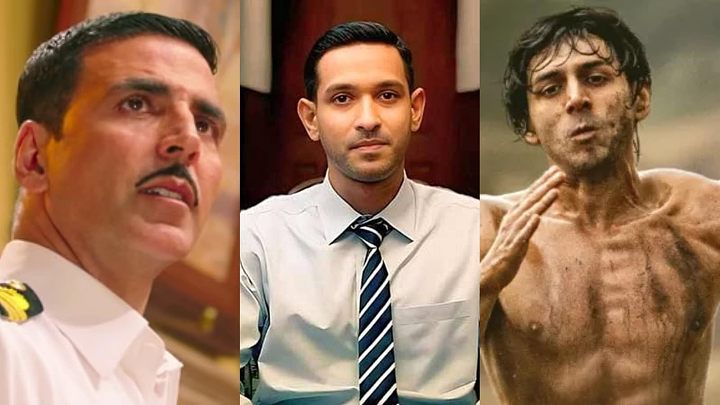
Out of the 8 Hindi actors who have won since 2016, 5 have won for a biopic or a film inspired by real people or events. These include Akshay Kumar for Rustom, Vicky Kushal for URI: The Surgical Strike (real-life event with some fictionalised elements), Ajay Devgn for Tanhaji: The Unsung Warrior, Vikrant Massey for 12th Fail and Kartik Aaryan for Chandu Champion.
Other Hindi winners in the last 10 years were Ayushmann Khurrana for Andhadhun, Manoj Bajpayee for Bhonsle and Shah Rukh Khan for Jawan. A look across the wins reveals a stark shift: while early decades honoured original character studies in cinema, the modern era heavily leans toward real-life figureheads or events that required some transformation from the actor.
While actors like Ajay Devgn, Irrfan Khan and Rajkummar Rao (to name a few) have previously won for The Legend of Bhagat Singh, Paan Singh Tomar and Shahid, the Hindi winners back then were scattered across genres. Actors like Amitabh Bachchan have won for Agneepath, Black, Paa and Piku. Shashi Kapoor won for New Delhi Times, Anil Kapoor won for Pukar, and Saif Ali Khan won for Hum Tum.
However, since 2016, a noticeable shift towards transformation-heavy performances can be observed. From weight-loss protocols and dialect coaching to intense prosthetics, the biopic and real-life historical figure has become Bollywood’s most dependable shortcut to a Rajat Kamal.
From Weight Loss To Dialect Coaches
In Rustom, Akshay Kumar’s character, Rustom Pavri, is based on Commander Kavas Maneckshaw Nanavati, a decorated officer in the Indian Navy. The film is a dramatised account of the sensational 1959 KM Nanavati v. State of Maharashtra court case. Akshay Kumar had to lose weight to play Nanavati and pick up a subtle Parsi accent.
Vicky Kaushal’s URI is based on the 2016 Indian Army response to the terror attacks in Uri, Jammu and Kashmir. His character, Major Vihaan Singh Shergill, is a fictionalised composite character inspired by the real-life leaders and soldiers. The actor gained 15 kg of muscle and underwent rigorous military and physical boot-camp training.
Ajay Devgn’s Tanhaji showcased the real-life story of Tanaji Malusare, a military leader in Maratha king Chhatrapati Shivaji Maharaj’s army. Ajay had to master Maratha swordplay and shield combat. The film 12th Fail sheds light on Manoj Kumar Sharma’s journey to becoming an IPS Officer. Vikrant Massey reportedly lost about 9 kgs to play a 19-year-old Manoj.
In Chandu Champion, Kartik Aaryan plays Murlikant Petkar, the real-life soldier in the Indian Army who went on to become India’s first Paralympic gold medalist swimmer. The actor dropped his body weight from 90 kg to 72 kg and reduced his body fat from 39% to 7% over 14 months. He also trained with a language coach to master the Marathi accent.
Why The Shift Towards ‘Real’?
Perhaps when an actor plays a fictional character, “good acting” can feel subjective to a multilingual jury evaluating 30+ languages. However, when an actor plays a real person -such as Kartik Aaryan portraying Murlikant Petkar or Vikrant Massey as IPS Manoj Sharma- the jury has an existing reference point.
The performance can be evaluated against real-world voice recordings, historical photographs, and documented life events. Physical transformations also provide an easy promotional narrative during festival screenings and jury deliberations.
Another reason could be that Bollywood blockbusters are often labelled as “too commercial, too glamorous” unless a historical or motivational aspect is attached to the project. Taking on a biopic allows an actor to strip away the glitz of Bollywood, even in a high-budget film, and express physical vulnerability.
Hindi vs Regional Cinema
Interestingly, this reliance on physical biopics highlights a structural difference between Hindi cinema and regional film industries. Regional icons routinely secure Best Actor trophies for entirely original fictional creations. For example, since 2016, Mammootty has won for original fictional constructs in Bramayugam, Allu Arjun won for playing a labourer-turned-smuggler in Pushpa: The Rise, and Dhanush won for Asuran, playing a fictional working-class lead.
The shift in the last 10 years is thus clear: as long as commercial Hindi scripts favour larger-than-life star vehicles, the real-life hero’s journey remains Bollywood’s most reliable path to critical acclaim.