A decade ago, Indian stand-up comedy was largely a club circuit, with comedians fighting for stage time at bars, restaurants and small comedy rooms. Today, comedians are selling out 1,000, 3,000 and 5,000-seat venues, to
A decade ago, Indian stand-up comedy was largely a club circuit, with comedians fighting for stage time at bars, restaurants and small comedy rooms. Today, comedians are selling out 1,000, 3,000 and 5,000-seat venues, touring multiple cities and commanding premium ticket prices. The business has moved from small rooms to a full-fledged touring economy.
In an exclusive conversation with News18, Anil Makhija, COO – Live Entertainment & Venues, BookMyShow, says comedy has grown 15% year-on-year for the last two years and is now among the biggest categories in India’s live entertainment business. “What used to be a circuit of small, intimate club sets has evolved into a full-fledged touring economy, with large-scale, ticketed shows and multi-city tours becoming the norm for established and emerging comedians alike,” he said.
“Some of the most popular names in the business are now experimenting with stadium formats, a scale that would have been unthinkable for a comedy show even a few years ago.”
From Six Cities To More Than 100 Markets
The biggest change has been geographical. Comedy is no longer restricted to Mumbai, Delhi and Bengaluru. Tusharr Kumar, CEO and Director of Only Much Louder (OML) Entertainment, says Pune, Hyderabad, Kolkata and Chennai have become meaningful markets, while smaller cities are increasingly filling auditoriums, college stages and non-traditional venues.
“Cities like Chandigarh, Lucknow, and Gandhinagar, rarely associated with large-ticketed events earlier, have seen comedy shows sell out,” he said, adding, “Comedy is no longer a large-city phenomenon.”
Ankur Kaushik, Co-Founder of live entertainment touring company Beacon Live, puts the expansion into numbers. “Today, we see around 108 domestic markets for stand-up, while Indian comedians are performing in more than 80 cities globally,” he said.
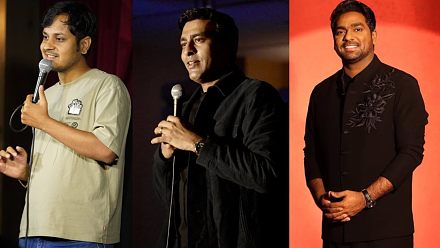
The size of individual tours has changed too. Kaushik says that before Covid, a large comedy tour would typically cover around six major cities. Today, comedians are moving into much bigger venues, with top names like Zakir Khan and Samay Raina among those who have sold out large-format venues in Delhi.
Ticket prices have followed the expansion. “A few years ago, Rs 749 was around the average price point for some of the larger comedy tours. Today, premium comedy shows can reach Rs 9,999 in India, while international Indian-comedy shows can command ticket prices of Rs 20,000 or more,” Kaushik said.
The Internet Changed The Game
For stand-up comedian Varun Thakur, who began performing in 2010, the difference between then and now is almost impossible to overstate. “When I started, there were literally like sixteen, sixteen of us, twenty of us,” Thakur recalled.
The early scene depended heavily on open mics and amateur nights. Comedians would approach bars and restaurants for a stage, microphone and lights, sometimes allowing the venue to keep the night’s earnings simply for the opportunity to perform. “We were more hungry for just being able to get on stage and do our jokes,” he said.
Varun remembered the arrival of dedicated comedy clubs as an important moment. But the biggest acceleration, according to him, came when internet access spread beyond the metros. “The third and probably the biggest push then happened in 2017,” he said.
“Internet became accessible to everybody. So it’s not just the dude in Mumbai who has it, but it’s the person in a tier II, tier III down in India as well.”
By then, stand-up had started becoming a career rather than an experiment. “We were just throwing darts at the board and hoping something sticks,” Thakur said of the early years. “Then after 5-6 years of doing it, it formalised the scene.”
Today, he says, “It’s a legitimate career option.”
Content First, Tickets Later
The internet did more than introduce comedians to new viewers. It created a pipeline from online audiences to live shows. Tusharr Kumar says comedians building audiences through YouTube, short-form video and OTT specials are now able to convert those audiences into ticket buyers. “Content travels faster than any touring schedule can, builds communities across geographies, and then converts them at the box office,” he said.
Ankur Kaushik says follower count is not necessarily the most important indicator of whether a comedian is ready to scale. Instead, Beacon Live looks at ticket-buying behaviour. “How quickly does a show sell out? What percentage of the audience converts into ticket buyers? Can you add a second show in the same city? Can you move from a theatre to a larger auditorium or arena? That’s what signals to us when an artist is ready to scale.”
What Happens To The Ticket Money?
A bigger comedy show also means a more complicated business behind the scenes.
“The easiest way to understand the economics is to look at every Rs 100 of gross ticket revenue,” Kaushik said.
According to him, approximately 18% goes towards GST and, depending on the arrangement, ticketing platforms can account for up to another 10%. Of the remaining revenue, roughly 55% can go towards operating and production costs, including venue rental, production, marketing, travel, accommodation and logistics. “The remaining 35-45% is then generally shared between the artiste, management and promoter, depending on the commercial structure of the particular tour,” he said.
Kumar says that there is no single formula for a comedy tour. A small independent comic can route through cities with minimal overhead, while an arena-scale production can involve stage design, premium sound and fan-experience zones outside the venue.
“The revenue split across comedian, management, promoter, venue, production and ticketing platform varies accordingly,” he said. “There is no industry-standard formula, and anyone who claims otherwise is simplifying.”
Comedy Is Now A Multi-Income Career
The money is also no longer limited to live shows. Kumar says comedians now earn through YouTube advertising, OTT specials, brand integrations, writing for films and television, live events and other creator opportunities. “The career economics of stand-up comedy in India are genuinely multifaceted now in a way they simply weren’t five years ago,” he said.
Piyush Sharma, a stand-up comedian, sees the change at the performer level. “Comedians no longer have to live from one invoice to the next, constantly waiting for their next payment or source of income,” he said.
He believes audiences have also become more accepting of comedy as a mainstream form of entertainment. “Thankfully, audiences today celebrate stand up comedians in much the same way they celebrate singers and actors,” Piyush added.
For him, the expansion has also opened up more creative possibilities. “The Indian comedy scene is no longer limited to comedians going on stage, telling jokes and calling it a day. We now see comedians exploring different formats, such as India’s Got Latent, Lie Hard, and Akal Ke Ghode, all of which have been well received by audiences and brands alike. Comedians, including me, have also tried their hand at being influencers and streamers during the IPL. The willingness of comedians to take risks and adapt, combined with the audience’s wholehearted acceptance of these formats, has helped comedy become a much bigger part of people’s lives.”
The Audience Is Getting Bigger Too
The business is not only growing because established comedians are selling larger venues. The audience itself is changing. Makhija says families and first-time attendees are increasingly joining the traditional comedy audience, while Hinglish comedians are finding stronger audiences outside the metros. He also points to newer formats such as crowd work, which allow comedians to create a more interactive live experience. “Audiences are also willing to pay more for a well-curated show,” Makhija said.
For Varun Thakur, who remembers a time when comedians were simply trying to find a place to perform, the transformation is perhaps best understood through the speed at which the audience can now be built. Earlier, he says, it could take two or three years to put together a first national tour. Today, comedians can build an audience much faster because the audience already exists across cities and can be reached digitally.
The result is an industry that now stretches from open mics and short-form videos to OTT specials, brand deals, multi-city tours and arena shows. Indian stand-up comedy is no longer just a group of comedians trying to get on stage. It is a creator economy, a touring business and a growing part of India’s organised live entertainment industry now.