Brazil Election: Lula Wins Fourth Term In Dramatic Comeback Against Bolsonaro
Brazilian President Luiz Inacio Lula da Silva secured a dramatic election victory on Sunday, defeating right-wing senator Flávio Bolsonaro in a comeback that defied expectations after he lost the first round.
Yazan News Desk··55K okunma
Brazil Election: Lula Wins Fourth Term In Dramatic Comeback Against Bolsonaro
Brazilian President Luiz Inacio Lula da Silva secured a dramatic election victory on Sunday, defeating right-wing senator Flávio Bolsonaro in a comeback that defied expectations after he lost the first round.
Lula’s win comes amid a broader shift towards conservative politics in several countries, including Argentina, Chile, Colombia and Peru, where right-wing forces have gained ground with support from US President Donald Trump.
The left-wing leader, who turns 81 on Tuesday, has won an unprecedented fourth presidential term despite projections suggesting otherwise.
Official results showed Lula securing 51.7% of the vote, compared with 48.2% for Flavio Bolsonaro, the son of former far-right president Jair Bolsonaro. Flavio had entered election day confident of victory, having held a lead in opinion polls.
Since Brazil held its first direct presidential election after the end of dictatorship in 1989, no candidate who lost the first round had gone on to win the runoff.
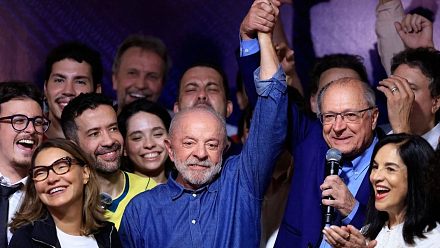
Celebrations erupted across the country following Lula’s victory. Fireworks and vuvuzelas filled the air in Rio de Janeiro, while thousands of supporters dressed in red, the colour associated with Lula’s Workers’ Party, took to the streets of Sao Paulo.
In a video shared on social media, Lula was seen jumping with joy at a hotel in Sao Paulo, wearing red, star-shaped glasses. He was scheduled to address the press later.
Flavio Bolsonaro, who was in Brasilia, had yet to respond to the results.
In Rio de Janeiro’s Cinelandia Square, Lula supporters were overcome with emotion, with some breaking down in tears.
Julio Canelo, a 42-year-old lawyer, described the outcome as a victory for “the entire democratic spectrum.”
“It was the result of the people mobilising, in the streets and online,” he told AFP.
Following the first-round setback, the left intensified its campaign with large rallies, adopting the slogan “Never Again Bolsonaro” and overhauling its previously lacklustre social media strategy.
Voter abstention also declined, dropping from 21% in the first round to 19% in the runoff.
The closely fought campaign was marked by scandals and personal attacks, highlighting the deep political divisions that have persisted in Brazil, a country of more than 200 million people, over the past decade.
Lula now begins another term in a deeply divided nation, with nearly half the electorate having voted against him and many demanding change.
Flavio Bolsonaro, 45, attempted to project a more moderate and approachable image than his father. His campaign attracted conservative voters as well as people less driven by ideology but frustrated with crime, rising living costs and a perceived lack of progress.
“We’re in a deep hole, things are dire. People can barely afford to eat — buying meat is out of the question,” said Tereza Cristina Ramos, a 68-year-old retiree who voted in Rio de Janeiro.
The election campaign, already fraught with allegations and mudslinging, descended into confusion on Sunday after a last-minute Supreme Court ruling extended voting by two hours. The decision followed a request from Lula, who alleged that buses had been withdrawn from service in several cities, preventing people from reaching polling stations.
Lula Makes Another Political Comeback
Lula’s victory marks another major return to power for a leader who grew up in extreme poverty in northeastern Brazil, in a family of illiterate farmers.
He first became president in 2003, rising to prominence as a champion of the working class, and won re-election in 2006.
Known for social welfare programmes that helped millions escape poverty, Lula returned to the presidency in the 2022 election after a corruption scandal led to his imprisonment for more than 18 months.
Although the charges were annulled on procedural grounds, the controversy has continued to follow him.
During his third term, Lula oversaw falling inflation and unemployment and helped lift millions out of hunger. However, voters who backed Flavio Bolsonaro expressed dissatisfaction with their financial circumstances and concerns over crime.
Fear-based messaging featured prominently on both sides of the campaign, with many voters saying they had chosen the candidate they considered the lesser evil.
Age, Economic Pressures Pose Challenges For Lula
Lula will be among the world’s oldest leaders during his new term, turning 85 by the time it ends in 2030.
His latest victory means he will have spent 16 years as president, including his first two terms between 2003 and 2010.
However, Lula faces significant political hurdles, including a Congress dominated by the right, which could limit his ability to advance his agenda.
The economic outlook presents another challenge, with growth expected to slow. He is also under increasing pressure to address widespread security problems in a country where criminal factions have terrorised working-class neighbourhoods.
Lula’s campaign placed considerable emphasis on national sovereignty amid commercial and diplomatic pressure from the United States under Trump.
Voters must “choose a country where the flag is respected,” he said during the campaign, his voice hoarse after an intense election push. He accused his rival of wanting to “govern with the American flag.”