Tamannaah’s Viral ‘Chhathi Maiya’ Song: Patna's Temple Legend Behind It And Sidharth’s Bhojpuri Baggage
The newly released Chhathi Maiya song from Sidharth Malhotra and Tamannaah Bhatia’s upcoming film The Vvaan: Force Of The Forrest has brought Chhath Puja, Bihar’s traditions and an intriguing temple legend into the spotl
Yazan Parishmita Saikia··49K okunma
Tamannaah’s Viral ‘Chhathi Maiya’ Song: Patna's Temple Legend Behind It And Sidharth’s Bhojpuri Baggage
The newly released Chhathi Maiya song from Sidharth Malhotra and Tamannaah Bhatia’s upcoming film The Vvaan: Force Of The Forrest has brought Chhath Puja, Bihar’s traditions and an intriguing temple legend into the spotlight. The devotional track has been drawing attention on social media, with several posts linking its story to a centuries-old temple near Patna.
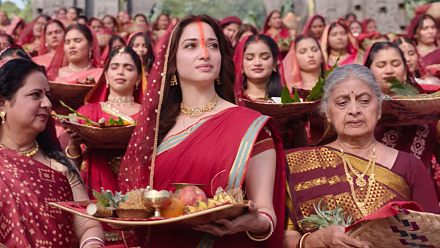
The song, composed and sung by Vishal Mishra with lyrics by Kaushal Kishore, features Tamannaah performing Chhath Puja alongside other devotees, while Sidharth is also seen as part of the sequence. The track has been positioned around the film’s Van Devi folklore and the faith at the heart of its story. But while the song has sparked curiosity about the temple behind the film, it is worth separating local belief and folklore from established historical fact. (YouTube/@Zee Music Company)
The 400-Year-Old Van Devi Legend Behind The Film: The story of The Vvaan is linked to a Van Devi temple near Patna that is believed to be around 400 years old. According to accounts about the film, its makers visited the temple and spoke to local residents, priests and villagers while developing the folklore that forms the basis of the story. Some reports place the origins of the temple several centuries ago and describe a range of mysterious beliefs associated with it. (Instagram/@ashu_aspect)
One popular legend centres on Vidyanand Mishra, described as a devotee of Vidyachali Mata, also known as Vidyavanshi Maa. According to the folklore, Mishra would undertake the long journey to Vidyachal Dham in present-day Mirzapur to seek the goddess’s blessings. As he grew older and found the journey increasingly difficult, the legend says the goddess appeared to him in a dream and instructed him to bring a part of her pind (sacred form) back and establish it near his home. Mishra is then said to have installed the sacred fragment in a forest and begun his penance there. (Instagram/@ashu_aspect)
Another part of the legend tells of a sanyasi who attempted to disturb his meditation. Mishra is said to have placed a pot before him, from which answers emerged to the sanyasi’s questions. Angered by what he saw, the sanyasi broke the pot. A fragment of the broken vessel – described in the folklore as a kanka, or piece – is believed to have flown into a nearby Ashoka tree. The legend says the goddess then punished the sanyasi, repeatedly striking him with the sacred fragment, before Mishra intervened and asked her to forgive him. It is from this story that the deity came to be associated with the name Kanka Mata, according to the local tradition. The temple is also surrounded by other beliefs. One account associated with the film says the goddess is believed to protect the surrounding forest and area from negative forces, with local lore holding that the temple takes on a particularly powerful character after sunset. (Instagram/@ashu_aspect)
What Does Chhathi Maiya Get Right About Chhath Puja? While the temple legend provides the supernatural backdrop for The Vvaan, the Chhathi Maiya song turns towards one of Bihar’s most important festivals – Chhath Puja. Observed over four days, Chhath is marked by fasting, discipline, ritual preparation and prayers to the Sun. On the third and fourth days, devotees gather at rivers, ponds and other water bodies to offer arghya to the setting and rising Sun. (YouTube/@Zee Music Company)
The song recreates several of these recognisable elements. Tamannaah is seen carrying a bamboo soop, surrounded by women at a Chhath ghat, while the sequence depicts devotees preparing to offer prayers to the Sun. The song’s devotional mood and chorus also evoke the sound of traditional Chhath geet, even as the overall presentation is unmistakably designed for mainstream cinema. (YouTube/@Zee Music Company)
The Bollywood Touch: For people familiar with the festival, however, some details in the song appear more cinematic than traditional. The bamboo soop is an important part of Chhath offerings, but the way it is carried and used in the song does not necessarily reflect the sequence of the actual ritual. People from Bihar and Jharkhand who spoke about the video also pointed to differences in clothing and the arrangement of the offerings. (YouTube/@Zee Music Company)
The women in the song are largely dressed in red, creating a visually coordinated Bollywood aesthetic. Traditional Chhath attire can certainly include red, but women commonly wear a seedha pallu saree, with the pallu covering the head. The differences do not necessarily make the sequence incorrect as cinema. Rather, they underline the gap between a ritual performed at a real Chhath ghat and a carefully choreographed film sequence designed to convey its emotion and visual identity. (YouTube/@Zee Music Company)
A Festival Rooted In Faith, Not Spectacle: At its core, Chhath is less about spectacle and more about devotion, discipline and gratitude. Devotees observe a strict fast and undertake a series of rituals before gathering at water bodies for the evening and morning arghya. Both men and women can observe the fast, while entire families and communities often participate in the preparations. That makes the perfectly arranged groups, coordinated costumes and choreographed movements in Chhathi Maiya feel more like Bollywood’s interpretation of Chhath than a documentary-style recreation of the festival. Yet the song does capture something important – the emotional and spiritual connection devotees have with Chhathi Maiya and the Sun. (YouTube/@Zee Music Company)
The connection between the temple legend and Chhath is central to the film’s larger folklore world. The song brings together the faith surrounding Chhathi Maiya with the mysterious Van Devi mythology that drives The Vvaan. Tamannaah’s character is shown insisting on performing Chhath despite Sidharth’s character questioning her faith, before the sequence takes a supernatural turn. The video ultimately presents what is portrayed as a miracle, strengthening the couple’s faith. The film is scheduled to release on September 25, 2026. (YouTube/@Zee Music Company)
Sidharth Malhotra’s Bhojpuri Controversy Resurfaces: There is also an interesting layer to Sidharth Malhotra’s involvement in a film so closely connected with Bihar and its cultural traditions. In 2018, while promoting Aiyaary on Bigg Boss 11 with Manoj Bajpayee and Rakul Preet Singh, Sidharth was asked by Bajpayee to deliver a dialogue in Bhojpuri. After attempting it, he made a remark saying he got a “latrine” feeling while speaking the language. The comment drew criticism, particularly from actor Neetu Chandra, who accused him of disrespecting Bhojpuri on national television. Sidharth later apologised, saying he had been trying to speak a new language on television and that he was sorry if his comments had hurt anyone’s sentiments. Eight years later, the actor is part of a film that places Chhath, Bihar’s cultural traditions and a folklore legend at the centre of its narrative. That does not mean the old controversy has been revived as a new dispute over Chhathi Maiya. Rather, the contrast is likely to draw attention online: an actor who once faced criticism over a Bhojpuri remark is now appearing in a film heavily invested in the cultural world of Bihar and eastern India. (YouTube/@Zee Music Company)
A Bollywood Interpretation Of Chhath: Ultimately, Chhathi Maiya works best as a Bollywood interpretation of Chhath rather than a completely faithful recreation of every ritual detail. It gets the larger picture right – the ghat, the soop, the prayers, the arghya, the devotion and the emotional significance of Chhathi Maiya. But some of the visual choices, costumes and choreography have clearly been shaped for cinema. (YouTube/@Zee Music Company)
For audiences unfamiliar with Chhath, the song offers an accessible introduction to a festival deeply rooted in Bihar, Jharkhand and parts of eastern India. For those who have grown up observing it, some details may feel distinctly Bollywoodised. And behind the song lies another reason for the curiosity: the centuries-old Van Devi temple legend that inspired the folklore world of The Vvaan. The temple’s stories may belong to the realm of faith and oral tradition rather than established history, but that mythology is precisely what gives the film – and its Chhath song – its distinctive identity. (YouTube/@Zee Music Company)