Ricky Kej On Damrooh, Grammys, AI Music And Why He Calls Himself An ‘Overtime Music Composer’ | Exclusive
Ricky Kej has spent years making music about the planet, but he does not want to lecture people into caring about it. If anything, the three-time Grammy winner has moved in the opposite direction. He would rather make an
Yazan Yatamanyu Narain··139K okunma
Ricky Kej On Damrooh, Grammys, AI Music And Why He Calls Himself An ‘Overtime Music Composer’ | Exclusive
Ricky Kej has spent years making music about the planet, but he does not want to lecture people into caring about it. If anything, the three-time Grammy winner has moved in the opposite direction. He would rather make an audience fall in love with what is worth protecting first.
That thinking sits at the centre of Damrooh, his upcoming arena tour built around the damru. For Kej, the instrument is more than a visual or sonic motif. Its association with creation, rhythm and the natural elements gives him a framework to bring together Indian folk traditions, orchestral music, electronic production and a sprawling ensemble of nearly 75 musicians. The scale may be enormous, but his brief to himself remains surprisingly simple: give people a great concert, then leave them with something to carry home.
The show also arrives at an interesting moment for Kej. Artificial intelligence is beginning to change the way music is composed, independent musicians are still fighting for attention in a market dominated by film songs, and environmental advocacy itself is being forced to rethink how it speaks to people. Kej has fairly definite views on all three. He believes AI may soon take over generic composition, that Indian audiences often celebrate legendary musicians without actually engaging with their work, and that fear and outrage are far less effective than making people care deeply about the world around them.
In an exclusive conversation with News18 Showsha, Ricky Kej opens up about the making of Damrooh, why every musician on stage must retain an individual identity, his fascination with rare instruments and the histories they carry, and why he thinks composers will now have to create music with no obvious precedent. He also speaks about the curious burden of recognition, the kind of film that could finally draw him deeper into mainstream cinema, and the two full-length symphonies he is already preparing for 2027.
Here are the excerpts:
Q. You’ve built the upcoming Damrooh tour around the damru, an instrument associated with creation, destruction, rhythm and cosmic time. How do you translate something so elemental and ancient into the language of a modern arena production?
For at least the last 10 years, I’ve been creating a lot of music around the environment and sustainability. The music is always energetic and entertaining, but I also want people to have something to think about once they’ve listened to it.
For this particular concert, I felt the damru was the perfect symbol. It is ancient, absolutely beautiful, and is believed to represent the first sound of creation. The deity most closely associated with the damru is Lord Shiva, who is also considered the protector of the five elements of nature and an embodiment of coexistence. So, for me, all those ideas came together beautifully.
The damru will feature very prominently in the concert, but the production itself will also be orchestral and symphonic, with electronic elements woven into it. At the heart of all of this will remain the soul of Indian music, particularly our traditional and folk forms. I think that entire combination beautifully represents what the damru stands for.
Q. There is an interesting contrast at the heart of Damrooh. The damru itself is one of the simplest instruments imaginable, while you’re building what promises to be a technologically elaborate arena production around it. Was that contradiction part of what attracted you to the idea?
The damru might appear to be a very simple instrument, but what it represents is incredibly complex, diverse and profound. At the end of the day, it is regarded as a symbol of creation itself. So there is enormous meaning contained within something that looks deceptively simple.
I look at the concert in much the same way. At its simplest, Damrooh is going to be an extremely entertaining and immersive concert. But the individual elements that go into creating that experience are going to be quite complex because we are building a spectacular audiovisual production. In fact, I would go as far as to say that we want it to be the most spectacular audiovisual concert experience India has ever seen.
But when you strip all of that away, the idea is actually very simple. We want people to have a fantastic time. We want them to dance, sing along with us and be completely entertained. At the same time, as I mentioned earlier, when they eventually go back home, I want them to leave with something important to think about.
Q. You have Sudhir Yaduvanshi, Siddharth Basrur, Anjana Padmanabhan, Abi K Safa and Siddhartha Belmannu sharing the same vocal universe in Damrooh, even though they come from very different musical backgrounds. Were you almost casting voices the way a filmmaker would cast characters?
These are all singers I’ve worked with before, so I know their vocal capabilities very well. We are also very good friends, and that sense of camaraderie and the heart-to-heart connection between musicians was something I really wanted to bring onto the stage.
In my music, vocals are not used merely as a vehicle to communicate lyrics. I also treat the human voice as a musical instrument in itself. Every singer you mentioned is exceptionally good at using their voice in that way, almost as one of the most divine instruments available to us.
We have a very large ensemble for this concert, with around 75 musicians on stage. Every single musician we are bringing in is somebody I deeply admire and somebody whose musicality and virtuosity I genuinely want the audience to experience. That was very important to me while putting this entire ensemble together.
Q. Siddharth Basrur brings a distinctly rock-driven vocabulary to the stage. What can that rawness and power contribute to Damrooh that a more conventionally trained orchestral voice perhaps cannot?
Siddharth has an incredibly powerful voice. I think I’ve done more than 200 concerts with him across over 10 countries now, and he still manages to surprise me with how expressive his performances can be.
There is a sheer force to the way he performs that, vocally, is extremely difficult to match. You will definitely see that side of him at Damrooh.
For me, the damru does not represent one particular genre of music. It represents energy, in whatever form that energy can be expressed through music. Siddharth is probably one of the best examples of that idea because his voice carries tremendous intensity, movement and power. That is exactly why he belongs in this concert.
Q. Keith Middleton’s work with STOMP is built on the idea that rhythm can be extracted from almost anything, including everyday objects. Since Damrooh is also rooted in the idea of rhythm as something elemental and universal, did his approach fundamentally shape the way you imagined the show?
Keith is another musician I’ve performed with extensively around the world and somebody I deeply admire.
I remember watching STOMP several times when I was much younger and being completely mesmerised by it. You had a group of performers, often led by Keith, creating rhythm and music out of everyday objects. Rhythm was not just an element of those performances; it was the driving force behind the entire experience. That stayed with me for a very long time.
So, when I began conceptualising this tour, Keith was pretty much one of the first names that came to mind. I immediately felt that he had to be a part of Damrooh.
He has performed with me in India before at the Serendipity Arts Festival in Goa, but I think that was the only time we have done a concert together here. Internationally, we have performed together in places such as Rome, Geneva, France, the United States, Sri Lanka and Vietnam, among others.
It will be wonderful to bring him back to India for a much larger audience and place him in a concert where rhythm is so central to the entire idea. He gets to do what he loves most, which is taking rhythm and showing just how expansive it can become.
Q. A recurring idea in your music is that human beings are part of nature rather than separate observers of it. But an arena tour inevitably involves electricity, transportation, infrastructure and material consumption. How do you reconcile that contradiction while building a concert around environmental consciousness?
The way our systems are currently built, there are certain things we simply cannot do in a completely environmentally friendly manner. What we can do, however, is carry them out as sustainably as possible.
Take airports, for example. There is no realistic way to make air travel entirely environmentally friendly, but travel is also necessary. What we can do is build airports more sustainably, operate them more responsibly and constantly look for ways to reduce their environmental impact. That is essentially the philosophy I follow with my concerts as well.
For every concert I have done over the last 15 years, and that includes Damrooh, we calculate the carbon footprint. I then mitigate that footprint through investments in renewable energy companies. So, on paper, the concerts become carbon neutral, but mitigation is only one part of the process.
The larger goal is to keep reducing the footprint itself. With every concert, I ask how we can bring down our carbon footprint further, how we can reduce the water footprint and how we can make the entire production more sustainable.
Hopefully, as technology and infrastructure continue to evolve, we will eventually reach a point where concerts can become genuinely carbon neutral without having to compensate for their emissions afterwards. That is what we should ultimately be working towards.
Q. Damrooh brings together instruments as varied as the kora, hand drums, sarod and sitar within a large orchestral setting. How do you prevent those instruments from becoming merely exotic colours in the arrangement and ensure that each retains its own musical identity?
That is one of the most important things for me. Every instrument, every vocalist and every musician in my concerts has to retain their own unique identity.
Anybody who has attended one of my concerts will probably tell you that, by the end of it, it becomes very difficult to choose a favourite musician or even a favourite sound. That is because there is such a diverse musical collage on stage.
Damrooh will work in exactly the same way. Every instrument you mentioned, and many more, will retain its own identity and its own philosophy, but they will still come together beautifully as one.
To me, that is what oneness actually means. Hindu philosophy, Buddhist philosophy, Islamic philosophy and Christian philosophy have all spoken about oneness in different ways, but I think we often misunderstand oneness as uniformity. They are not the same thing.
Oneness does not mean everybody becoming identical. It means preserving your own identity and philosophy while still working together in harmony.
Music itself gives us the perfect example. In harmony, everybody is singing or playing a different note, but those different notes complement one another and create something larger together. You are not working in unison, where everyone produces exactly the same note. You are maintaining individuality while contributing to a collective sound.
That is exactly what I want Damrooh to represent. Every musician remains distinct, every instrument retains its character, but when everything comes together, the whole becomes far greater than simply adding up its individual parts.
Q. You’ve described yourself as an “instrument archaeologist.” When you encounter a rare or unfamiliar instrument, what draws you in first: its sound, its history, the community that created it, or the musical possibilities it opens up for you as a composer?
It is really a combination of all those things, but for me, the history of the instrument is perhaps the most important. I want to understand why that instrument was created in the first place and what role it played in the lives of the people who made and played it.
For example, I spent almost four years making an extensive documentary on the Baul tradition of Bengal called Who Is Baul?, which is available on YouTube and other movie platforms. What fascinated me about the Baul tradition was not only that it is around a thousand years old, but also that music became their pathway to God.
Many people within that tradition had suffered because of caste discrimination and the consequences that came with it. They chose to step outside those confines and essentially said, “Our pathway to God is not going to be through an intermediary. It is going to be through our music, our voice and the instruments we play.” I found that extraordinarily beautiful.
Once you understand that context, the instrument itself begins to sound sweeter because you realise what it represented in their lives. Music gave them purpose, dignity and even a livelihood. Many Bauls led nomadic lives, singing in exchange for food or a place to stay. Their music and instruments were inseparable from the way they lived.
I have always believed that art requires context. Without context, you may appreciate the sound, but you do not necessarily understand what that sound carries within it.
Then, of course, there are the musical possibilities. I look at whether an instrument can enter into a larger collaboration with another instrument or whether it needs the space to express itself completely on its own as a solo voice. Those are the possibilities I explore whenever I collaborate with a musician or an instrumentalist from a particular tradition.
Q. Damrooh is also associated with UNICEF. How do you ensure that a partnership with a humanitarian organisation becomes something materially meaningful rather than simply another name attached to the tour?
That connection happens very organically because I have been working with UNICEF since 2018 as a high-profile supporter. It is not a relationship that has been created specifically for this concert.
Over the years, I have worked with UNICEF on education programmes, sustainability initiatives for children and children’s rights programmes, not just in India but internationally as well. I have also done several concerts with them, whether as fundraisers, awareness initiatives or celebrations around occasions such as Children’s Day.
So UNICEF and I already have a very deep relationship. I also have tremendous admiration for the people who work with UNICEF in India.
One thing I find remarkable about the organisation is that UNICEF established its presence in India in 1948, literally a year after Independence. In that sense, its history here is deeply intertwined with India’s own journey. It has offices across the country and works extensively with governments and communities to ensure that policies, information and benefits reach children.
Their involvement with children begins even before birth. That gives you a sense of how deeply committed they are to protecting children and their futures.
With Damrooh, the integration therefore feels completely natural. The music itself is going to speak about humanity, coexistence and protecting our collective future. And when you talk about protecting the future of a nation, you are ultimately talking about protecting its children. That is what UNICEF works tirelessly towards.
Q. India has extraordinary classical and folk traditions, yet contemporary orchestral and independent composition still occupies a relatively unusual space in the mainstream. Why do you think we haven’t built an audience for composers and independent musicians in the same way cinema has built audiences for playback singers?
India is predominantly a film-music market, whether you are talking about Bollywood or the various regional film industries.
I was recently speaking to a couple of extremely successful playback singers about this. These are artists who also create and release their own original music, but hardly anybody listens to it compared to their film songs.
A singer may get 100 million views for a song that appears in a movie, but when that same artist releases an independent song based entirely on their own sensibilities, philosophy and artistic vision, it may struggle to reach even half a million views.
That does not necessarily mean the independent song is of lesser quality. The difference is that film music has an enormous marketing machinery behind it and a much wider reach.
In that sense, I consider myself fortunate because I never really entered the film industry. People who come to my concerts, whether the audience is small or large, are coming specifically to hear my music. They are not coming to hear something I created for a director or for a particular situation in a film. And over the last few years, those audiences have fortunately become very large. I find that incredibly fulfilling.
There is also something I often call the “Ravi Shankar syndrome.” Ask almost anybody in India about Pandit Ravi Shankar and they will immediately tell you that he was one of the greatest musicians India has ever produced and one of the greatest sitar players in history.
But then ask them to name one of his albums. Most people cannot. Ask them to name even one composition, and again, many will struggle, despite the fact that he made dozens of albums.
So we know the personality, we recognise the greatness, but we are not necessarily listening to the music. I find that deeply troubling.
We need to make a conscious effort to engage with our own musical traditions. Someone may assume that an Indian classical concert will be boring simply because they have never experienced one. But put that same person in a two-hour concert by Pandit Hariprasad Chaurasia, Ustad Amjad Ali Khan, Amaan and Ayaan Ali Bangash, Rakesh Chaurasia or Rahul Sharma, and I would challenge them not to be mesmerised.
The problem is not that audiences are incapable of appreciating these forms. The problem is exposure. People are often not introduced to them, and because they are not exposed to them, they do not actively seek them out.
That is what needs to change. Once people genuinely experience these traditions, I believe many of them will discover that this music can be every bit as compelling, and perhaps even more rewarding, than much of what they are routinely exposed to.
Q. AI is increasingly moving into composition, sound design and live production. For someone whose work is so deeply rooted in human culture, endangered ecosystems and physical instruments, where do you personally draw the line between technological expansion and technological replacement?
I believe AI can absolutely be used as a tool. We have seen similar anxieties around technology before.
In the early 2000s, for instance, virtual instruments, or VSTs, became increasingly sophisticated. Suddenly, you could create the sound of a guitar, flute, violin, drums or even an entire orchestra on a computer. Some of those sounds became so authentic that even a discerning ear could struggle to distinguish a synthetic instrument from a real recording.
At the time, people predicted that drummers would disappear, nobody would hire guitarists or flute players anymore, and orchestras would eventually become unnecessary. But that did not happen. Live musicians continued to thrive.
There were two major reasons for that. First, many of the people using virtual instruments were never in a position to hire live musicians in the first place. So those tools were not necessarily taking work away from musicians.
More importantly, a lot of composers began using virtual instruments as mock-ups or sketchboards. You could construct an idea, understand how the arrangement might work and then bring in real musicians to take it further.
And something else happened: musicians themselves evolved. They stopped simply walking into a studio, reading what was written on a sheet of paper and playing exactly what the composer asked them to play. They became collaborators.
If I invite a bansuri player into my studio today, I don’t want that musician to simply reproduce what I’ve already composed. I want them to improvise, interpret it and take the composition somewhere I could never have imagined myself.
That is why I personally cannot function without live musicians. I need that human creativity in the studio because musicians can elevate a composition in ways that I cannot predict.
Q. So, do you see AI eventually taking over certain kinds of music-making while forcing human composers to become more inventive?
I think that is exactly what is going to happen.
AI ultimately works through machine learning. It creates by studying what has already existed and working from precedent. So, if a filmmaker has made a comedy and simply wants generic comedy music, AI will probably be able to provide that. If somebody makes a horror film and wants conventional horror cues, they can generate endless options almost instantly instead of waiting several days for a composer.
And perhaps those kinds of jobs should go to AI.
What that means for us as composers and musicians is that we have to step up our game. We need to create music that is sufficiently unique, music without an obvious precedent, something people genuinely haven’t heard before.
Instead of making 100 pieces of music in a year, maybe we should make five or six extraordinary pieces and try to start new trends with them.
That is where I think the future of human composition lies.
Q. You often cite film composers who continually reinvent their sonic language. Is that the kind of response you think AI will demand from composers?
Absolutely. Ludwig Göransson is an example I constantly use.
Look at Black Panther. You had someone like Baaba Maal, a Senegalese singer, alongside instruments such as talking drums, hand percussion and powerful orchestral brass. It created a sound world that felt completely distinct.
Then you look at Oppenheimer, where the violin was used in ways and styles that felt very different from what audiences were accustomed to hearing. And with The Odyssey, he has continued experimenting with the very idea of what an instrument can be and how sound can be created.
Hans Zimmer has also been doing this for years. Whether it was Man of Steel or Dune, he has repeatedly explored new instruments, textures and methods of constructing sound.
That is what composers are going to have to do now. We have to remain ahead of the curve.
AI will eventually learn from whatever new musical language human beings create. So our responsibility is to keep moving forward again before it catches up. We have to constantly create the next sound rather than competing with AI at reproducing the sounds that already exist.
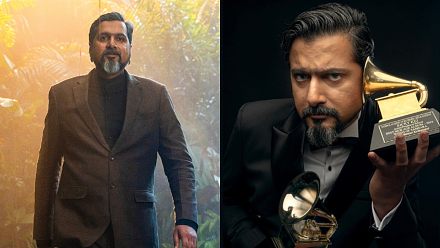
Q. You’ve spent years being introduced as a three-time Grammy Award winner. Does that accolade ever become an uncomfortable prefix, where you wish a new piece of work could meet the audience without carrying the weight of your past achievements and validation?
Not really. I look at every award as a beautiful platform that allows me to do bigger and better things. I genuinely don’t mind being introduced as a three-time Grammy Award winner. In fact, I’m extremely grateful for it.
Those awards open doors. They allow me to take my music to a much wider audience, and since my music almost always carries a message, whether it is about environmental awareness, celebrating nature or celebrating humanity, that wider reach becomes incredibly valuable to me.
It also gives me opportunities to collaborate with musicians I have always wanted to work with, and those collaborations ultimately help me make better music.
I understand the point you are making. Perhaps, ideally, an artist would not want their identity to be defined or weighed down by any one achievement. But I don’t feel burdened by it. As long as people are listening to my music and showing up for my concerts, that is ultimately what matters to me.
Q. You’ve been writing about the environment for years. As the climate crisis has become more urgent, has the emotional character of your music changed too? Is there more grief or anger in it today than there was when you began?
When I began my musical career and my life in advocacy, I was like many activists when they first start out. I was angry all the time. Everything felt very black and white. It was always about stopping something, fighting something, taking an all-or-nothing position.
I was extremely idealistic. There was probably a lot of virtue signalling and armchair activism too, although I certainly did not see it that way at the time. I simply believed that I was right and everybody who disagreed with me was wrong.
That approach is what I sometimes describe as the Greta Thunberg approach, where the messaging can be very stark, very black and white, with an emphasis on urgency, doom and gloom, and sometimes even shaming people into taking action.
As I grew older, I think I became a little wiser and began gravitating towards what I would call the Sir David Attenborough approach.
I had the good fortune of working with Sir David Attenborough on Wild Karnataka, and what I deeply admire about his advocacy is that he begins by showing people how beautiful the natural world is. He makes you fall in love with nature first, and hopefully, through that love, you find it within yourself to protect, conserve and sustain it.
I think that is a far more enduring approach.
You can speak to environmentalists and naturalists almost anywhere in the world, and so many of them will tell you that David Attenborough inspired them to pursue the work they do today. That is an extraordinary legacy, and it comes from using love rather than fear as the primary means of communication.
There is a quote by the Senegalese conservationist Baba Dioum that has always stayed with me: ultimately, we protect only what we love, we love only what we understand, and we understand only what we are taught.
That has become my mission. I want to teach people what exists in the natural world, help them fall in love with it and hope that, through that love, they will feel compelled to protect and sustain it.
Q. You’ve scored feature films but have largely remained outside the conventional film-song machinery. If a director came to you tomorrow with a major theatrical film and offered you both the songs and background score, what would make you say yes immediately?
If the film had a strong social message at its heart, or an environmental message, or even something that could benefit humanity in a small but meaningful way, I would jump at the opportunity.
The challenge is that I have never really been part of the film industry. Most directors who make socially conscious or environmentally driven films are deeply passionate about their work, but they also usually have composers with whom they have already developed long-standing relationships.
They may have worked together across several films that had nothing to do with social or environmental themes, but over time they have built a creative rapport and a shared language. Naturally, when that director eventually makes a socially relevant film, they are likely to return to the composer they already trust.
That is why it can be difficult for somebody like me to enter that ecosystem.
But if a filmmaker approached me with a project centred on a meaningful social message or social impact, I would absolutely want to do it. I may not already have that established rapport with a director, but I can certainly tell them, “Come work with me, and we can build that rapport together.”
Q. Once Damrooh begins its journey, what does the rest of 2026 and 2027 look like for you? Are there albums or larger compositions already taking shape?
There is quite a lot happening. First, I am working on a couple of singles.
More significantly, I’m also composing two full-length symphonies. One is called the Gandhi Symphony, and the other is the Ekam Symphony.
I plan to record both in early 2027 with full symphony orchestras. Those recordings will eventually become two albums, and later in 2027, I intend to take both symphonies on tour.
The idea is to move from one symphony orchestra to another across different parts of the world and perform these works internationally.
Damrooh itself is also going to expand. We have announced three cities so far, but we will be announcing more cities for 2027, along with international dates. The intention is to take the entire Damrooh experience around the world.
So there are going to be a lot of concerts, a lot of new music and several new projects.
I often joke that I’m not a full-time music composer, I’m an overtime music composer. I’m constantly in the studio and constantly thinking about music. Music occupies virtually every part of my life.
Even while I’m speaking to you right now, somewhere in my head there is probably a background score being composed for this conversation. That is simply how my mind works.