Inside Ramayana’s Massive Sets: Ravana’s Rs 1 Crore Throne, Surpanakha’s Rs 1.5 Crore Chariot And More
Nitesh Tiwari’s Ramayana: Rise of a Legend may be mounted on a gigantic scale, but a considerable part of that world was physically built rather than created entirely on a green screen. From Ravana’s throne to Surpanakha
Yazan Yatamanyu Narain··140K okunma
Inside Ramayana’s Massive Sets: Ravana’s Rs 1 Crore Throne, Surpanakha’s Rs 1.5 Crore Chariot And More
Nitesh Tiwari’s Ramayana: Rise of a Legend may be mounted on a gigantic scale, but a considerable part of that world was physically built rather than created entirely on a green screen. From Ravana’s throne to Surpanakha’s chariot and a 24-foot model of Jatayu, the film’s art department spent months constructing elaborate sets and props for the mythological epic.
Speaking to Prabhat Khabar, art director Ramesh revealed that more than 150 sets were created for the film. Construction began in April 2024 at Prime Focus Studios in Mumbai’s Film City, with each major structure reportedly going through multiple revisions before being approved.
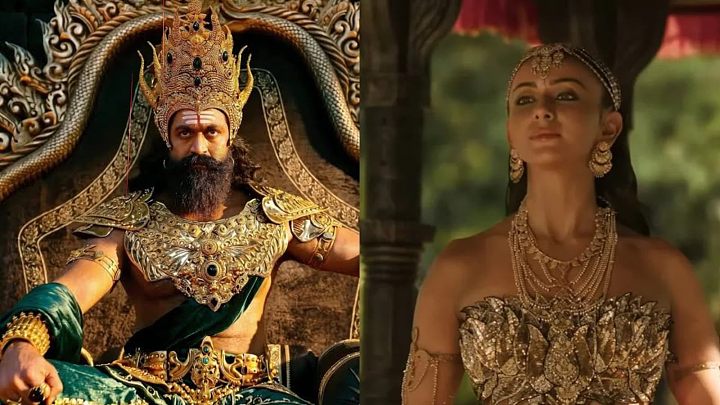
Ravana’s Throne Took Four Months And Cost Around Rs 1 Crore
One of the most expensive pieces created for Ramayana was Ravana’s throne.
According to Ramesh, the throne took around four months to complete and cost approximately Rs 1 crore. The team first created a clay base before moulding the final structure in fibre.
The finishing was equally elaborate. The throne was covered with 24-carat gold leafing to give it the required appearance on screen.
Ramesh said the production team worked extensively on physical details across the film’s sets, including flooring, wall textures and decorative elements. Each set reportedly underwent around 10 to 15 design changes before the final version was locked.
The aim was to create spaces in which the actors could physically interact with their surroundings rather than relying entirely on digital backgrounds.
Surpanakha’s Chariot Cost Around Rs 1.5 Crore
Surpanakha’s chariot was another major undertaking for the art department.
Unlike a decorative prop that would simply remain stationary in the background, the chariot was designed to function during filming. It reportedly took three months to construct and cost around Rs 1.5 crore.
The production also built considerably larger structures for scenes that required actors to interact with creatures and vehicles that would later be enhanced through visual effects.
A 24-foot-tall skeleton model of Jatayu, for instance, was constructed to help the cast maintain accurate eye-lines while delivering their dialogues.
The physical model allowed actors to know exactly where they needed to look during a scene instead of performing against an empty space.
Pushpak Vimana Was Too Big For The Studio
The Pushpak Vimana presented an entirely different logistical challenge.
Measuring approximately 50 feet in diameter, the structure was simply too large to be built as a single piece inside the studio. The team therefore divided it into four separate modules.
Construction reportedly took between 40 and 50 days.
Ramesh also revealed that Nitesh had been developing the concept for Pushpak Vimana for nearly six years before it finally reached the set.
The aircraft was among several large-scale pieces designed specifically for the production, which required the art department to balance mythology with the practical demands of shooting.
Hundreds Of Workers Built Lanka
The scale of Ramayana also extended to the manpower required behind the camera.
Ramesh revealed that approximately 500 to 600 workers were involved simultaneously while the Lanka set was being constructed.
Some of the film’s large crowd sequences were similarly demanding, with up to 1,000 dancers and junior artists reportedly participating in individual scenes.
Managing those numbers required the art department to create sets spacious enough for performers, camera equipment and the technical crew while still maintaining the visual detail required for close-up shots.
Nitesh Tiwari Personally Inspected Sets Before Filming
Ramesh said Nitesh remained closely involved with the production design throughout filming.
The director reportedly inspected every set a day before shooting began there. Four days ahead of a scheduled shoot, he would also review the storyboards and concept art to ensure that the planned visuals matched what was being constructed.
That process continued across the more than 150 sets built for the film.