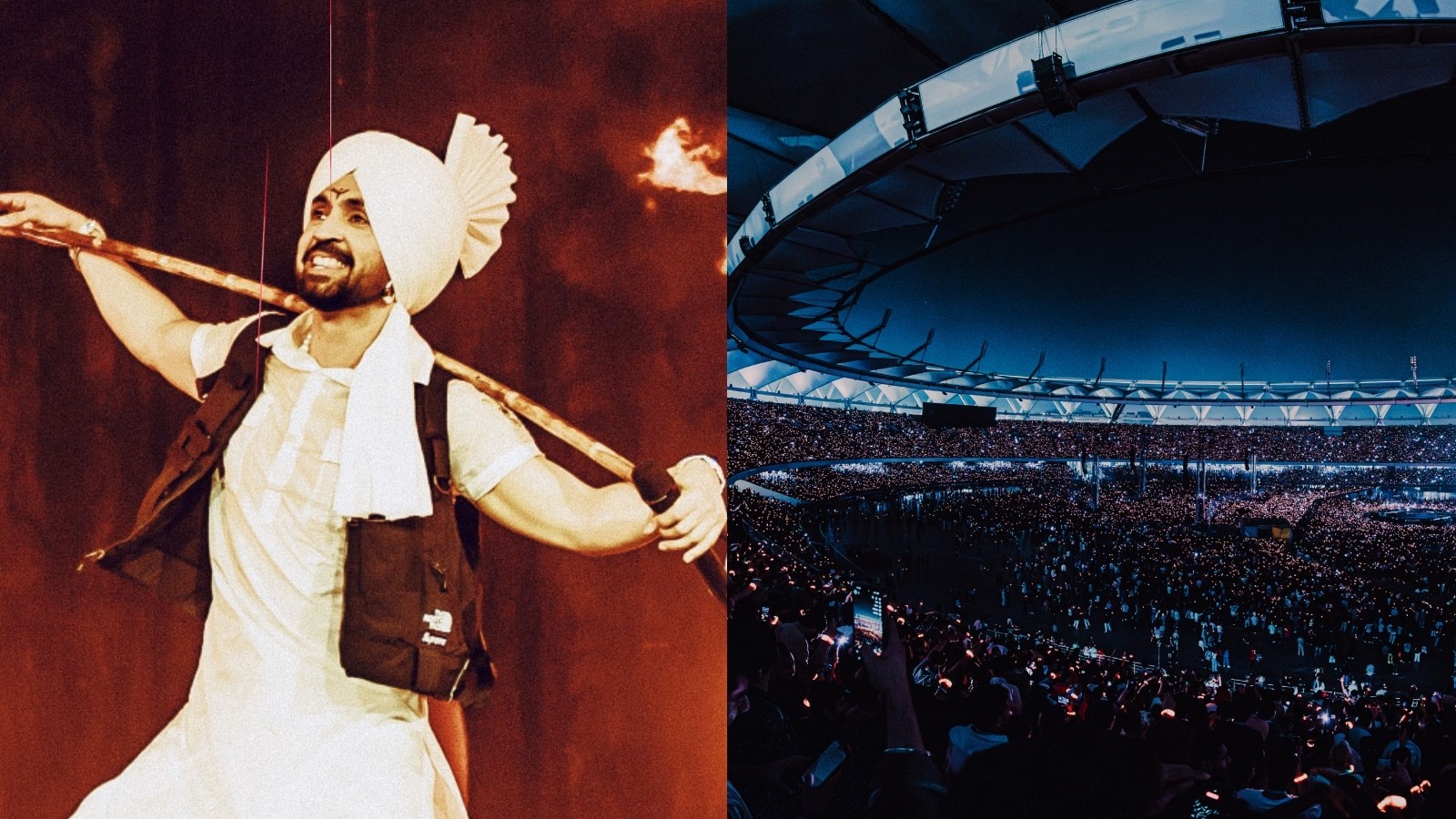
Inside Diljit Dosanjh’s Delhi Concert: Morni, Turbans, Fan Sing-Alongs And ‘Panjabi Aa Gaye Oye’ In The Sky
By the time the first notes of Morni travelled across the venue on Thursday night, Delhi had already spent hours assembling itself around Diljit Dosanjh. Fans had streamed in through the evening, turbans were being tied
Yazan Yatamanyu Narain··159K okunma
Inside Diljit Dosanjh’s Delhi Concert: Morni, Turbans, Fan Sing-Alongs And ‘Panjabi Aa Gaye Oye’ In The Sky
By the time the first notes of Morni travelled across the venue on Thursday night, Delhi had already spent hours assembling itself around Diljit Dosanjh. Fans had streamed in through the evening, turbans were being tied at a complimentary camp outside, food counters were doing brisk business, and a sold-out stadium was waiting for the man whose concerts have grown progressively larger with every touring cycle.
That was the atmosphere at Delhi’s Jawaharlal Nehru Stadium as Diljit Dosanjh opened the India leg of his RuPay AURA India Tour 2026 on October 30. After taking the show through international venues, including stadiums in Australia, Madison Square Garden in New York and Wembley Stadium in London, Diljit brought the tour home with a sold-out night in the capital.
The Delhi concert also marked the beginning of a longer India run that will take him to Indore, Ahmedabad, Mumbai, Bengaluru and Lucknow, with Chandigarh and Kolkata dates to be announced separately.
For the opening night, however, Delhi had the first word.
View this post on Instagram
A post shared by TEAM DOSANJH (@teamdiljitglobal)
Diljit Opens The Night With Morni
Diljit began the show with Morni, immediately setting the pace for an evening built around familiar hits, big production and a crowd that had clearly arrived ready to sing.
The set moved through different periods of his catalogue, bringing together songs such as G.O.A.T., Ikk Kudi, Lalkara, Lover, Case, Panjtaara, Hass Hass, Saanso Ki Mala and Water.
For many in the stadium, these were songs they had already heard countless times through playlists, weddings, drives and social-media clips. In a live setting, they landed differently. Choruses were frequently handed over to the audience, turning sections of the concert into large-scale sing-alongs.
View this post on Instagram
A post shared by TEAM DOSANJH (@teamdiljitglobal)
Diljit’s performance style also kept the distance between performer and crowd relatively thin despite the size of the venue. At different points, he brought fans onto the stage to dance and sing with him, allowing the evening to briefly shift from spectacle to interaction.
The scale was undeniably large, but some of the night’s most memorable moments came when the performance stopped feeling like a stadium production and became something more direct.
Fans Join Diljit On Stage
Throughout the show, Diljit repeatedly addressed the crowd and invited fans into the performance.
Those moments allowed individual audience members to briefly become part of a show that otherwise unfolded on a massive stage with elaborate lighting, visuals and production.
View this post on Instagram
A post shared by TEAM DOSANJH (@teamdiljitglobal)
The India version of AURA retained the visual language and staging used during the international run, but the Delhi show also carried a local energy that came naturally from the audience.
At one point, Diljit paused to thank Delhi Police for their work around the event.
The concert was held at Jawaharlal Nehru Stadium, where tens of thousands of fans had gathered for the opening show. Crowd management, entry, security and post-show movement were major parts of the evening simply because of the number of people converging on the venue.
View this post on Instagram
A post shared by TEAM DOSANJH (@teamdiljitglobal)
Diljit acknowledged the security arrangements from the stage, thanking the police for helping keep the event organised and safe.
View this post on Instagram
A post shared by TEAM DOSANJH (@teamdiljitglobal)
A Show Built Around Scale
AURA arrived in India after already establishing itself as a large-format touring production overseas.
The international run had included performances in Australia, New York and London, with Diljit also becoming the first Punjabi artist to headline and sell out Wembley Stadium.
View this post on Instagram
A post shared by TEAM DOSANJH (@teamdiljitglobal)
The Delhi show brought that same emphasis on scale to India.
There were expansive visuals, immersive stage production, lighting sequences and a set structured to move between high-energy Punjabi tracks and more melodic portions.
The concert did not depend entirely on spectacle, though. The performance itself remained anchored in Diljit’s catalogue and his ability to move between celebratory anthems, romantic songs and quieter material without breaking the momentum of the show.
View this post on Instagram
A post shared by TEAM DOSANJH (@teamdiljitglobal)
The reaction to songs such as Lover and G.O.A.T. was expectedly loud, but tracks such as Ikk Kudi and Saanso Ki Mala allowed the set to briefly change temperature.
The result was a programme that did not remain trapped in one musical mood for too long.
View this post on Instagram
A post shared by TEAM DOSANJH (@teamdiljitglobal)
Delhi Sets The Tone For The India Leg
Naman Pugalia, Chief Business Officer – Live Events, BookMyShow, said the Delhi opener had established the scale for the cities that will follow.
“Delhi didn’t just open the RuPay AURA India Tour; it set the bar for every city that will follow. Diljit has spent a decade earning the applause and emotions of a crowd that sings his songs back to him, city by city, country by country, and a fully sold-out Jawaharlal Nehru Stadium tonight gave him exactly that,” he said.
View this post on Instagram
A post shared by TEAM DOSANJH (@teamdiljitglobal)
He added, “This is the grand scale he commands around the world, and his fans back home made sure they answered his call. We believe the magic of live entertainment lies in shared moments like these, where tens of thousands of fans become one chorus and go back home with a memory of a lifetime.”
The Delhi concert is the first stop in a six-week India run.
‘Panjabi Aa Gaye Oye’ Lights Up Delhi Sky
The night ended with one of the biggest visual moments of the concert.
A specially curated drone show appeared above the venue, spelling out the message, “Panjabi Aa Gaye Oye!”
It worked as both a sign-off and a callback to the phrase that has become inseparable from Diljit’s global rise.
The drone display followed a show that had already leaned heavily into Punjabi music and identity without treating either as something that required translation or dilution for a stadium audience.
View this post on Instagram
A post shared by Udit Jain (@uditjainphotography)
That confidence has also defined much of Diljit’s international touring journey over the past few years.
His live shows have increasingly placed Punjabi-language music in venues that were once largely associated with Western pop and rock touring circuits.
The Delhi finale brought that same assertion back home.
Turban Camp And Fan Experiences Outside The Stage
The concert experience also extended beyond the performance itself.
A complimentary turban camp was set up at the venue, allowing attendees to have turbans tied before entering the stadium.
Food and beverage zones were also spread across the venue as part of the larger fan setup.
These additions were designed around the idea of turning the concert into a longer event rather than simply a two-hour performance.
For many attendees, the evening began well before Diljit walked onto the stage, with crowds gathering around the venue, moving through security and spending time across the fan areas before the music started.
That scale also meant the event carried the logistical challenges that inevitably accompany a stadium concert in Delhi, from long walks and packed entry points to heavy movement around the venue before and after the show.
Diljit’s Touring Journey Comes Back To India
The AURA India Tour arrives after several years of increasingly ambitious international touring for Diljit.
His live performances have become an important part of his global profile, alongside his music and acting career.
In 2023, he became the first Indian-born artist to perform at Coachella. His Born to Shine Australia Tour also generated more than $10 million in ticket sales.
He has since performed at venues such as Rogers Arena in Vancouver, Scotiabank Arena in Toronto and Rod Laver Arena in Melbourne.
His Melbourne show sold 14,000 tickets in less than 72 hours.
Those milestones have steadily expanded the audience for Punjabi music outside India while also changing the scale at which Indian artists are being presented internationally.
The AURA Tour continues that trajectory, but the Delhi opener carried a different kind of significance simply because it brought that expanded touring machine back to an Indian crowd.
What’s Next For The RuPay AURA India Tour
After Delhi, Diljit will head to Indore, where he is scheduled to perform on November 15.
Ahmedabad follows on November 21, with the concert set to take place at Narendra Modi Stadium.
The Mumbai show is scheduled for November 27 at Mahalaxmi Race Course, followed by Bengaluru on November 29 at NICE Grounds.
Lucknow will host the tour on December 5 at the 19th National Jamboree Ground.
Details for Chandigarh and Kolkata are expected to be announced separately.
Tickets for the remaining shows are available through BookMyShow.