119 Hindus Of 146 Dead: Report Documents Minority Killings In Bangladesh Since Hasina Exit | Exclusive
A new report documenting the deaths of 146 members of religious and ethnic minority communities in Bangladesh has brought renewed attention to the question of minority security in the country following the political uphe
By Kamalika Sengupta··39K reads
119 Hindus Of 146 Dead: Report Documents Minority Killings In Bangladesh Since Hasina Exit | Exclusive
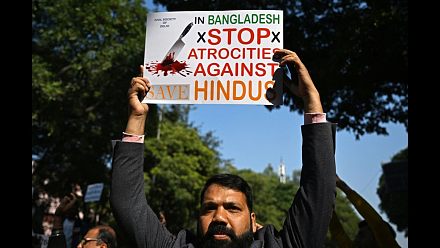
A new report documenting the deaths of 146 members of religious and ethnic minority communities in Bangladesh has brought renewed attention to the question of minority security in the country following the political upheaval of August 2024.
Compiled by Democracy, Rights and Persecution Watch (DRPW), the report records 146 named deaths between August 4, 2024, and October 27, 2026. It includes members of the Hindu, Buddhist Barua and Indigenous communities and provides case-specific details intended to establish a verifiable public record of killings, mob violence and deaths in custody.
According to the report, the 146 victims comprise 119 Hindus, five Buddhist Barua and 22 Indigenous people belonging to communities, including the Chakma, Marma, Tripura, Bawm, Santal and Munda.
The report comes against the backdrop of widespread political and social unrest following the ouster of Sheikh Hasina in August 2024. Attacks on minority homes, businesses and places of worship were reported in several parts of Bangladesh during the period surrounding the change of government. Since then, questions over the safety of religious and ethnic minorities have remained an important human rights concern.
Unlike reports that provide only aggregate figures, the DRPW document attempts to establish an individual record of each victim.
The register includes the victim’s name, date of death, address, community identity, professional background and a brief description of the circumstances surrounding the death. It also provides links or QR codes to published news reports to enable readers to examine the available documentation.
The cases cover a range of circumstances, including street clashes, mob lynchings, attacks on homes, robbery-related murders, deaths during protests and fatalities in police, military or prison custody.
Among the cases highlighted are those of former minister Ramesh Chandra Sen and musician Proloy Chaki, whose deaths in custody have raised questions about the treatment of individuals belonging to minority communities.
COMMUNAL VIOLENCE
The report also places the deaths in the context of a wider pattern of reported violence against minorities.
According to figures cited in the document, the Bangladesh Hindu Buddhist Christian Unity Council (BHBCUC) recorded 2,963 incidents of communal violence between August 2024 and June 2026.
The council has separately published periodic assessments of violence against minorities, including attacks on homes and businesses, vandalism of places of worship, killings, violence against women and allegations of torture.
In its assessment of the first half of 2026, the organisation reported 257 incidents of communal violence across Bangladesh. These included 44 murders, 62 attacks or acts of vandalism targeting temples and other places of worship, and 47 attacks, arson incidents or acts of vandalism involving homes and business establishments.
These figures are significant in understanding the scale of allegations made by minority organisations. However, they represent incidents documented by the organisations concerned and should not automatically be interpreted as independently established communal crimes in every individual case.
VIOLENCE FOLLOWING THE POLITICAL TRANSITION
The political transition of August 2024 marked a particularly turbulent period in Bangladesh.
Following Sheikh Hasina’s departure from power on August 5, attacks on properties belonging to members of minority communities were reported from different districts. Hindu homes, businesses and temples were among the reported targets.
The scale and character of the violence, however, have been contested. While minority organisations have described the incidents as communal persecution, Bangladeshi police have maintained that many attacks were politically motivated rather than driven by religious hostility.
The distinction is important, particularly in cases where victims or property owners were allegedly targeted because of their political affiliations, alongside their religious or ethnic identities.
A country assessment published by the European Union Agency for Asylum in 2025 recorded 147 incidents of violence against religious minorities in 2024, according to Ain o Salish Kendra (ASK). The assessment noted that 81 of those incidents occurred in August.
It also cited different assessments by the Bangladesh Hindu Buddhist Christian Unity Council and Prothom Alo, demonstrating that the reported scale of violence varied according to the methodology and sources used.
The available evidence therefore points to a serious security and accountability challenge, while also underlining the need to distinguish between verified incidents, allegations of communal motivation and politically motivated violence.
THE QUESTION OF ACCOUNTABILITY
One of the most significant aspects of the DRPW register is its inclusion of deaths occurring in state custody.
The cases of former minister Ramesh Chandra Sen and musician Proloy Chaki bring attention to questions surrounding the treatment of detainees, access to medical care, custodial safeguards and the accountability of law-enforcement agencies.
Deaths in custody require particular scrutiny because the individuals concerned are under state supervision. An independent investigation should establish the circumstances of detention, the timeline preceding death, medical records, post-mortem findings and whether established custodial procedures were followed.
INDIGENOUS COMMUNITIES AND THE CHITTAGONG HILL TRACTS
The report also draws attention to Indigenous communities, whose security concerns extend beyond the question of religious identity. The 22 Indigenous victims listed in the register belong to the Chakma, Marma, Tripura, Bawm, Santal and Munda communities.
The situation of the Jumma peoples in the Chittagong Hill Tracts has historically involved concerns relating to land rights, displacement, political representation, ethnic discrimination and security.
These issues require a separate assessment from violence against religious minorities in the plains. Treating all incidents under a single communal-violence category could obscure the distinct historical and political circumstances affecting Indigenous populations.
The inclusion of Indigenous victims in the register is therefore relevant to a broader examination of minority protection and human rights in Bangladesh.
WHAT INDEPENDENT ASSESSMENTS SAY
The concerns raised by minority organisations have also been examined by international and independent institutions.
The European Union Agency for Asylum’s August 2025 country report on Bangladesh documented widespread attacks on minority properties following the fall of the Hasina government. It referred to attacks on Hindu homes, businesses and places of worship, as well as violence affecting Ahmadiyya Muslims, Christians and Indigenous communities.
Importantly, the EU assessment also highlighted the overlapping motivations behind the violence. These included political retaliation, religious and ethnic discrimination, personal disputes and local conflicts.
There have also been questions about the methodology used in some earlier communal-violence datasets. An investigation published by The Dacca on September 25, 2026, examined the underlying entries in an earlier BHBCUC report and identified duplicate entries, cases without established communal motives and incidents involving political affiliations. Its findings underline the importance of independently checking aggregate figures rather than treating every reported incident as a proven communal crime.
The central issue, therefore, is not merely how many incidents have been reported, but how many have been properly investigated, how many have resulted in charges or convictions, and whether victims and their families have received justice.
DEMAND FOR INDEPENDENT INVESTIGATIONS
The DRPW report calls on national and international human rights organisations, the United Nations and judicial institutions to press for independent and impartial investigations into all 146 documented deaths.
It also urges the Bangladeshi authorities to strengthen protection for religious and ethnic minorities, ensure that complaints are investigated without discrimination and bring those responsible for criminal acts to justice.
The recommendations focus on three critical areas:
• Independent investigations: Every documented death should be examined individually, with particular attention to killings, mob violence and deaths in custody.
• Protection of vulnerable communities: Authorities should ensure the safety of minority homes, businesses, religious institutions and Indigenous settlements.
• Accountability and justice: Investigations should lead to appropriate legal action, with victims’ families receiving information about the progress and outcome of cases.
The report argues that a credible public record is essential to preventing the denial, distortion or politicisation of human rights violations.
More than two years after the political transition of August 2024, the protection of religious and ethnic minorities remains an important test of Bangladesh’s human rights commitments.
The documentation of 146 named deaths provides a basis for examining individual cases rather than relying exclusively on competing political narratives and aggregate claims.
At the same time, the distinction between a documented death and a judicially established communal crime must be maintained. A victim’s religious or ethnic identity, by itself, cannot establish the motive for a killing. Equally, the absence of a proven communal motive should not become a reason to ignore a suspicious death or an allegation of targeted violence.
The challenge for Bangladesh’s authorities is to ensure that every case receives a credible investigation, irrespective of the victim’s religious identity, political affiliation or ethnic background.