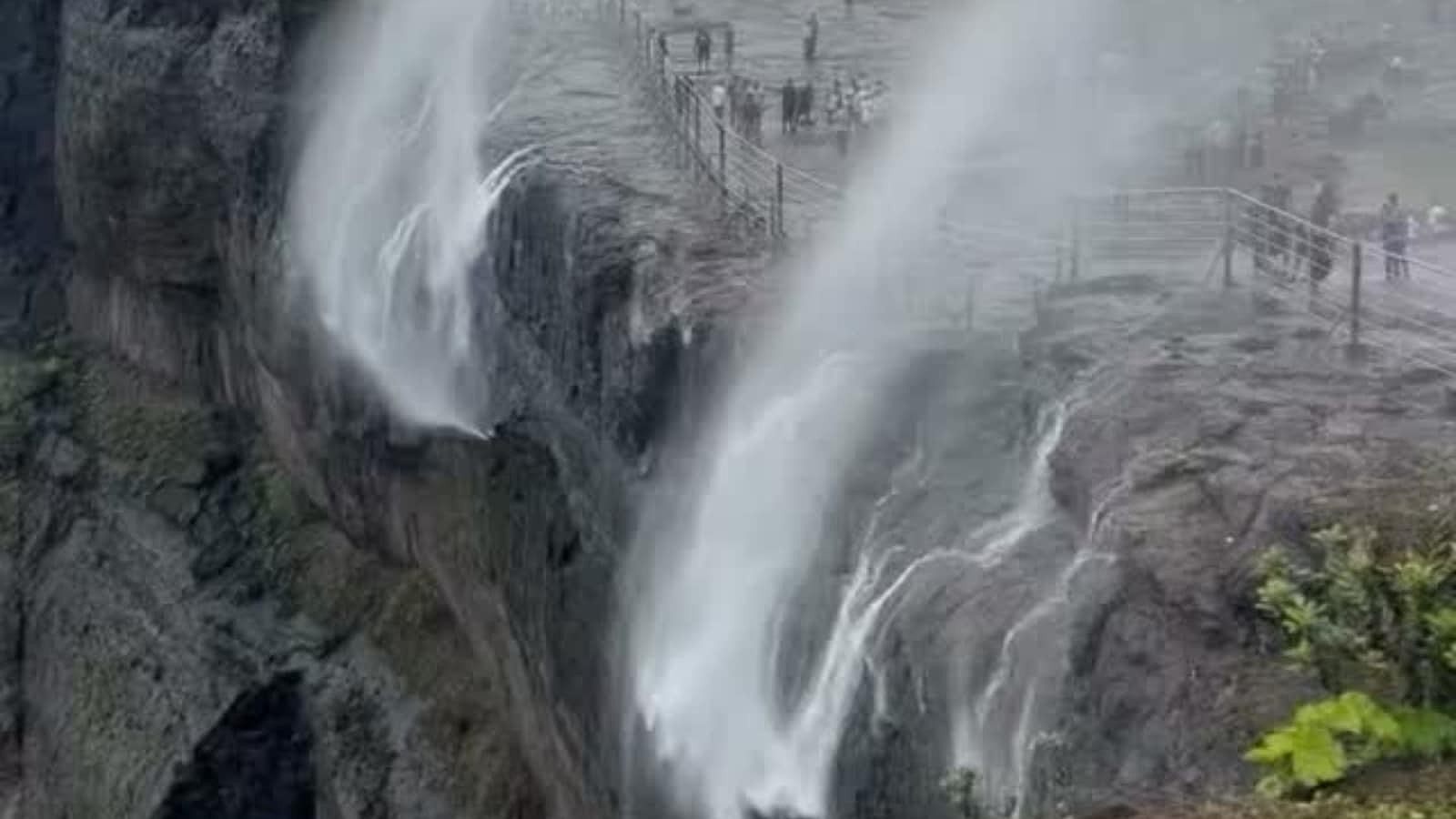
Watch: Maharashtra’s Naneghat ‘Reverse Waterfall’ Flows Uphill During Monsoon
During Maharashtra’s monsoon, the Western Ghats transform into a landscape of mist-covered hills, lush greenery and seasonal waterfalls. Among the region’s most unusual sights is the so-called “Reverse Waterfall” at Nane
By Nibandh Vinod··88K reads
Watch: Maharashtra’s Naneghat ‘Reverse Waterfall’ Flows Uphill During Monsoon
During Maharashtra’s monsoon, the Western Ghats transform into a landscape of mist-covered hills, lush greenery and seasonal waterfalls. Among the region’s most unusual sights is the so-called “Reverse Waterfall” at Naneghat, where water appears to move upward instead of falling towards the ground. It’s located in the Junnar region of Pune district, near the border with Thane district.
The spectacle may look as though nature has temporarily switched off gravity. But there is no violation of the laws of physics. The dramatic effect is created by a combination of falling water and powerful winds sweeping across the hills.
Why does Naneghat’s waterfall appear to flow upward?
Water naturally falls downward under gravity.
At Naneghat, however, strong monsoon winds can hit the falling water with enough force to push and disperse the droplets back upward.
View this post on Instagram
A post shared by reverse waterfall Naneghat Jivdhan (@reverse_waterfall_naneghat)
Instead of remaining as a continuous downward stream, the water is broken into fine droplets. When the upward wind is sufficiently strong, those droplets are carried back towards the ridge, creating the appearance of a waterfall flowing in reverse.
In other words, gravity is still doing its job. The water is not genuinely flowing uphill; the wind is overcoming the downward motion of individual droplets and carrying them upward.
The phenomenon is therefore better described as a wind-driven reverse-flow illusion rather than a waterfall that literally defies gravity.
Why does it happen during the monsoon?
The monsoon is crucial because Naneghat receives heavy rainfall while powerful winds sweep through the Western Ghats. When rainfall and strong gusts coincide, the conditions can become ideal for the reverse-waterfall effect.
The spectacle is consequently weather-dependent rather than permanent. Visitors may see ordinary falling water at one moment and the dramatic upward spray when wind conditions intensify.
Monsoon in India is a surreal experience
The incredible reverse waterfall effect�
This is from Naneghat, Maharashtra pic.twitter.com/fDlxnWel0c
— Vertigo_Warrior (@VertigoWarrior) August 10, 2026
Maharashtra Tourism describes the state’s monsoon landscape as a season of misty hills, greenery and seasonal waterfalls, making the rainy months particularly attractive for nature and adventure trips.
Naneghat is more than a monsoon spectacle
Naneghat is an ancient mountain pass in Maharashtra’s Western Ghats and has long been associated with travel between the Konkan region and the Deccan plateau.
Today, it is also popular with trekkers and monsoon visitors. During the rainy season, the surrounding hills become dramatically green and misty, while streams and waterfalls add to the landscape.
The Reverse Waterfall has helped make Naneghat particularly popular on social media. Videos showing water apparently travelling upward have repeatedly gone viral.
Is the Reverse Waterfall really defying gravity?
No.
The phrase “defying gravity” makes for a striking headline, but scientifically, the phenomenon does not overturn gravity. Gravity continues to pull the water downward, while sufficiently strong wind exerts an upward force on the falling droplets.
Waterfall flows upwards ⛰️� #Naneghat’s #ReverseWaterfall in the Sahyadris.
The monsoon wind is so strong,
it pushes the fall back to the sky. A
hidden gem of #Maharashtra worth visiting.
120km from Pune & 160km from #Mumbai
#Sahaydri
HV Presents pic.twitter.com/NRRvhMXUrG
— Dr. Subhash (@Subhash_LiveS) August 18, 2026
A useful way to imagine it is to picture a garden hose being sprayed into a strong wind. The water can be blown sideways or backwards rather than following the direction in which it was initially projected.
At Naneghat, the scale and natural setting make that familiar physics look extraordinary.
When is the best time to see it?
The Reverse Waterfall is a weather-dependent phenomenon, so there is no guarantee that visitors will see the water flowing upward. The monsoon, particularly periods of heavy rain accompanied by strong winds, offers the best chance of witnessing the effect.
A spectacle best explained by science
Naneghat’s Reverse Waterfall is a reminder that some of nature’s most spectacular sights do not require supernatural explanations. The combination of monsoon rain, terrain and strong winds is enough to create a scene that appears to challenge one of the most familiar forces in nature.
— ???????????????????? ???????????????????????? (@Im_Sanju_Ss) August 8, 2026
For a few moments, falling water can look as though it is climbing into the sky. Gravity has not disappeared, the wind has simply become strong enough to make the water behave in a spectacularly unexpected way.
How to reach Naneghat from Mumbai and Pune?
Naneghat can be reached by road from both Mumbai and Pune, with the final stretch involving the approach to the trekking base near Vaishakhare village. The route and travel time can vary depending on the starting point and monsoon road conditions.
From Mumbai
Visitors can drive via Kalyan and Murbad towards Vaishakhare, from where the Naneghat trail begins. The road journey to the base is generally around three hours, depending on traffic and weather.
Kalyan is also one of the nearest major railway points for those travelling by train, after which a bus or taxi can be used to reach the Naneghat side.
From Pune
The road route generally passes through Chakan and Junnar before approaching Naneghat. Depending on the exact starting point and route, the journey can take around three to four hours.