Odd News
GK: Do You Know At What Speed The Earth Moves Through Space?
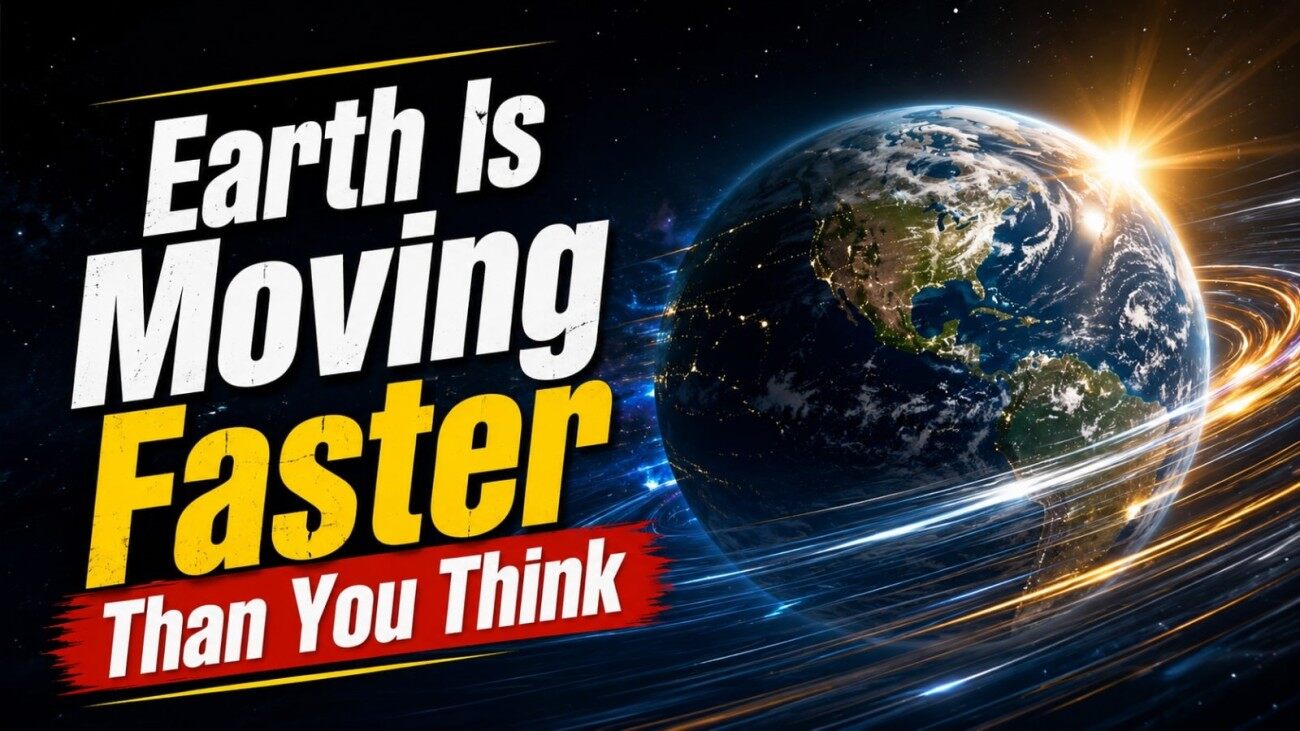
Earth’s movement can broadly be understood in two ways: its rotation around its own axis and its revolution around the Sun. So, just how fast is our planet actually moving? (Image-AI)
36K reads
Earth’s movement can broadly be understood in two ways: its rotation around its own axis and its revolution around the Sun. So, just how fast is our planet actually moving? (Image-AI)
Earth takes approximately 24 hours to complete one rotation on its axis. This rotation is responsible for the cycle of day and night. The speed of this rotation varies depending on where you are on the planet. It is highest at the equator, where Earth’s surface moves at roughly 1,670 kilometres per hour, or around 460 metres per second.
As you move from the equator towards either pole, the rotational speed decreases. At the North and South Poles, the rotational movement around Earth’s axis is effectively zero because the points there lie directly on the axis of rotation.
Earth is not only spinning on its axis; it is also travelling around the Sun along its orbit. The planet takes about 365.25 days to complete one revolution around the Sun. During this journey, Earth moves at an average speed of approximately 107,000 kilometres per hour, equivalent to nearly 30 kilometres per second.
In other words, in the time it takes to blink, Earth has already travelled a considerable distance through space. In just one second, our planet moves roughly 30 kilometres along its orbit around the Sun.
Despite these enormous speeds, humans do not feel Earth’s movement. There are a couple of scientific reasons behind this. Earth’s rotation and revolution occur continuously and without sudden changes in speed. This is similar to sitting inside a plane or a fast-moving train travelling smoothly. When there are no sudden changes in motion, passengers generally do not feel the vehicle’s speed.
Everything around us, including the atmosphere, oceans, land and objects on the surface, is moving along with Earth. Gravity keeps us bound to the planet, while the atmosphere largely moves with it. Since we, the air around us and the planet are all travelling together, there is no obvious sensation of Earth speeding through space. So, while life on Earth may seem perfectly still, our planet is actually part of a massive cosmic journey through space.
Share
Tags